10 Best API Penetration Testing Tools
Robin
Senior Pentest Consultant
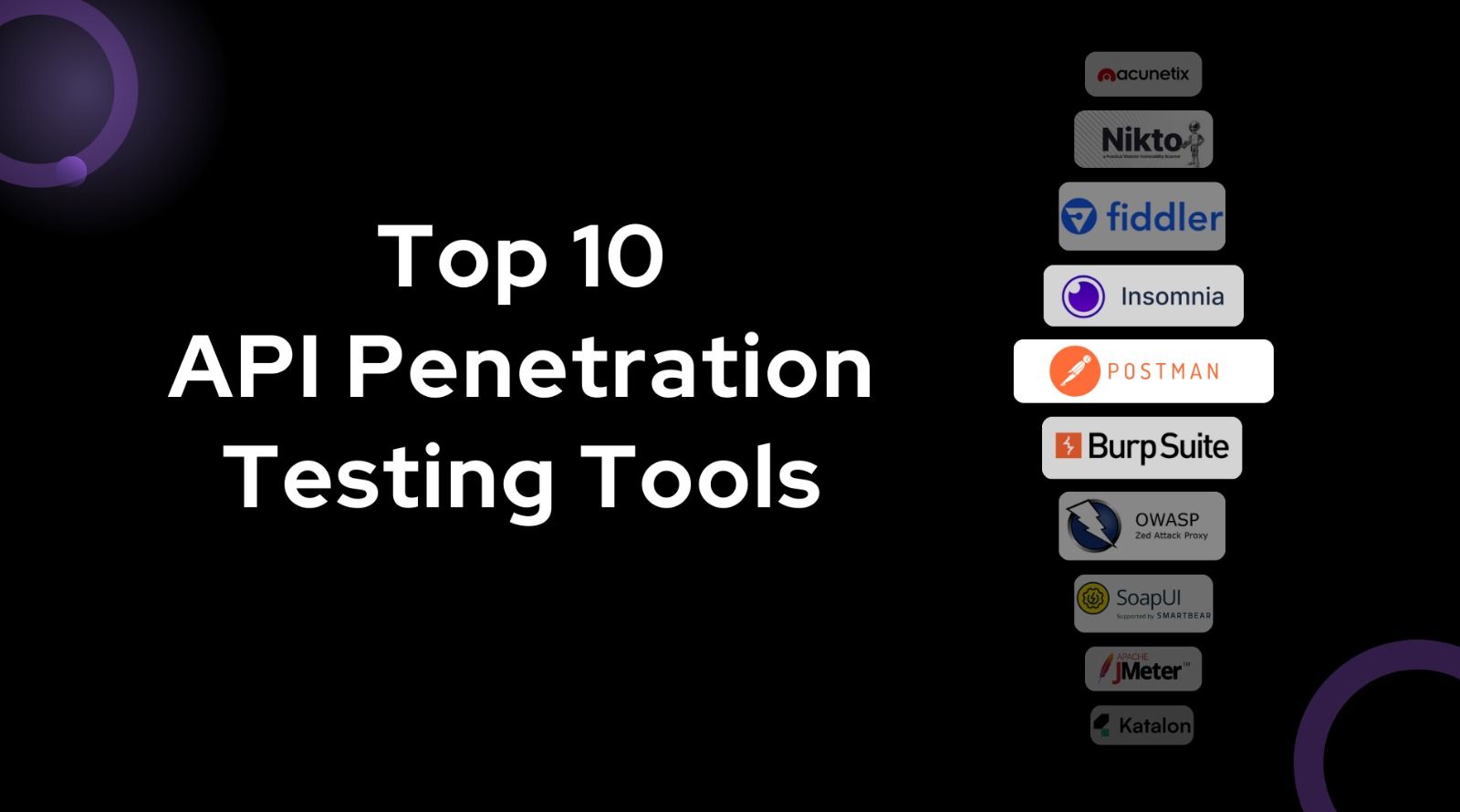
TL;DR
| Tool Name | Description | Suitable for | G2 Rating | Best for |
|---|---|---|---|---|
| Postman | A versatile tool for API testing and development. | Functional testing, security testing | 4.5/5 | Small to medium-sized businesses |
| Burp Suite | A comprehensive web vulnerability scanner. | Intercepting and analyzing API traffic | 4.7/5 | Medium to large enterprises |
| OWASP ZAP | Free, open-source tool with automated scanners and manual testing tools. | Discovering vulnerabilities, misconfigurations | 4.6/5 | Startups to large organizations |
| Insomnia | Modern API testing tool focused on usability | Testing REST, GraphQL, and WebSocket APIs | 4.3/5 | Small to medium-sized businesses |
| Fiddler | Web debugging proxy tool to monitor HTTP/HTTPS traffic. | Identifying API vulnerability issues | 4.4/5 | Small to large organizations |
| SoapUI | Designed for testing SOAP and REST APIs. | Simulating requests and analyzing responses | 4.2/5 | Medium to large enterprises |
| JMeter | Performance and security testing tool. | Simulating attack scenarios, load testing | 4.4/5 | Startups to large organizations |
| Nikto | Web server scanner identifying vulnerabilities. | Detecting outdated software and misconfigurations | 4.0/5 | Freelancers to enterprises |
| Acunetix | Enterprise web vulnerability scanning platform | Comprehensive web and API security testing | 4.65/5 | Best for enterprise companies |
| Katalon Studio | All-in-one automated testing platform | API, web, and mobile testing solutions | 4.4/5 | Small to Enterprise |
APIs have become the primary gateway to critical enterprise data and services - making them an increasingly attractive target for malicious actors. According to Salt Security's 2024 State of API Security Report, API deployments have surged by 167% in just the past year. More concerning, 95% of organizations have encountered security issues in their production APIs, with 23% suffering actual breaches.
Despite this growing threat landscape and increasing API traffic, only 7.5% of organizations have implemented dedicated API testing and threat modeling programs. This security gap presents a critical vulnerability in many enterprise systems.
This comprehensive guide examines the most effective API penetration testing tools available today.
The Top 5 Security Risks in APIs
APIs are susceptible to a range of vulnerabilities, often outlined in the OWASP API Security Top 10 Security Risks.
Here are the common five vulnerabilities that increase the chance of security breaches:
-
Broken Object Level Authorization: APIs often expose endpoints that handle object identifiers, making them prone to access control issues. Attackers can manipulate these identifiers to access unauthorized data.
-
Broken User Authentication: Weak authentication mechanisms can allow attackers to gain unauthorized access to API endpoints and sensitive user data.
-
Excessive Data Exposure: APIs sometimes return more data than required, exposing sensitive information that could be exploited by attackers.
-
Security Misconfiguration: Insecure default settings, incomplete configurations, and improperly implemented security controls can leave APIs vulnerable.
-
Injection Attacks: APIs are prone to injection vulnerabilities, such as SQL or command injection, when they fail to validate and sanitize user inputs properly.
What is API Penetration Testing?
API Penetration Testing is a systematic process of identifying vulnerabilities, misconfigurations, and security risks in APIs. This form of ethical hacking, which is a core aspect of penetration testing, simulates real-world cyberattacks to assess how well an API can withstand malicious exploitation. The goal is to proactively detect security weaknesses before attackers can exploit them, ensuring data protection and system reliability.
How to Conduct API Penetration Testing
API penetration testing involves a structured approach to uncover security flaws.
Here’s a step-by-step guide:
-
Understand API Documentation: Gather and review the API’s technical documentation to understand its functionality, endpoints, and expected behaviors.
-
Define the Scope: Determine which APIs and endpoints will be tested, ensuring alignment with the organization's security objectives.
-
Conduct Reconnaissance: Identify potential attack surfaces, including exposed endpoints, query parameters, and authentication mechanisms.
-
Test Authentication and Authorization: Validate that user authentication is robust and access controls are enforced correctly.
-
Analyze Input Validation: Test the API’s ability to handle malicious inputs, such as injecting payloads to detect vulnerabilities like SQL injection.
-
Simulate Attacks: Use penetration testing tools to simulate attacks like brute force, session hijacking, and unauthorized data access.
-
Report Findings: Document vulnerabilities, their impact, and remediation recommendations in a detailed report.
10 Best API Penetration Testing Tools
1 . Postman
A comprehensive API development environment that enables testing, monitoring, and debugging of APIs. It offers a user-friendly interface for sending requests, automating tests, and collaborating with team members.
Key Strengths:
- Intuitive interface for API testing
- Extensive documentation support
- Strong collaboration features
- Built-in test automation capabilities
- Large community and resource library
Customer Reviews:
Users consistently praise its ease of use, comprehensive documentation features, and team collaboration capabilities.
Limitations
- Can be resource-intensive for large collections
- Limited security testing features in free version
- Some advanced features require significant learning curve
Pricing
- Forever free plan with limited features
- Team plan starts at $12/user/month
- Enterprise plans available with custom pricing
2 . Burp Suite
A powerful web vulnerability scanner and security testing tool that provides comprehensive features for penetration testing of web applications and APIs.
Key Strengths
- Advanced intercepting proxy
- Automated vulnerability scanning
- Extensive security testing tools
- Customizable with extensions
- Professional-grade reporting
Customer Reviews:
Security professionals praise its comprehensive feature set and reliability in finding vulnerabilities.
Limitations
- Steep learning curve
- Resource-intensive
- Some features only available in professional version
Pricing
- Professional version: $399/year
- Enterprise version: Custom pricing
- Free Trial in community edition available with limited features.
3 . OWASP ZAP (Zed Attack Proxy)
An open-source security testing tool that functions as both an intercepting proxy and automated scanner.
Key Strengths:
- Free and open-source
- Active community support
- Automated scanning
- Integration with CI/CD pipelines
- Regular updates and improvements
Customer Reviews:
Users appreciate its cost-effectiveness and comprehensive feature set for an open-source tool.
Limitations
- Less polished UI compared to commercial alternatives
- Can be complex for beginners
- Limited premium support options
Pricing - Free (open-source)
4 . Insomnia
A modern API testing client that supports REST, GraphQL, and gRPC with a focus on user experience.
Key Strengths:
- Clean, modern interface
- Strong GraphQL support
- Git synchronization
- Environment variables
- Template support
Customer Reviews:
Users highlight its clean interface and excellent GraphQL support
Limitations:
- Limited automated testing capabilities
- Fewer extensions compared to competitors
- Basic reporting features
Pricing:
- Free individual plan with partial core features
- Team plan starts at $8/user/month
- Enterprise: Custom pricing
5 . Fiddler
Telerik Fiddler Everywhere is a modern, cross-platform version of the classic Fiddler web debugging proxy tool. It's specifically designed for API testing, web debugging, and traffic analysis with support for all major operating systems (Windows, macOS, and Linux). The tool provides comprehensive capabilities for monitoring, inspecting, and modifying web traffic between your computer and the Internet.
Key Strengths
- True cross-platform compatibility
- Modern, intuitive user interface
- Real-time traffic capture and modification
- Advanced API composition and testing
- Collaborative features for team sharing
- Automated response mocking
Customer Reviews:
- Users praise its modern interface and ease of use
- High marks for cross-platform compatibility
- Positive feedback on collaboration features
Limitations
- Higher resource consumption compared to Fiddler Classic
- Some advanced features from Classic version not yet available
- Premium pricing for full feature set
- Occasional performance issues with large traffic volumes
Pricing
- Pro: $119/user/year
- Team: $239/user/year
- Enterprise: Custom pricing based on needs
- 30-day free trial with full feature access
6 . SoapUI
A dedicated API testing tool specifically designed for SOAP and REST API testing.
Key Strengths:
- Comprehensive API testing capabilities
- Strong SOAP testing features
- Script-less test creation
- Security testing tools
- Data-driven testing
Customer Reviews: Users appreciate its robust SOAP testing capabilities and extensive feature set.
Limitations:
- Dated user interface
- Can be slow with large projects
- Limited modern API protocol support
Pricing:
- Open-source version: Free
- Pro version: $699/year
- 14-day trial for Pro version
7 . JMeter
An open-source tool primarily for performance testing but capable of functional API testing.
Key Strengths:
- Powerful performance testing
- Extensive plugin ecosystem
- Cross-platform compatibility
- Strong community support
- Highly customizable
Customer Reviews: Users value its reliability for performance testing and extensibility.
Limitations:
- Complex interface
- Limited native reporting
- Requires technical expertise
- Pricing: Free (open-source)
- Free Trial: N/A (completely free)
8 . Nikto
Nikto is a comprehensive open-source web server scanner designed to identify potential vulnerabilities, security misconfigurations, outdated software versions, and insecure files/CGIs in web servers and applications. It performs comprehensive tests against web servers for multiple items, including over 6400 potentially dangerous files/programs.
Key Strengths:
- Extensive vulnerability database with regular updates
- Command-line interface enabling easy automation and integration
- Support for multiple authentication types
- SSL/TLS scanning capabilities
- Customizable scanning options
- Integration with other security tools like Metasploit
Customer Reviews
- Highly effective at identifying common web server misconfigurations
- Excellent for initial reconnaissance during penetration testing
- Simple to use with straightforward command-line interface
- Reliable results with minimal false positives
Limitations
- Command-line only interface may be challenging for beginners
- Can be noisy and easily detected by intrusion detection systems
- Scanning can be slow due to thoroughness
- Limited web application vulnerability testing compared to modern tools
- May generate false positives requiring manual verification
Pricing
- Users can download and use the full version without any restrictions.
- No commercial version available
- No subscription required
9 . Acunetix
It is an automated web vulnerability scanner designed specifically for enterprise-grade web applications and APIs. It features an advanced crawler capable of thoroughly analyzing both HTML5 and JavaScript-heavy applications, along with APIs, to detect security flaws and vulnerabilities.
Key Strengths
- Advanced vulnerability scanning engine
- DeepScan technology for JavaScript and HTML5
- Comprehensive API security testing
- Continuous scanning capabilities
- Integration with CI/CD pipelines
- Low false-positive rate
- AcuSensor Technology for accurate results
Customer Reviews
- Praised for accuracy and low false positives
- High marks for comprehensive scanning capabilities
- Positive feedback on integration options
- Appreciated for detailed reporting features
- Strong ratings for enterprise-level support
Limitations
- Higher pricing point compared to competitors
- Resource-intensive during deep scans
- Complex setup for advanced features
- Learning curve for full utilization
Pricing
- Premium: Starting at $4,495/year
- Enterprise: Custom pricing
- Special pricing for MSPs and resellers
- 14-day free trial available
10 . Katalon Studio
Katalon Studio is an all-in-one automation testing platform that provides comprehensive features for API, web, mobile, and desktop testing. It offers both script-less and script-based testing approaches with cross-platform compatibility and built-in project templates.
Key Strengths
- Unified testing platform
- Low-code/no-code capabilities
- Built-in frameworks and templates
- Cross-browser testing support
- Extensive integration options
- AI-powered testing features
- Record and playback functionality
Customer Reviews:
- Praised for ease of use
- High marks for comprehensive features
- Positive feedback on community support
- Appreciated for quick start capabilities
Limitations
- Performance issues with large projects
- Limited advanced customization
- Steeper learning curve for scripting
- Some features only in premium version
Pricing
- Premium: Starting at $118/month
- 14-day trial for premium features
- Enterprise: Custom pricing
- Special pricing for teams
Conclusion
API penetration testing is a critical aspect of securing modern applications. By understanding the key risks, following a structured testing approach, and leveraging the right tools, organizations can safeguard their APIs against potential attacks. The tools listed above offer diverse functionalities to help security professionals identify and mitigate vulnerabilities effectively. Prioritize API security to protect your systems and users in today’s interconnected digital ecosystem.
Pentesting & Offensive Security