
What is your compliance program costing?

Robin Joseph
Senior Security Consultant
The line item finance isn't tracking
Ask a CFO what compliance costs and you'll get the audit invoice — $15k to $45k for a SOC 2 Type II. That number is real, and it's almost irrelevant. The actual cost is the engineering time spent feeding the program: screenshotting consoles, chasing evidence, re-collecting it six months later because the auditor wants something current.
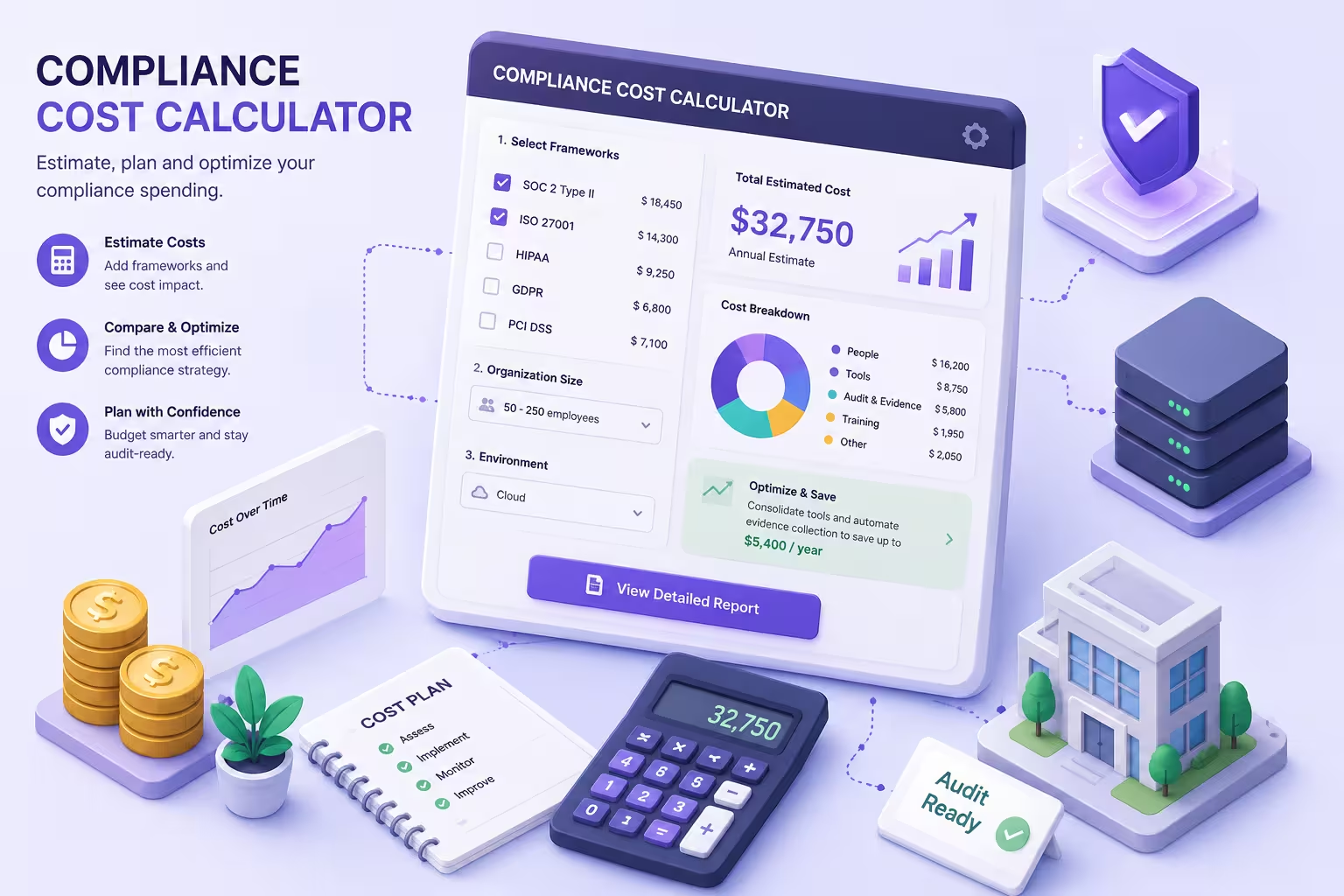
For most teams that hidden cost is 5 to 8× the audit fee, and it never appears on a budget line because it's distributed across people who were hired to ship product. The calculator below makes it visible. Move the sliders to your team and watch the gap between "how you do it now" and "continuous" appear.
Run your numbers
Four inputs. No email required, nothing leaves your browser.
engineering time recouped, at your fully-loaded rate
Model built from a 12-company reference set, 2025. Hours scale with headcount; additional frameworks add re-implementation cost under manual/legacy models and near-zero cost under continuous (the same evidence satisfies overlapping controls).
How the math works
No black box. Here's the model the calculator runs.
- Baseline hours. A first SOC 2 Type II at 25 engineers costs ~1,240 engineering hours under spreadsheets, ~740 under legacy GRC, and ~162 under continuous evidence collection.
- Scale by headcount. Evidence surface grows with the org, so hours scale roughly linearly with team size relative to that 25-engineer baseline.
- Add frameworks. Each additional framework adds ~70% of the base under manual/legacy (you re-implement and re-collect) but only ~8% under continuous, because one control maps to many frameworks.
- Convert to dollars. Saved hours × (fully-loaded cost ÷ 2,080 working hours) = year-one savings.
What teams actually see
Hidden engineering cost as a multiple of the external audit fee.
Median saved per audit cycle vs. a manual program, on a 25-engineer team.
Year-one savings on a 28-engineer team running SOC 2 + ISO 27001 in parallel.
The savings also compound. Year two, a manual program re-collects everything; a continuous one doesn't. Adding the next framework costs an afternoon instead of a quarter. The calculator only shows year one — the real number is larger.
FAQ
Three buckets: internal engineering hours (the big one), external audit fees, and deal-cycle drag from security reviews you can't answer fast. The calculator focuses on the first because it's the one finance never tracks and the one that's 5–8× larger than the audit invoice.
For a first Type II on a 25-engineer team, manual programs land around 1,200–1,400 hours in year one; legacy GRC tools cut that to roughly 700–800; continuous evidence collection lands near 160. Year two and beyond, the gap widens because manual programs re-collect evidence every cycle and continuous ones don't.
It's a model, not a quote — built from a 12-company reference set. The absolute hours will vary with your stack and auditor, but the relative shape (which model costs what) holds remarkably steady across team sizes.
Salary plus benefits, equity, taxes, tooling and overhead — the real annual cost of employing an engineer, not just base pay. We default to $215k; adjust it to your market. Dividing by 2,080 working hours gives the hourly rate the calculator uses.
Your next step
The calculator is an estimate from a model. The honest version is to point us at your real stack: in 20 minutes we connect read-only to your AWS, Okta and GitHub and show you the actual hours your current program is burning — with your data, not a benchmark.
Want the number for your actual stack?
A 20-minute read-only scan replaces the estimate above with your real posture and your real hours. No deck, no obligation.