What is ISO 27001? Everything You Need to Know

Robin Joseph
Senior Security Consultant
Last reviewed: September 2026.
Ever notice how some companies seem bulletproof while data breaches make headlines daily? Meet ISO/IEC 27001 — the gold standard for information security management. If you’re wondering about the ISO 27001 meaning, think of it as a structured system that helps organizations manage and reduce security risks effectively.
It’s not just a certificate to hang on the wall. It’s a blueprint: build, run, maintain, and improve your security setup. Nail it, and you can get certified through accredited auditors.
Here’s a stat that might surprise you: over 70,000 organizations across 150 countries have ISO 27001 certificates — from farms to factories to social services. Small startup? Big enterprise? Government agency? Non-profit? ISO 27001 scales with you. It adapts to your size, your processes, and your growth plans.
Legally required? Not really. But in today’s world, it’s often the price of doing business. Big clients and government contracts won’t even consider you without it. Miss it, and doors stay closed. Implement it well, and trust, credibility, and business opportunities open wide.
ISO 27001 Standard Explained
ISO 27001 is the global standard for information security management systems (ISMS).
It is part of the broader ISO 27000 family of standards, which provides guidance and best practices for managing information security risks.
It’s not a checklist — it’s a blueprint for protecting what matters most: your data, systems, and trust. The standard shows you how to build, run, and continuously improve security across any organization — from startups to enterprises, government agencies, and non-profits.
Its strength is a risk-based approach: identify threats, assess impact, implement controls, and monitor continuously. Policies, audits, staff training, and documented processes create a living, breathing security system. Certification proves your organization takes data protection seriously, earning client and partner trust.
Who Needs ISO 27001 Certification
If your organization wants to stay competitive and secure, ISO 27001 is essential. Typical cases include:
- Clients ask for it: Partners demand proof of security practices
- Contracts require it: Enterprise or government tenders list it as mandatory
- You handle sensitive info: Financial, personal, or intellectual property data
- Security gaps exist: Past incidents or audit failures
- Market access matters: Certain sectors won’t work with uncertified vendors
Getting ISO 27001 right doesn’t just protect data — it builds trust, credibility, and stronger business opportunities.
If you’re a startup weighing whether now is the right time to start, see our dedicated guide on ISO 27001 for startups for timing, cost, and how it compares to SOC 2.
Understanding the ISO 27001 ISMS Framework
An Information Security Management System (ISMS) is ISO 27001’s master playbook. It doesn’t just cover firewalls or passwords — it aligns people, processes, technology, and policies into a risk-focused framework that actually works.
The Core Principles Behind ISO 27001 Information Security Management
ISO 27001 stands on the CIA triad — three core principles that guide every security decision:
-
Confidentiality: Only the right people access sensitive information. Think hackers draining bank accounts after stealing credentials — classic confidentiality failure.
-
Integrity: Data stays accurate, consistent, and trustworthy. Imagine stock exchange software losing two years of transactions — integrity failure.
-
Availability: Authorized users can access information exactly when needed. Remember undersea cables getting damaged and cutting internet access? Availability failure.
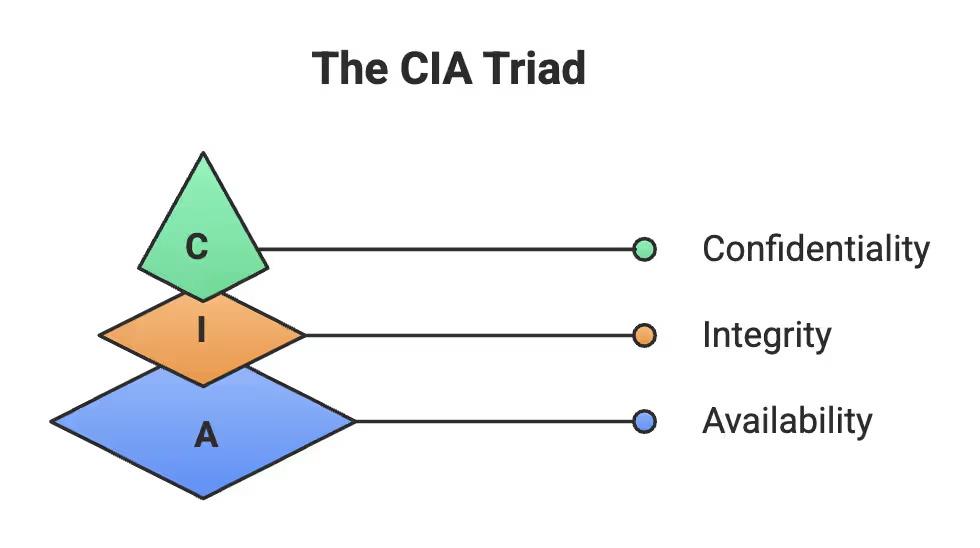
These aren’t abstract concepts to memorize. They’re your practical roadmap for spotting risks, putting controls in place, and keeping your information assets safe.
How the ISO 27001 ISMS Definition Applies to Organizations
An ISMS isn’t just a theory on paper — it’s a practical framework that organizes your security efforts so nothing falls through the cracks. A real-world ISMS covers the four Ps:
- People: Employees, contractors, and leadership teams
- Policies & Processes: Documented rules and workflows
- Products & Technology: Encryption, access management, monitoring tools
- Partners: Vendors and third parties handling your data
Without an ISMS, security becomes a messy patchwork — random solutions slapped onto specific problems. ISO 27001 forces organizations to systematically evaluate risks, design complete control packages, and implement management processes that ensure security works continuously.
Why Information Security Management System Matters
Data breaches can devastate organizations financially and reputationally. An ISMS identifies vulnerabilities before they turn into crises, helping businesses stay resilient. Companies with effective ISMS frameworks benefit from better risk management, smoother operations, and stakeholders who actually trust them.
But it’s more than compliance. An ISMS fosters security awareness across the organization, making employees part of the defense. It proves you’re investing in real protection, showing customers, partners, and stakeholders that information security is a priority — and in turn, builds credibility, confidence, and long-term trust that keeps your business secure and respected.
Benefits of ISO 27001 Certification for Modern Organizations
ISO 27001 isn’t just a certificate for the office wall. Organizations that get certified see real improvements in trust, risk management, and daily operations.
Improved Customer Trust and Business Credibility
Customers and partners need proof you protect their data. ISO 27001 delivers that through independent, third-party validation. This is why ISO 27001 certified companies are often preferred by enterprise clients and procurement teams.
The benefits hit the bottom line:
- Stand out: Certification sets you apart from competitors
- Close deals faster: Enterprise clients trust certified suppliers, reducing time spent on security questionnaires
- Open doors: Many contracts require ISO 27001, especially in regulated industries
- Better retention: Certification boosts credibility, keeping customers loyal
Procurement teams recognize ISO 27001 as a mark of serious security, speeding onboarding and reducing friction during due diligence.
Stronger Risk Management and Security Posture
Data breaches can cost millions, and small businesses may fail after a single incident. ISO 27001 provides a structured approach to identify risks, select effective controls, and monitor them, drastically reducing the chance of breaches, system outages, and insider threats while keeping operations secure and reliable.
Operational Efficiency and Cost Reduction
Certification streamlines workflows, clarifies responsibilities, and unifies security practices. Policies are consistent, controls organized, documentation centralized. Proactive risk management saves money by avoiding costly breaches and fines. Better processes cut redundancies, improve incident response, and make operations smoother and more cost-efficient.
ISO 27001 Certification Requirements
Getting certified isn’t just about ticking boxes. It’s a methodical process: define your scope, meet mandatory clauses, document thoroughly, and continuously evaluate effectiveness. Nail these steps, and certification becomes inevitable.
ISO 27001 Scope Definition
Your ISMS scope shows up on your ISO 27001 certificate — proof for customers of what you actually protect. It covers people, processes, technology, and locations. Smart scoping focuses resources where they matter and sets clear boundaries. Reality check: if your scope only covers a cupboard but customers use your SaaS, your certification counts for nothing. Align it with real services and products your customers rely on.
Mandatory Clauses (4–10) for Certification
Clauses 4–10 set the blueprint for a robust, auditable ISMS:
- Clause 4: Understand your organization and define ISMS scope — know what matters most.
- Clause 5: Leadership must commit; approve the security policy and lead by example.
- Clause 6: Assess risks, plan treatments, and set objectives — spot threats early.
- Clause 7: Provide resources, competent staff, and clear communication; security isn’t solo.
- Clause 8: Implement controls and operational plans — make processes work, not just exist.
- Clause 9: Monitor, audit, and review to ensure ISMS effectiveness.
- Clause 10: Manage nonconformities and drive continual improvement — evolve or fall behind.
Required Policies, Documents, and Records
The 2022 revision reduced mandatory documents. Core requirements include ISMS scope, information security policy, risk assessment report, Statement of Applicability, and internal audit reports. Proper documentation demonstrates compliance and ensures smooth audits.
Internal Audits and Management Review
Internal audits confirm your ISMS works and follows ISO 27001 requirements. Management reviews evaluate suitability, adequacy, and effectiveness. Together, audits and reviews identify gaps, verify improvements, and align ISMS goals with business priorities, ensuring your security program grows with your organization.
ISO 27001 Annex A Controls Explained
The 2022 update cut 114 controls down to 93, organizing them into practical buckets. This isn’t theory — it’s actionable guidance that matches how modern businesses operate.
Organizational Controls
Your management playbook: govern security, set rules, and manage risk.
- Information security policies (5.1) – Establish clear rules.
- Threat intelligence (5.7) – Spot threats early.
- Cloud services security (5.23) – Protect SaaS platforms.
- Incident management planning (5.24) – Respond efficiently to incidents.
- Access control (5.15) – Multi-factor authentication, role-based access.
- Supplier management (5.19) – Secure vendor relationships.
These controls form a strong organizational backbone for your ISMS.
People and Physical Security Controls
Protect people and physical assets, often the weakest links.
- Background checks (6.1) – Hire the right people.
- Security training (6.3) – Reduce human error.
- Remote work security (6.7) – Protect data outside the office.
- Offboarding (6.5) – Remove access when employees leave.
- Physical perimeters (7.1) – Secure your premises.
- Entry controls (7.2) – Authorized personnel only.
- Equipment maintenance (7.13) – Keep hardware safe.
- Secure disposal (7.14) – Safely remove sensitive info.
People and physical measures prevent easy breaches and protect critical assets.
Technological Controls
Secure your digital world with these tech measures.
- Encryption (8.24) – Protect data in transit and at rest.
- Malware protection (8.7) – Block threats before damage occurs.
- Secure coding (8.28) – Build software resistant to attacks.
- Data masking & deletion (8.11, 8.10) – Limit exposure and remove safely.
- Monitoring & web filtering (8.16, 8.23) – Detect anomalies and block risky sites.
Technological controls are your digital armor against modern cyber threats.
ISO 27001 Risk Assessment Process in an ISMS
Clause 8.2 requires a documented, repeatable risk assessment process. Identify, analyze, and evaluate information security risks across your organization. Most companies see only part of their exposure — leaving gaps that can turn into crises. Systematic assessment isn’t optional; it’s essential.
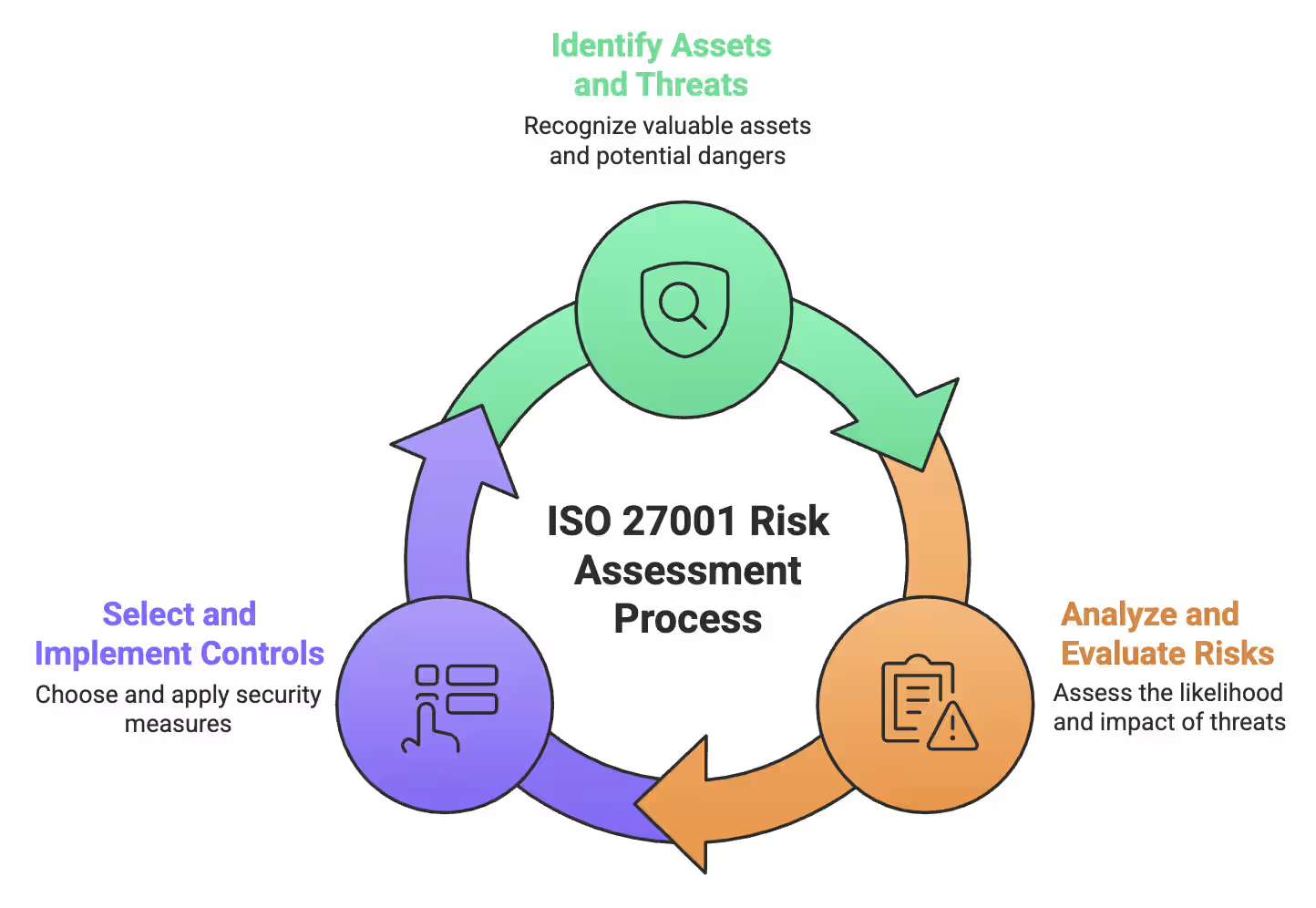
Identify Information Assets and Potential Threats
Start by cataloging every asset in your ISMS scope: customer databases, IP, hardware, tech systems, and sensitive processes. Form teams across IT, Legal, HR, and operations to uncover hidden risks. Consider internal threats like employee errors or malicious insiders, and external ones such as cyberattacks, natural disasters, or regulatory changes. Map threats to vulnerabilities for clear scenarios — for example, an unpatched server exploited by ransomware. Focus attention on critical assets; not everything needs equal scrutiny.
Analyze and Evaluate Security Risks
Score risks using qualitative methods like a 5×5 likelihood-impact matrix or quantitative approaches estimating potential financial loss. Compare each risk against your organization’s appetite and thresholds. Prioritize business-critical risks for immediate action, while monitoring lower-impact ones. Document assessments to guide mitigation, ensure accountability, and strengthen overall security posture.
Select Controls and Implement Risk Treatment
Handle risks by mitigating, transferring, accepting, or avoiding them. Map mitigated risks to Annex A controls to ensure coverage. Document every decision in a risk treatment plan with owners, timelines, and accountability. Here’s the payoff: risks aren’t just identified — they’re actively managed, strengthening your security posture and proving due diligence to auditors and clients.
ISO 27001 vs ISO 27002: Key Differences Explained
Confused about ISO 27001 and ISO 27002? You’re not alone. One builds the ISMS framework and is certifiable; the other guides control implementation in detail. Here’s the breakdown:
| Aspect | ISO 27001 | ISO 27002 |
|---|---|---|
| Purpose | Defines ISMS requirements and certifiable framework | Provides detailed guidance on implementing security controls |
| Certification | Can be certified | Cannot be certified |
| Risk Focus | Requires risk assessment to determine needed controls | Lists controls without assessing organizational risk |
| Level of Detail | High-level; one or two sentences per control in Annex A | In-depth; entire page per control with implementation advice |
| Role | Skeleton of your ISMS | Muscle showing how to put controls into practice |
Start with ISO 27001 to set up your ISMS framework. Then use ISO 27002 as your practical guide to implement and operationalize the controls effectively. Together, they make a complete, risk-aware information security system.
Securing Your Future with ISO 27001
How long will it take? That depends on your readiness. Small businesses with dedicated resources can get certified in 90 days. Most organizations need 6–12 months, and large enterprises with multiple locations may require 9–18 months.
First things first — get executives on board and secure the budget. Assign someone with authority to drive the project, and grab ISO 27001:2022 and ISO 27002:2022 standards to guide your team.
A 90-day sprint looks like this:
- Day 30: Security policy approved, scope defined, context documented, gap assessment complete
- Day 60: Full risk assessment done, Statement of Applicability approved, core procedures written
- Day 90: ISMS fully operational, internal audit complete, Stage 1 audit scheduled
Your risk assessment and Statement of Applicability are make-or-break. Cover all 93 Annex A controls, get your ISMS fully operational and audited, pass the two-stage certification, and maintain annual surveillance audits. Your certificate stays valid for three years — customers notice when you take security seriously.
Frequently Asked Questions
It's an international standard that gives organizations a structured way to manage information security — identifying risks, applying controls, and proving those controls actually work through independent audits.
No, it's not a legal requirement. In practice, though, it's often a de facto requirement for winning enterprise deals, government contracts, and business in regulated industries or international markets.
Build an Information Security Management System (ISMS) that meets clauses 4-10 of the standard, select and implement the relevant controls from Annex A's 93 controls based on your actual risks, document everything in a Statement of Applicability, and pass a two-stage external audit.
ISO 27001 is a certifiable management system standard, not just a checklist of technical controls — it requires ongoing leadership involvement, risk assessment, and continuous improvement, not just a one-time technical review.
Protect your organization, simplify ISO 27001 compliance, and turn audits into a smooth, automated process with UprootSecurity — where GRC meets real security outcomes.
→ Book a demo today
ISO 27001