The Complete Guide to Risk Management for Modern Organizations

Robin Joseph
Senior Security Consultant
Ever notice how most organizations treat risk management like an unopened insurance policy? They know it’s important, yet when threats appear, they hope for the best. Risk management is the process of spotting, assessing, and mitigating threats before they become crises—your organization’s immune system. It helps businesses make smarter decisions, protect assets, and stay resilient when uncertainty hits.
Here’s the uncomfortable truth: 41% of organizations reported increased risk exposure in 2022. That’s not a trend—it’s a wake-up call. Threats lurk where you least expect them, and your business may not even see them coming.
Stay alert, because threats evolve constantly, and yesterday’s solutions won’t solve tomorrow’s problems. The companies that get this right reduce operational losses by 25% and respond faster. The ones that don’t? They end up as cautionary tales, paying the price for ignoring risk until it’s too late.
What is Risk Management?
Risk management is how your organization spots danger before it hits—and ensures one mistake doesn’t become a catastrophe. It’s not a checklist or a compliance form; it’s a structured approach to identifying threats, analyzing impact, prioritizing what matters, and putting defenses in place. The goal isn’t just avoiding losses—it’s making smarter decisions and keeping your business steady.
Modern risk management spans several domains: IT risk, security risk, supply chain, third-party vendors, and industry-specific areas like healthcare compliance. Companies using frameworks like ISO 31000 or integrated governance, risk, and compliance practices can anticipate challenges, act fast, and protect both assets and reputation.
The difference between thriving and struggling organizations isn’t luck—it’s preparation. Effective risk management empowers you to foresee problems, respond efficiently, and maintain continuity across operations, vendors, and crises.
Understanding Core Types of Risk
Think you know what threatens your business? Think again. Most organizations focus on the obvious: market downturns, competition, economic uncertainty. But the real threats? They’re hiding in plain sight, disguised as everyday operations.
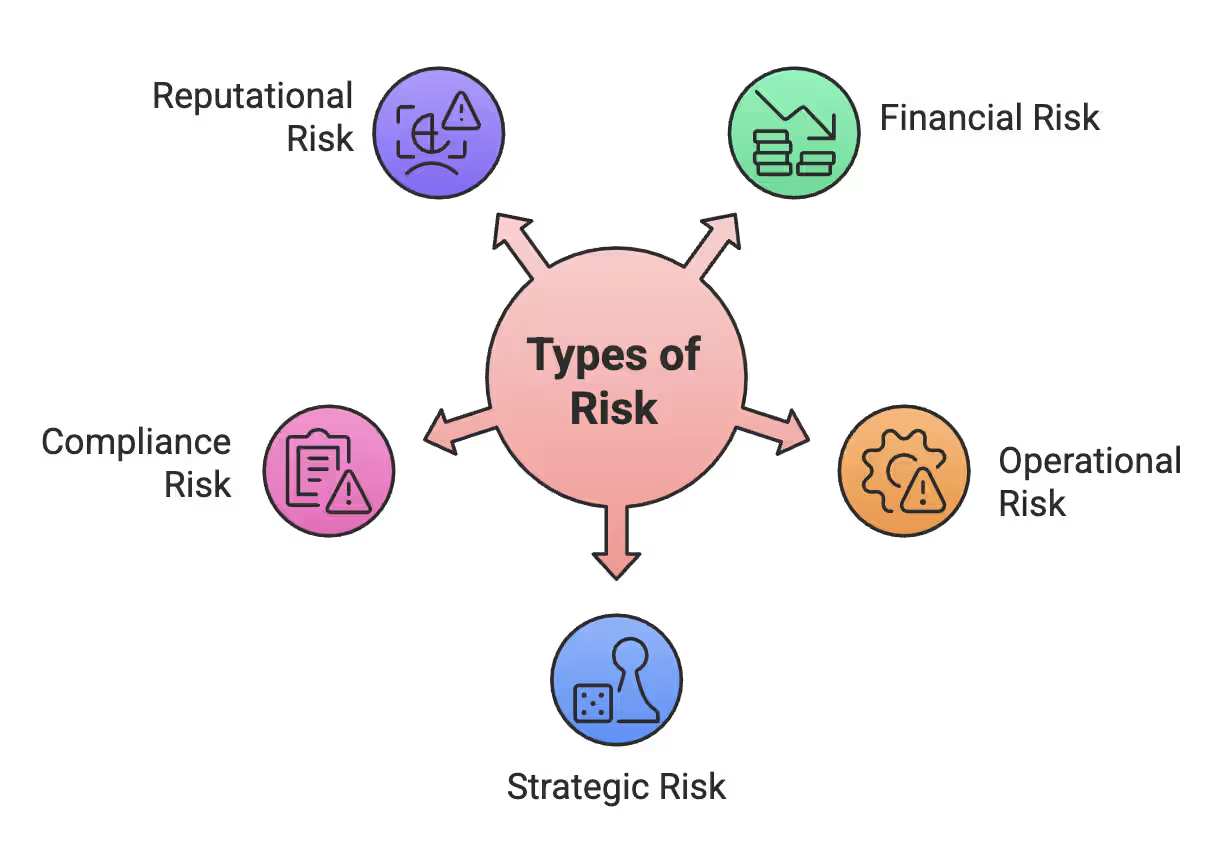
Here are the types of risks every organization should watch:
- Financial Risk
- Operational Risk
- Strategic Risk
- Compliance Risk
- Reputational Risk
Let’s get into these in detail.
1. Financial Risk
Financial risk is all about money—and the ways it can slip through your fingers. On paper, your business may look solid, but unseen exposures can tank everything fast.
- Credit Risk: When customers, partners, or counterparties fail to pay.
- Liquidity Risk: Profitable on paper, but unable to meet obligations when bills are due.
- Market Volatility: Price swings that affect investments, securities, and financial instruments.
Even small financial issues can cascade fast. Awareness is your first defense.
2. Operational Risk
Operational risk comes from within. Your systems, processes, and people can all backfire, often in ways you don’t anticipate.
- System Failures: Crashes, downtime, or technical glitches that halt operations.
- Human Error: Slips, mistakes, and intentional violations.
- Fraud & Incidents: Internal fraud cost $3.6B in 2022; data breaches average $4.45M per incident.
Plan for mistakes. Resilience beats regret.
3. Strategic Risk
Strategic risk strikes when your plans go off course—or the market changes before you can react.
- Poor Planning: Decisions that fail to achieve intended goals.
- Execution Gaps: Failure to implement strategies properly.
- Market Disruption: New tech, competitors, or business models that upend your industry.
Adaptation is the key to surviving disruption.
4. Compliance Risk
Compliance risk is about breaking rules—regulatory, legal, or ethical—and paying the price.
- Regulatory Violations: Fines, penalties, or government action.
- Legal Exposure: Contract disputes, lawsuits, or damages.
- Ethical Breaches: Actions that hurt your credibility or trustworthiness.
Following the rules keeps your business safe.
5. Reputational Risk
Reputation is fragile. One mistake can ripple across your brand, trust, and finances.
- Public Perception: How customers and stakeholders view your organization.
- Brand Damage: Loss of market trust or credibility.
- Crisis Amplification: Social media and cyber threats accelerate reputational fallout.
Protect your reputation—it affects everything else.
The Risk Management Process Explained (Based on ISO 31000)
You’ve seen the numbers. You know the stakes. Now let’s talk about how to actually fix this mess. Risk management isn’t just a checklist—it’s the playbook organizations with 28% better performance actually follow. Miss a step, and you’re back to crossing fingers.
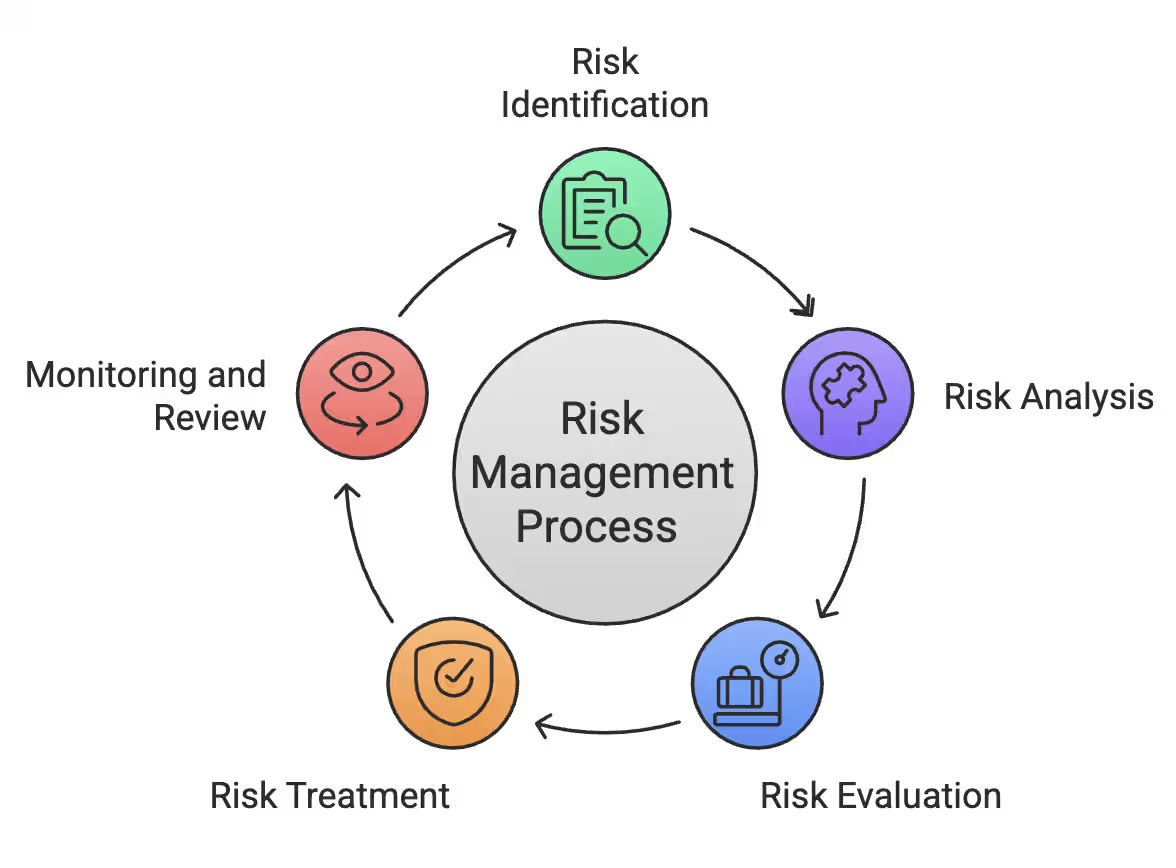
Here are the core steps of the risk management process:
- Risk Identification
- Risk Analysis
- Risk Evaluation
- Risk Treatment
- Monitoring and Review
Let’s get into these steps and see how they actually protect your business.
1. Risk Identification
Every threat needs a name and a home. This is where your risk management journey begins. If you don’t know what could go wrong, you can’t protect against it. Document all risks in a risk register:
- Risk name or ID
- Potential impact
- Category (financial, operational, strategic…)
- Owner (someone responsible)
- Date spotted
Companies with formal registers see 37% fewer surprises. Wing it, and you get blindsided repeatedly.
2. Risk Analysis
Once risks are identified, it’s time to understand them. Risk analysis measures the probability and potential impact of each threat, turning vague concerns into actionable insight:
- Likelihood: How probable is it?
- Impact: How bad would it be?
Many organizations use a 5×5 matrix: red = act now, yellow = watch, green = noted. Simple. Clear. No guessing.
3. Risk Evaluation
Not all risks are created equal. This step helps you decide which ones to tackle first and which can wait. Rank and prioritize based on:
- Overall threat score (likelihood × impact)
- Alignment with business objectives
- Available resources
- Regulatory pressure
This ensures your attention hits the biggest risks first, avoiding wasted time and effort.
4. Risk Treatment
Now comes the action. Risk treatment is where you decide how to respond to each risk, choosing the approach that fits your business and appetite for uncertainty:
- Avoid: Change plans so the risk can’t touch you
- Reduce: Apply controls to lower odds or impact
- Transfer: Let someone else handle it (insurance, contracts)
- Accept: Recognize it exists but take no action (sometimes smart)
Companies that implement structured treatment plans see 25% fewer incidents.
5. Monitoring and Review
Risk isn’t static. Threats evolve, environments change, and controls can fail. Monitoring and review keeps your defenses sharp:
- Reviewing the risk register regularly
- Updating scores as conditions change
- Checking if controls are effective
- Adapting when plans fall short
A dynamic approach turns risk management from “oh crap” into “we saw this coming and we’re ready.” That’s how organizations thrive, not just survive.
Enterprise Risk Management (ERM) and Governance Integration
ERM isn’t just risk management—it builds systems for smarter decisions. Most companies treat it as a compliance checkbox, but integrating ERM with a unified GRC strategy lets organizations act faster and keeps boards fully informed.
COSO Framework: 8 Components of ERM
Think of COSO as your organization’s operating system. You need these eight components to run risks properly:
- Internal Environment: The culture that drives behavior
- Objective Setting: Aligning risk appetite with ambitions
- Event Identification: Spot trouble before it spots you
- Risk Assessment: Know what matters and what doesn’t
- Risk Response: Decide what to do
- Control Activities: Ensure people follow the plan
- Information & Communication: Keep everyone in the loop
- Monitoring: Check that everything still works
Updated in 2017 to match a changing world.
Aligning Risk Appetite with Strategic Goals
Risk appetite isn’t bravado; it’s honesty. Most life sciences companies (67%) have missing or broken risk appetites—like driving blindfolded. Ask yourself:
- What are we trying to achieve?
- How much can go wrong before it hurts?
- Where do we stand today?
Answering these isn’t optional—it’s fundamental to making smarter, more proactive business decisions.
Governance Risk and Compliance (GRC) Alignment
Siloed GRC systems slow decisions and leave risks unaddressed. Problems include:
- IT, Legal, and Finance working in separate universes
- Risks falling through departmental cracks
- 48% of companies with no formal GRC procedures
A unified GRC connects the dots and turns compliance into an advantage instead of a constant headache.
Using Risk Scoring Models Across Business Units
Comparing cyber, supply chain, and regulatory risks? You need a common language. Risk scoring lets you:
- Rate likelihood (1=unlikely, 3=probable)
- Rate impact (1=manageable, 3=critical)
- Multiply to get a clear score
- Use color-coded matrices: green = fine, yellow = watch, red = urgent
The goal isn’t perfect matrices—it’s focus on what really matters. Integrated ERM with GRC transforms risk management into a competitive edge, letting you make better decisions while competitors are still checking boxes.
Specialized Risk Domains
Many businesses think risk is covered—security? Compliance? Done. Reality: risks don’t fit boxes. Siloed IT, procurement, and legal teams let threats multiply. Understanding specialized risk domains keeps organizations resilient.
IT Risk Management: CIA Triad
IT risk management isn’t just buying software—it’s building a structured defense across all technology areas. Smart organizations focus on three pillars—the CIA triad:
- Confidentiality: Protect sensitive info with access controls, encryption, authentication
- Integrity: Keep data accurate using checksums, signatures, and version control
- Availability: Ensure systems work via redundancy, backups, disaster recovery
Cover all three pillars to significantly reduce incidents. Missing one leaves gaps.
Supply Chain Risk Management: Disruption, Quality, ESG
Supply chains are often an invisible weakness. Every disruption can ripple through operations, hurting revenue and reputation. Effective supply chain risk management evaluates traditional risks and ESG factors:
- Third-party failures cause 9.3% of business disruptions (BCI 2025)
- Only 48% of organizations assess supply chain impacts
- ESG concerns require evaluating supplier sustainability and governance
Ignoring these risks? Half of businesses operate blind to critical operational threats.
Third Party Risk Management (TPRM): Vendor Classification, Monitoring
Many TPRM programs fail by treating all vendors the same. Smart programs classify and monitor high-risk vendors. Effective third party management protects your operations, prevents losses, and ensures compliance.
- Classify vendors by criticality and risk level
- Apply rigorous assessments for high-risk vendors
- Continuously monitor to catch issues before they escalate
Good TPRM turns potential disasters into manageable risks.
Security Risk Management: Cyber Threats and Data Breaches
Security risk management is essential. Data breaches cost $4.45M on average. Strong programs combine assessment, prevention, and monitoring. Without proactive security, organizations face repeated attacks, financial losses, and reputation damage.
- Conduct risk assessments and vulnerability management
- Implement prompt notification protocols
- Deploy security controls consistently
Skipping the first step? Expect repeated incidents.
Risk Management in Healthcare: HIPAA and Patient Data
Healthcare risk management faces unique challenges, especially around HIPAA compliance. Patient safety and data privacy demand specialized attention beyond standard organizational risk practices.
- Safeguard ePHI with administrative, physical, and technical measures
- Assess threats from internal and external sources
- Evaluate likelihood and potential impact
Over 176M U.S. patients affected—mostly due to employee negligence. Generic approaches won’t cut it.
Risk Management Solutions and Tools
Spotting risks isn’t enough. The right platforms automate monitoring, provide real-time insights, strengthen vendor risk management and enterprise risk management, reduce manual work, and help teams act fast before small problems escalate.
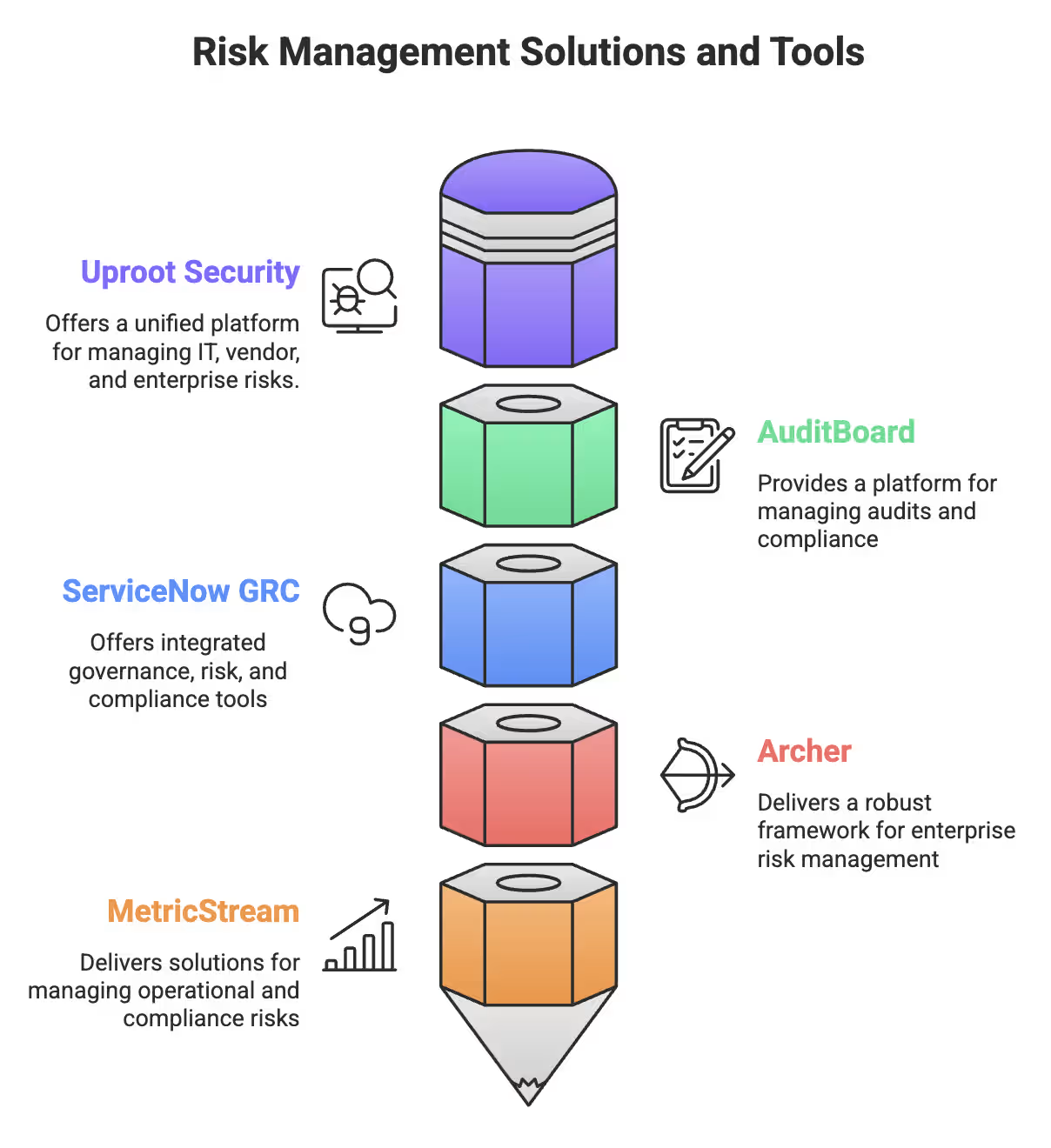
These are some of the top risk management tools and platforms:
1. Uproot Security: Integrated Risk Insights
Uproot Security unifies IT, vendor, and enterprise risks with clarity.
- Continuous monitoring detects threats early.
- Centralized dashboards speed team collaboration.
- Tracks emerging risks before they escalate.
- Customizable reporting prioritizes interventions.
Turns scattered risk data into actionable insights for faster decisions.
2. AuditBoard: Streamlined Enterprise Risk Management
AuditBoard simplifies enterprise risk and compliance for smarter workflows.
- Connects all risk data and streamlines processes.
- Simplifies documentation and audit tracking.
- Assigns and tracks ownership of risks and controls.
- Real-time metrics highlight where action is needed.
Reduces blind spots and makes integrated risk management seamless.
3. ServiceNow GRC: Automated Risk and Vendor Management
ServiceNow GRC automates assessments and integrates IT with business systems.
- Centralizes policies, procedures, and key risk indicators.
- Sends alerts for overdue tasks or unusual vendor activity.
- Supports audit readiness through automated evidence collection.
- Keeps risk processes consistent and proactive.
Ensures risk processes stay efficient and responsive.
4. Archer: Centralized Risk and Compliance Insights
Archer provides enterprise-wide visibility and actionable insights.
- Tracks trends over time to inform decisions.
- Integrates with other systems for holistic management.
- Includes scenario analysis tools to simulate events.
- Turns raw data into actionable insights.
Helps organizations anticipate and mitigate risks effectively.
5. MetricStream: Analytics-Driven Risk Management
MetricStream delivers dashboards, analytics, and reporting for enterprise and vendor risks.
- Automates repetitive tasks, reducing errors.
- Benchmarks performance against industry standards.
- Offers GRC-aligned reporting tools.
- Improves proactive monitoring and control.
Provides clarity, control, and smarter enterprise risk decisions.
These platforms turn risk data into actionable insights, automate tasks, and give leadership a clear view of vendor and enterprise risks, helping organizations respond faster and reduce surprises.
Building a Resilient and Adaptive Risk Culture
Fancy software alone won’t protect you. A strong risk culture embeds awareness into daily decisions, making everyone responsible. Organizations doing this see 28% fewer incidents and faster recovery.
Training and Awareness Across Departments
Most risk training is boring, so people tune out. What actually works:
- Formal risk designations add measurable value—82% of completers reported improvements
- Training in plain language, not textbook jargon
- Executives championing awareness see 5x higher employee engagement
Finance doesn’t need ISO lectures—they need to spot vendor red flags. IT needs actionable steps for system failures.
Incident Response Planning and Testing
Tested incident response plans help organizations respond 75% faster during disruptions. Effective testing includes:
- Tabletop exercises with realistic scenarios
- Paper walkthroughs to catch gaps
- Full simulations that stress-test responses
Experts say: “Practicing your plan in real-time is the only way to know it works.”
Cross-Functional Integration: IT, Legal, Finance, Procurement
Risks don’t respect departmental boundaries. Siloed teams miss connections, cascading effects, and hidden threats.
Key steps for cross-functional collaboration:
- Clear roles and responsibilities across all departments
- Dedicated communication channels for risk updates
- Regular cross-departmental meetings
When teams collaborate, risks are spotted early and handled effectively.
ESG and Sustainability Risk Considerations
ESG factors carry real consequences:
- Integrate sustainability into risk workflows
- Boards must continuously monitor ESG risks
- Ignoring ESG risks limits investment and stakeholder confidence
It’s not about annual reports—it’s about real operational and reputational risks.
Zero Trust & Access Control Principles
Zero Trust flips security assumptions:
- Assume breaches will happen; verify every access point
- Multi-factor authentication and device compliance checks
- Micro-segmentation with least-privilege principles
Organizations using Zero Trust align security with risk response strategies: tolerate, operate, monitor, improve.
Implementing an Effective Risk Management Strategy
Risk management isn’t going anywhere—and neither are the threats your organization faces. You can’t eliminate risk; anyone who says otherwise is selling something. What you can do? Make smarter bets. Companies that get it right see 25% fewer operational losses and respond 75% faster when problems arise.
Frameworks like ISO 31000 work because they’re systematic—no guesswork, no crossing fingers. Digital tools have transformed the game. Integrated risk management platforms reveal patterns, highlight connections, and help you act before small problems snowball.
But here’s the catch: tools alone aren’t enough. Strong risk awareness across teams reduces incidents by 28%. It’s not fear—it’s awareness. Everyone becomes part of the solution.
Risk landscapes evolve. Technology changes, regulations shift, expectations rise. The goalposts never stop moving. Done right, risk management isn’t just defense—it’s smart play. Informed decisions turn uncertainty from a liability into a strategic advantage, helping your organization thrive even under pressure.
Master risk, protect your business, and turn uncertainty into advantage with UprootSecurity — where risk management solutions make every decision smarter.
→ Book a demo today
Risk & Vendor Management