
11 Essential Common Security Frameworks Used by Top Companies

Robin Joseph
Senior Security Consultant

Security frameworks aren’t fancy tools you can buy—they’re your playbook. Think of them as clear rules, best practices, and step-by-step processes that tell you how to protect data, manage risks, and stay compliant.
Most companies get it wrong: they treat frameworks like a one-and-done checklist. Set it up once, mark compliance “done,” then forget about it. That’s the fastest way to get breached, fined, or lose customer trust.
Done right, frameworks become your backbone. They create consistency across teams, give IT and executives a shared language, and improve your overall security posture. They also help you stay ahead of threats, avoid regulatory penalties, and prove to leadership that your security efforts actually work.
Understanding what a security framework is lays the foundation for choosing the right one. Let’s break down what a framework really does and why it matters for your organization.
What is a Security Framework and Why It Matters?
A security framework is a structured playbook of guidelines and best practices that helps organizations protect data, manage risks, and stay compliant—examples include the common criteria security framework, which provides internationally recognized standards for evaluating information security. It turns scattered security efforts into a coordinated program, making it easier for teams to act decisively and keep systems—and business—secure.
Why it matters:
-
Consistency: Security measures are applied uniformly across the organization, reducing gaps.
-
Clear communication: Teams, executives, and auditors share a common language around risk.
-
Proactive defense: Frameworks enable organizations to prevent threats rather than just reacting to them.
-
Compliance: Helps meet regulations like HIPAA, PCI DSS, and GDPR.
-
Scalability: Adapts to organizations of all sizes, from small businesses to global enterprises.
In short, security frameworks aren’t optional—they’re essential for resilient and effective cybersecurity.
11 Must-Know Common Security Frameworks
Security frameworks aren’t optional—they’re your roadmap for protecting data, managing risk, and staying compliant. Knowing the right frameworks keeps your business secure and trusted.
These 11 must-know common cybersecurity frameworks provide structured guidance to keep organizations secure and compliant.
Here are the essential frameworks every organization should know:
- SOC 2
- ISO 27001
- NIST (CSF)
- HIPAA
- PCI DSS
- GDPR
- HITRUST (CSF)
- COBIT
- NIST SP 800-53
- CMMC 2.0
- FISMA
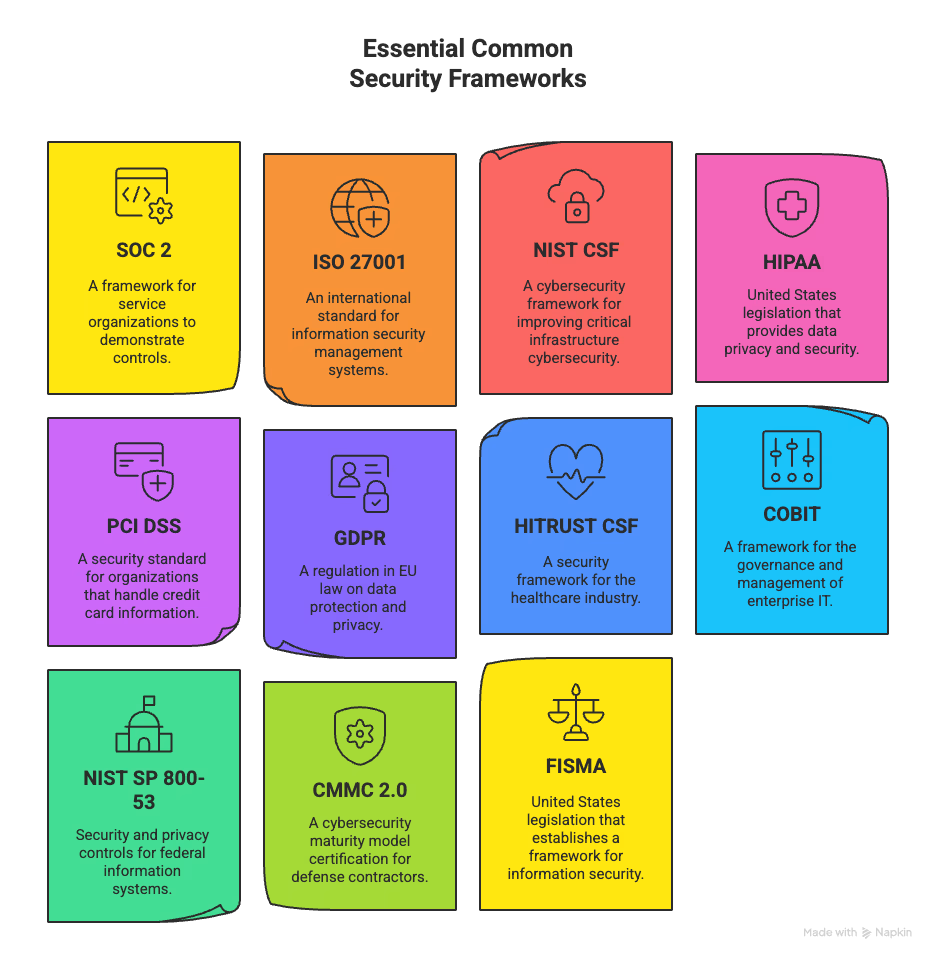
Let’s dive into each of these frameworks to understand what they cover, how they work, and why your organization should care.
1. SOC 2 Compliance Framework
Think SOC 2 is just another checkbox? Think again. Created by the AICPA, SOC 2 separates serious service providers from the rest. It focuses on protecting customer data and proving your security is real—not just talk.
Key Features
SOC 2 revolves around five Trust Services Criteria (TSC):
- Security (mandatory)
- Availability
- Processing Integrity
- Confidentiality
- Privacy
You pick the optional criteria based on your business needs. Security is non-negotiable, ensuring systems and data are protected with firewalls, MFA, and intrusion detection.
Certification / Compliance Process
- Type I: Snapshot audit, 1–3 months
- Type II: Controls tested over time, 3–12 months
- Cost: $20K–$50K depending on size and complexity
Roadmap: select TSC, build controls, remediate gaps, get audited, receive attestation report.
Who Should Use It / Why It Matters
Tech & SaaS, cloud providers, financial services, and healthcare tech can’t skip SOC 2. In North America, it’s often the price of entry for contracts and a signal to customers that your security is serious.
2. ISO 27001 Information Security Framework
ISO 27001 isn’t just another standard—it’s the global benchmark for managing information security. Companies in over 150 countries rely on it to protect their most critical data and prove they follow internationally recognized best practices.
Key Features
ISO 27001 is built around the CIA triad:
- Confidentiality: Only authorized people access information
- Integrity: Data remains accurate and complete
- Availability: Authorized users can access data when needed
Instead of mandating tools, it guides organizations to assess risks and implement the right controls, scaling from small startups to multinational enterprises.
Certification / Compliance Process
- Stage 1: Documentation review of ISMS policies and procedures
- Stage 2: On-site assessment to verify implementation
Certification is valid for three years, with annual surveillance audits and a full recertification audit at the end.
Who Should Use It / Why It Matters
ISO 27001 is ideal for any organization handling sensitive data globally. Certification demonstrates to leadership and customers that security is taken seriously and aligns with international best practices.
3. NIST Cybersecurity Framework (CSF)
The NIST Cybersecurity Framework is a flexible playbook for managing cyber risks, originally created to protect critical infrastructure. Today, it’s widely adopted across industries because it’s voluntary, adaptable, and practical for organizations of any size.
Key Features
NIST CSF is structured around five core functions:
- Identify: Know your assets, data, and potential risks
- Protect: Implement safeguards to keep threats out
- Detect: Spot anomalies and security events early
- Respond: Have a plan when incidents occur
- Recover: Restore systems and data after an attack
Version 2.0 adds a sixth function, Govern, emphasizing leadership involvement in cybersecurity.
Certification / Compliance Process
NIST CSF is voluntary and doesn’t require formal certification. Implementation involves:
- Assessing current cybersecurity posture
- Defining target maturity levels
- Implementing controls aligned with business risks
- Continuously monitoring and improving
Who Should Use It / Why It Matters
NIST CSF works for startups, enterprises, and public agencies alike. It provides a clear, adaptable roadmap for improving cybersecurity, aligning teams, and making informed risk-based decisions.
4. HIPAA Security Rule Framework
HIPAA isn’t optional—if you handle electronic protected health information (ePHI), compliance is mandatory. The Security Rule ensures healthcare organizations protect patient data while scaling requirements to fit their size and risk.
Key Features
HIPAA Security Rule mandates three types of safeguards:
- Administrative: Security management processes, designated officers, workforce training, risk assessments
- Physical: Facility access controls, workstation and device policies
- Technical: Access controls, audit logs, integrity measures, transmission security
The framework scales with your organization, considering size, infrastructure, costs, and ePHI risk levels.
Certification / Compliance Process
HIPAA doesn’t have a formal certification. Compliance is enforced by the Office for Civil Rights (OCR) via:
- Audits of covered entities and business associates
- Requests for documentation within 10 business days
- Penalties for non-compliance, including fines and corrective action plans
Who Should Use It / Why It Matters
HIPAA is essential for healthcare providers, insurers, and tech handling ePHI. Following the Security Rule protects patient data, reduces breach risk, and ensures legal compliance.
5. PCI DSS Framework for Payment Security
If your business accepts credit cards, PCI DSS isn’t optional—it’s mandatory. Created by major card brands, this framework protects payment data wherever it’s stored, processed, or transmitted.
Key Features
PCI DSS organizes security into 12 requirements under six control objectives:
- Build and maintain secure networks
- Protect cardholder data in storage and transit
- Manage vulnerabilities and malware
- Implement strong access controls and authentication
- Monitor and test networks regularly
- Maintain security policies
These requirements ensure consistent protection of payment systems across organizations of all sizes.
Certification / Compliance Process
Compliance level depends on transaction volume:
- Level 1: 6M+ transactions, requires annual ROC and quarterly scans
- Level 2: 1–6M transactions, SAQ and quarterly scans
- Levels 3 & 4: Fewer transactions, similar requirements but less rigorous
Costs vary based on size, complexity, and assessor fees.
Who Should Use It / Why It Matters
PCI DSS is crucial for any business handling cardholder data, especially e-commerce and retail. Compliance prevents data breaches and costly fines, ensuring trust with customers and payment partners.
6. GDPR Data Privacy Framework
The General Data Protection Regulation (GDPR) revolutionized data privacy worldwide. Any organization handling EU residents’ personal data must comply, no matter where it’s based.
Key Features
GDPR sets out seven non-negotiable principles:
- Lawfulness, fairness, and transparency in processing
- Purpose limitation – only collect data for specified purposes
- Data minimization – collect only what’s necessary
- Accuracy – maintain correct, updated data
- Storage limitation – delete data when no longer needed
- Integrity and confidentiality – implement proper security
- Accountability – prove compliance to regulators
High-risk processing may require a Data Protection Impact Assessment (DPIA).
Certification / Compliance Process
GDPR compliance is enforced by Data Protection Authorities (DPAs):
- Conduct audits and investigations
- Issue fines for violations (up to €20M or 4% of global revenue)
- Require organizations to demonstrate ongoing compliance
There’s no formal certification; compliance is continuous and monitored.
Who Should Use It / Why It Matters
Any company handling EU personal data must follow GDPR. Compliance reduces breach risks, avoids massive fines, and builds trust with customers globally.
7. HITRUST Common Security Framework (CSF)
HITRUST CSF is designed to simplify compliance while delivering measurable security results. It integrates multiple standards into a single framework, helping organizations manage risk efficiently and avoid breaches.
Key Features
HITRUST combines over 60 regulations and standards, including:
- HIPAA Security Rule
- NIST frameworks
- ISO 27001/27002
- PCI DSS
- GDPR
Controls are spread across 19 domains with three implementation levels, allowing organizations to tailor security based on actual risk.
Certification / Compliance Process
The certification journey typically takes 1–2 years:
- Readiness assessment: Identify current gaps
- Remediation: Fix deficiencies
- Validated assessment: HITRUST assessor verifies compliance
- Quality assurance review: Final evaluation and certification
R2 assessments require 62% across domains; I1 assessments require 83%. Certifications last two years, with an interim assessment at 12 months.
Who Should Use It / Why It Matters
HITRUST is ideal for healthcare organizations juggling multiple standards. One framework covers HIPAA, NIST, ISO, and more, streamlining compliance and strengthening overall security posture.
8. COBIT Framework for IT Governance
COBIT focuses on bridging the gap between IT operations and business objectives. It provides a structured approach to governance, ensuring IT aligns with organizational goals and regulatory requirements.
Key Features
COBIT is built on five components:
- Framework: Connects business goals to IT objectives
- Process descriptions: Creates a common language across teams
- Control objectives: Specifies necessary controls and their purpose
- Management guidelines: Assigns responsibilities and measures success
- Maturity models: Shows current performance and improvement paths
The latest version, COBIT 2019, organizes processes into five domains: Plan & Organize, Acquire & Implement, Deliver & Support, Monitor & Evaluate, and Manage & Assess.
Certification / Compliance Process
COBIT itself doesn’t require certification, but implementing its processes helps meet audit requirements and supports frameworks like SOX, ISO 27001, and ITIL. Organizations typically assess current maturity, implement controls, and monitor performance.
Who Should Use It / Why It Matters
COBIT is ideal for enterprises seeking IT governance clarity. It helps bridge IT and executive communication, supports compliance, and ensures IT investments drive business value.
9. NIST SP 800-53 Controls
NIST SP 800-53 is a comprehensive framework for securing federal information systems. It provides a detailed set of controls to protect operations, assets, and personnel from cyber threats.
Key Features
The framework organizes over 1,000 controls into 20 families, including:
- Access Control (AC): Manage who can access systems and data
- Audit and Accountability (AU): Track activities and detect anomalies
- System and Communications Protection (SC): Secure data and communications
- Incident Response (IR): Prepare for and respond to security events
Organizations often map these controls to the common control NIST catalog to ensure consistent and standardized risk management. Control selection depends on system criticality: low-impact systems may require around 150 controls, while high-impact systems could need nearly 400. This approach aligns with the nist common criteria, ensuring that all controls meet federal standards and follow best practices.
Certification / Compliance Process
SP 800-53 is used to achieve FISMA compliance. Implementation involves:
- Selecting controls based on risk
- Deploying them across the system
- Regularly assessing effectiveness through testing and audits
There’s no formal “certification,” but proper implementation is mandatory for federal systems.
Who Should Use It / Why It Matters
Federal agencies and contractors use NIST 800-53 to secure systems and comply with FISMA. It ensures a standardized, risk-based approach to cybersecurity, protecting critical data and operations.
10. CMMC 2.0 Framework for DoD Contractors
CMMC 2.0 is the Department of Defense’s cybersecurity standard for contractors. It ensures sensitive government data is protected across the defense supply chain.
Key Features
CMMC 2.0 has three levels:
-
Level 1 (Foundational): Protect Federal Contract Information (FCI) with 17 basic practices; annual self-assessment
-
Level 2 (Advanced): Aligns with 110 NIST SP 800-171 controls; protects Controlled Unclassified Information (CUI); self or third-party assessment allowed
-
Level 3 (Expert): Adds 24 NIST SP 800-172 practices; government-led assessment; defends against Advanced Persistent Threats (APTs)
The framework ensures contractors meet the right security posture for their contract level.
Certification / Compliance Process
Certification depends on the level:
- Level 1: Self-assessment
- Level 2: May require third-party verification
- Level 3: Government-led assessment
Contractors must complete gap assessments, remediate issues, and get verified before handling sensitive data.
Who Should Use It / Why It Matters
Any contractor working with the DoD must comply. CMMC 2.0 secures federal data, reduces supply chain risk, and ensures eligibility for defense contracts.
11. FISMA Federal Security Framework
The Federal Information Security Modernization Act (FISMA) sets mandatory cybersecurity requirements for U.S. federal agencies and contractors. It ensures government systems and data are protected against evolving threats.
Key Features
FISMA compliance revolves around five core requirements:
- Inventory Management: Know all systems, including cloud assets
- Risk Categorization: Classify systems as low, moderate, or high risk
- System Security Planning: Develop security plans with real deadlines
- Security Controls: Implement NIST SP 800-53 controls
- Risk Assessments: Test and validate controls regularly
Even “low-impact” systems require over 100 controls, making thorough implementation essential.
Certification / Compliance Process
FISMA compliance involves:
- Applying NIST guidance (FIPS 199/200, SP 800-37, SP 800-53)
- Conducting internal audits and risk assessments
- Ensuring third-party and cloud service compliance
There’s no formal certificate; compliance is enforced via audits and federal oversight.
Who Should Use It / Why It Matters
Federal agencies and contractors must comply. FISMA treats cybersecurity as a core business requirement, protecting sensitive government data and ensuring operational resilience.
These 11 frameworks guide organizations to stay secure, manage risk, and meet compliance. They’re not just checkboxes—they’re the backbone of strong cybersecurity.
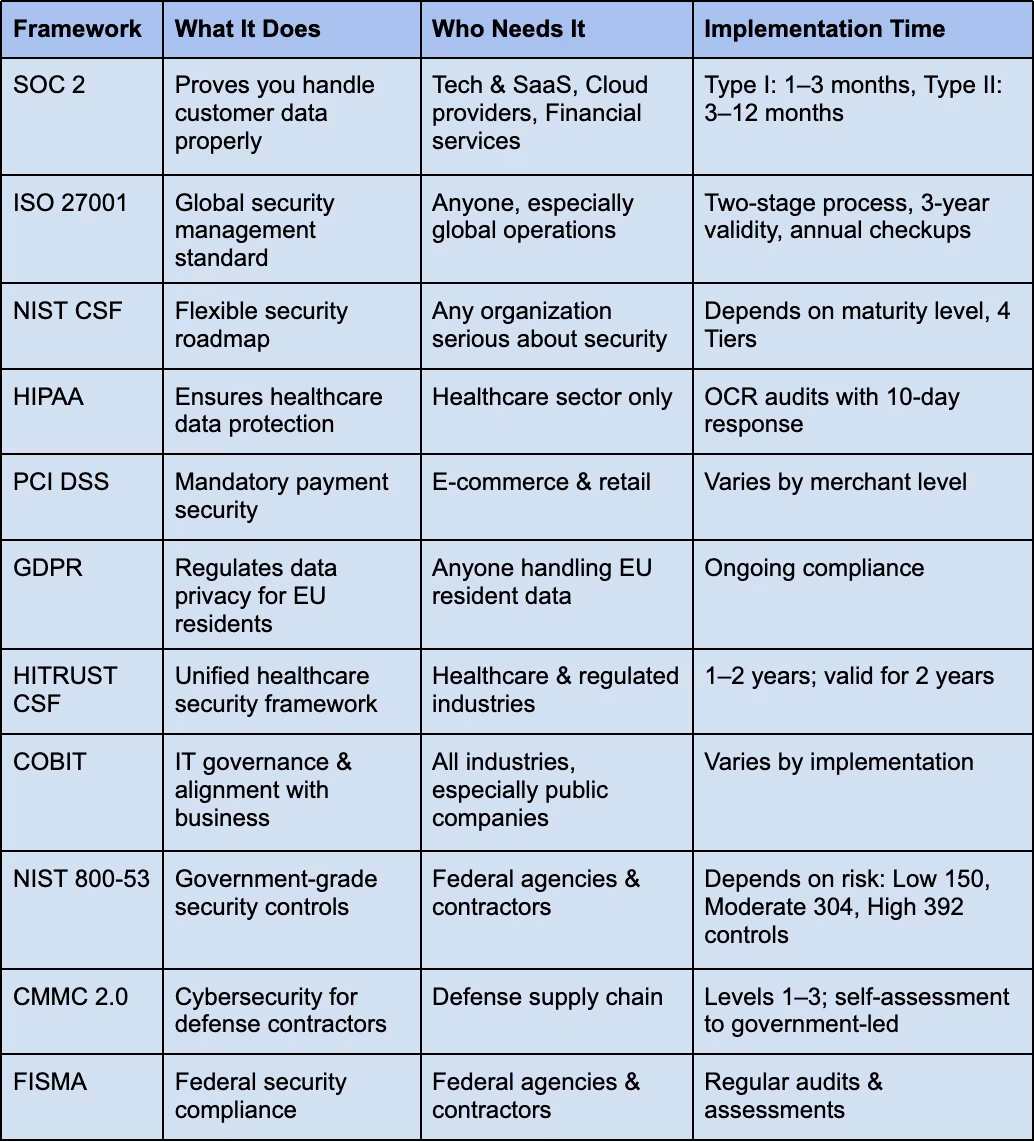
Use this table to see which frameworks fit your industry, who needs them, and how long they take. Pick, implement, and stay secure.
Choosing the Right Security Framework
Selecting the right security framework is simpler than it seems—focus on three key questions:
1. Your industry – Healthcare? HIPAA is mandatory; HITRUST adds credibility. E-commerce? PCI DSS is essential. Government contractors? CMMC 2.0 or FISMA. SaaS? SOC 2 is often table stakes.
2. Customer expectations – Enterprise clients often expect ISO 27001. Startups may ask for SOC 2. Vendor questionnaires reveal what matters most.
3. Your capacity – Some frameworks are major undertakings. HITRUST can take 1–2 years; ISO 27001 requires serious commitment. Start manageable, then scale.
The common mistake? Treating frameworks as one-time checklists. They need continuous updates, monitoring, and improvement. Layer frameworks strategically if necessary.
Pick one that fits your immediate needs, implement it thoroughly, and expand gradually. Doing it right costs far less than a breach, regulatory fines, or lost customer trust—your framework is your roadmap to real security.
Build trust and prevent breaches with UprootSecurity — making GRC the key to good security. → Book a demo today