ISO 27001 Risk Management Software for Automated Compliance

Robin Joseph
Senior Security Consultant

Last reviewed: September 2026.
Ever stared at a messy compliance spreadsheet at 2 AM, wondering if you’ve missed something critical?
You’re not alone.
ISO 27001 risk management isn’t a box-ticking exercise you do once and forget. It’s the line between resilient security and becoming the next data breach headline. In August 2024 alone, 5.9 million Americans had their data compromised—and most incidents weren’t sophisticated attacks. They were basic, preventable failures that manual compliance processes failed to catch.
Spreadsheets, email threads, and version chaos create blind spots. Evidence goes missing. Controls drift. Ownership becomes unclear. Everything looks “fine” until an audit—or worse, an incident—proves otherwise.
That’s the real risk: not knowing what you’ve missed.
This is where ISO 27001 risk management software changes the game. Instead of reacting late, teams gain visibility early. Instead of scrambling, compliance becomes structured, repeatable, and predictable.
And that shift—from guessing to knowing—is what modern compliance is really about.
Understanding ISO 27001 Risk Management and Its Automation Potential
ISO 27001 risk management is the structured process of identifying, evaluating, and treating information security risks that could impact an organization. Rather than relying on assumptions, it requires teams to systematically assess information assets, understand relevant threats and vulnerabilities, and determine which risks are acceptable versus which require treatment.
This process is grounded in the CIA triad—Confidentiality, Integrity, and Availability. Each risk assessment examines how data could be exposed, altered, or disrupted, and identifies the controls needed to prevent those outcomes. Assigning risk owners, defining treatment actions, and maintaining documentation are all part of this continuous cycle.
Execution is where most organizations struggle. Manual approaches depend on spreadsheets and disconnected documents, resulting in inconsistent scoring, outdated assessments, and unclear ownership. Risks are reviewed infrequently, even as systems and threats evolve.
Automation closes this gap. ISO 27001 risk management software standardizes risk identification, scoring, assignment, and monitoring, creating a single source of truth that keeps risks, controls, and compliance aligned at scale.
Defining a Consistent ISO 27001 Risk Assessment Methodology
ISO 27001 risk assessment isn’t something you can wing. You need a methodology that’s documented, repeatable, and comparable across teams. Skip steps or change approaches randomly, and the results won’t be reliable—just like a recipe gone wrong. A structured approach ensures that every assessment produces actionable insights, not guesswork.
Qualitative vs Quantitative ISO 27001 Risk Assessment Approaches
Many organizations get stuck here. Both approaches work, but each shapes how risks are understood and addressed.
Qualitative assessments rely on expert judgment using scales like Low–Medium–High. They’re useful because:
- Subtle risks surface faster
- Scenario discussions reveal issues numbers can miss
- Implementation is quick and practical
Quantitative assessments assign numbers to probability, impact, and potential losses. Benefits include:
- Objective data for leadership
- Clear cost-benefit analysis
- Easier prioritization of security investments
Most teams blend both. ISO 27001 risk assessment software lets you combine qualitative insight with quantitative precision when needed, so decisions are both fast and evidence-based.
Setting Risk Acceptance Criteria and Risk Scoring Scales
Risks only matter when you know what’s acceptable. Scoring scales clarify which risks need action and which can be tolerated.
- Match scale complexity to your organization
- Score likelihood and impact separately
- Keep metrics consistent across all teams
ISMS software applies these rules automatically, removing guesswork and ensuring every department scores risks the same way.
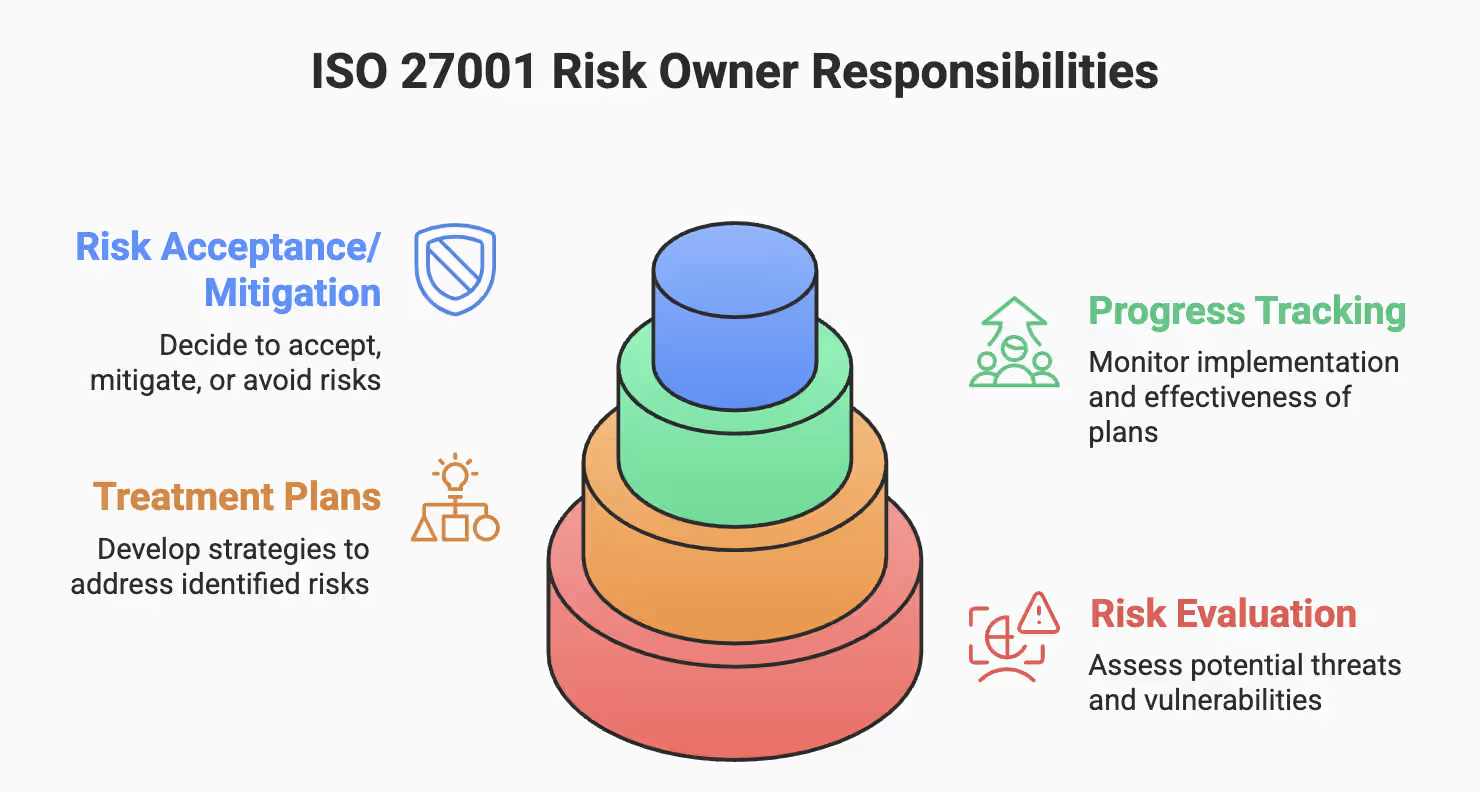
Role of Risk Owners in ISO 27001 Risk Assessment
Assigning ownership is more than naming someone responsible. Risk owners must understand the risk and have authority to act. They:
- Evaluate risks carefully
- Create practical treatment plans
- Track progress consistently
- Decide whether to accept, avoid, or mitigate risks
Without clear ownership, risks stall. ISO 27001 risk assessment tools assign accountability, send automated reminders, and provide visibility—no dropped balls, no finger-pointing.
When methodology, scoring, and ownership are clear, risk assessment becomes reliable. Teams share the same framework, every risk is actionable, and compliance shifts from a chaotic chore to a repeatable, scalable process.
Automating ISO 27001 Risk Assessment Workflows with Software
Manual tracking? It’s a disaster waiting to happen. Version chaos, missing pieces, and that sinking feeling when auditors start asking questions you can’t answer—sound familiar? ISO 27001 risk assessment software flips the script. Instead of drowning in spreadsheet hell, you get workflows that actually work.
Using ISO 27001 Risk Assessment Software for Asset–Threat Mapping
Traditional asset-threat mapping eats up weeks and still misses key risks. Software fixes this by:
- Automatically spotting connections between assets and threats
- Providing ready-made control libraries so you don’t start from scratch
- Creating a complete picture of vulnerabilities you didn’t know existed
- Integrating CIA considerations into every step
Result? Teams spend less time documenting and more time mitigating. Companies using these tools identify roughly 70% more potential risks than manual approaches.
Automated Likelihood and Impact Scoring Across Assets
Manual risk scoring fails because everyone scores differently. ISMS software solves this:
- Consistent scoring criteria across all departments
- Automatic application of risk rules for comparability
- AI-assisted pre-population of scores based on existing evidence
The outcome: risk assessments that actually make sense and stand up to auditors.
Generating Risk Registers and Risk Treatment Plans Automatically
This is the game-changer. Compliance software produces living documentation instead of static spreadsheets:
- Risks become actionable tasks with owners, deadlines, and progress tracking
- Direct integration with ticketing systems—no double work
- Automatic compilation of risks, scores, controls, and actions
- Each risk links directly to compliance requirements for audit readiness
One company cut risk register prep time by 67% while improving accuracy. Manual methods may work when you’re small—but as you grow, ISO 27001 risk assessment tools scale with your business.
Automation keeps everything current as your environment and regulations evolve.
Centralized Management of ISO 27001 Controls and Risks
78% of organizations are drowning in siloed compliance data. Treating ISO 27001 like a filing cabinet exercise isn’t just inefficient—it’s risky. Scattered information hides gaps, slows decisions, and makes audits a nightmare. Centralized management changes that.
Mapping Annex A Controls to Identified ISO 27001 Risks
Handling Annex A controls manually is like solving a 1,000-piece puzzle blindfolded. ISO 27001 compliance software cuts through the chaos by:
- Automatically matching the right controls to specific risks
- Bringing IT, HR, Legal, and Operations together under one roof
- Creating clear visual connections so you can see how everything fits
With 93 controls across four domains in ISO 27001:2022, manual tracking is overwhelming. Software turns complexity into clarity and manageability.
Creating a Dynamic Statement of Applicability (SoA)
The SoA isn’t just paperwork—it’s proof that what you claim matches reality. A proper SoA includes:
- Every Annex A control listed
- Honest implementation status (yes, no, N/A)
- Clear reasoning for each decision
- Actual owners and dates
Spreadsheet SoAs go stale immediately. ISO 27001 software creates a living document that evolves with your business. Auditors get accurate answers, no scrambling required.
Using ISMS Software to Track Residual Risk and Control Effectiveness
Perfect security doesn’t exist. Even with every control implemented, some residual risk remains. ISO 27001 requires you to monitor it. Software provides X-ray vision into:
- Remaining risk across assets
- Control effectiveness
- Gaps between current and desired risk posture
Companies using centralized ISO 27001 risk management cut costs, improve security, and get tasks done in-house—fast and accurately.
Centralized management turns scattered efforts into a unified defense. Controls, risks, and responsibilities live in one system—transparent, actionable, and audit-ready.
Continuous ISO 27001 Compliance Monitoring and Reporting
Most organizations treat compliance like a once-a-year checkup—show up, get tested, hope everything looks good, then move on. That’s not security. That’s security theater. ISO 27001 risk management software gives real-time visibility, so issues are caught and fixed as they happen.
Real-Time Control Monitoring and Deviation Alerts
Traditional compliance often leads to last-minute scrambles:
- Teams rushing to fix problems before audits
- Auditors finding unexpected issues
- Weeks spent correcting incidents that occurred months ago
Automated ISMS software changes this completely:
- Daily automated tests catch issues the moment they appear
- Instant notifications alert the right teams
- Alerts target specific control failures so you can act fast
Dashboards show exactly what’s slipping, where, and how to fix it—no surprises, no emergency firefighting.
Automated Evidence Collection Using ISO 27001 Compliance Software
Manual evidence collection consumes most of compliance prep. Teams dig through folders, chase screenshots, and hunt down reports. ISO 27001 software eliminates this by:
- Pulling timestamped, audit-ready evidence directly from systems
- Continuously capturing logs and documentation from cloud and SaaS platforms
- Maintaining evidence integrity with secure, least-privilege access
Compliance becomes part of daily operations, not a dreaded annual task.
Replacing Manual ISO 27001 Checklists with Integrated Software
Manual checklists are slow, error-prone, and exhausting. Modern software lets organizations:
- Map monitoring and automation opportunities
- Integrate existing systems
- Set up continuous control monitoring
- Centralize evidence collection
- Generate audit-ready documentation automatically
Integrated checklists save time, reduce errors, and automate up to 70% of compliance work, cutting audit prep in half.
Continuous monitoring transforms ISO 27001 compliance from a yearly scramble into a proactive system—keeping your organization audit-ready, aware of risks in real time, and able to respond before issues escalate.
Comparing Manual vs Automated ISO 27001 Risk Management
The numbers don’t lie—and they’re not pretty. While you’re debating automation, competitors are already saving time, money, and headaches. Here’s a clear look at how manual and automated approaches stack up:
| Aspect | Manual ISO 27001 Risk Management | Automated ISO 27001 Risk Management |
|---|---|---|
| Cost | USD 24,583–39,333 upfront + ~USD 30,000 consultant fees | Lower upfront costs, fewer consultant fees |
| Time | 2–4 months of senior team time, plus weeks fixing issues | Audits completed 50% faster, real-time updates |
| Accuracy & Human Error | High risk—88% of breaches caused by human mistakes; multiple versions, lost files | Single source of truth; eliminates version confusion and missing documentation |
| Scalability | Becomes exponentially painful and expensive as business grows | Scales with your organization without adding extra staff |
| Business Impact | Skilled workforce stuck on repetitive compliance busywork | Employees focus on innovation; compliance handled automatically |
Switching to ISO 27001 risk management software doesn’t just save money—it prevents costly errors, reduces audit prep time, and makes scaling compliance manageable as your organization grows.
The choice is simple: stick with manual spreadsheets and pay the hidden costs, or implement automated ISO 27001 risk assessment software and build a foundation that grows with your business. Automation isn’t just faster—it’s smarter.
Benefits of Automating ISO 27001 Risk Management
Time for some serious talk about money. ISO 27001 risk management software isn’t just another tool—it’s a game-changer that pays for itself fast. Instead of wasting time and cash on repetitive busywork, you get a system that actually works.
Reduced Compliance Costs and Consultant Dependency
Automation delivers results like:
- Slash compliance costs by up to 90% (from over $100,000 to under $10,000)
- Cut implementation time from 6–8 months to 3–4 months
- Eliminate consultant fees of $30,000–50,000
- Stop wasting money on repetitive manual tasks
The software connects to your existing tools and pulls evidence automatically. No more paying consultants to do what it handles faster and smarter.
Improved Risk Visibility Across Teams and Departments
Manual processes keep you blind. Automation flips on the lights:
- Live dashboards show exactly where you stand
- Smart alerts ping the right people
- Teams collaborate instead of playing email tag
With everyone seeing the real picture, threats get handled before they escalate.
Faster Certification Readiness and Surveillance Audit Preparation
Manual prep is exhausting. Automation changes that:
- Compliance achieved up to 90% faster
- Audit prep cut by 50%
- Evidence automatically organized and audit-ready
- Teams get real-time visibility of gaps
No more frantic scrambling. Auditors see what they need, and your team stays focused on risk. Automation doesn’t just save money—it scales, reduces errors, and keeps compliance continuous.
Frequently Asked Questions
It automates the parts of ISO 27001 that are painful to do manually: scoring and tracking risks consistently, mapping them to Annex A controls, collecting evidence from your existing tools, and keeping your Statement of Applicability up to date instead of letting it go stale in a spreadsheet.
No, ISO 27001 doesn't require any specific tooling — you can pass an audit with well-maintained spreadsheets and documents. In practice, most organizations past roughly 20-30 employees find manual tracking becomes error-prone and time-consuming enough that dedicated software pays for itself.
Pricing varies by vendor and company size, but it's typically an annual subscription rather than a one-time fee. Compared against consultant fees for a fully manual approach (often $30,000 or more), automation usually costs less overall once you factor in the time saved.
Yes. Most platforms are designed to import existing risk registers, policies, and evidence, so switching mid-process doesn't mean starting over — it typically means consolidating what you already have into a system that stays current automatically.
Final Thoughts on Streamlining ISO 27001 Risk Management
Here’s the truth nobody wants to admit: most companies hold their security together with digital duct tape—and hope. You’ve seen the stats, you know the problems, yet spreadsheets still feel familiar. Change is hard, and sticking to what feels comfortable is tempting.
Here’s what happens when you switch to ISO 27001 risk management software:
- Month one feels weird—you double-check everything because it seems “too easy.”
- Month two? You start trusting it, seeing gaps clearly, and sleeping better.
- Month three? You can’t imagine going back. Neither can your team.
The numbers speak for themselves. Companies typically cut compliance costs by 60%, uncover hidden risks, and stay audit-ready without last-minute panic.
The real win isn’t just money or time. It’s confidence. It’s knowing your security actually works. It’s spotting threats before they become crises, instead of scrambling afterward.
The choice is yours: keep playing compliance roulette with spreadsheets—or step up and make security predictable, continuous, and stress-free. Your data is counting on you.
Transform your compliance from chaos to confidence with UprootSecurity — making ISO 27001 risk management automated, continuous, and stress-free.
→ Book a demo today
ISO 27001