7 Risk Assessment Methodologies You Should Know in 2025

Robin Joseph
Senior Security Consultant

Ever wonder why some companies seem to dodge every bullet while others get blindsided by problems they never saw coming? The secret isn’t luck—it’s having the right risk assessment methodologies in place. Think of them as your early warning system. They spot trouble before it arrives demanding payment.
Fixing problems after the fact costs far more than preventing them in the first place. These methodologies all follow a familiar playbook: identify critical assets, map threats, assess vulnerabilities, evaluate risk levels, and recommend actionable upgrades.
Options like ISO 27005, NIST SP 800-30, and FAIR do the heavy lifting, but the goal is simple: know what could go wrong before it does.
From quick gut-checks to deep financial modeling, the right approach gives teams clarity, confidence, and the ability to act fast—without guessing.
What Are Risk Assessment Methodologies?
Risk assessment methodologies are the frameworks organizations use to figure out what could go wrong—and what to do about it—before disaster strikes. They aren’t just paperwork. They’re structured approaches to spotting threats, understanding vulnerabilities, and prioritizing actions in a repeatable, defensible way.
At their core, all methodologies follow the same rhythm: identify assets and determine what could harm them. Next, evaluate existing controls and measure risk levels. Finally, recommend improvements to reduce or mitigate those risks.
Some methodologies are qualitative, using simple labels like high, medium, or low. Others are quantitative, translating threats into numbers, dollar impact, or probabilities. Semi-quantitative methods bridge the gap with scorecards and risk matrices. Specialized approaches focus on assets, vulnerabilities, threats, or even dynamic, real-time changes.
The right methodology aligns with your organization’s goals, the type of data you protect, and the speed at which you need answers. Used well, they’re not just frameworks—they’re your early warning system.
7 Best Risk Assessment Methodologies You Should Know About
Not all risk assessment approaches are the same. Different risk assessment methodologies help organizations spot threats, prioritize risks, and make smarter, faster decisions. Each tackles risk from a different angle, giving teams clarity and confidence before problems hit.
Here are the seven key risk assessment methodologies every organization should know:
- Cybersecurity Risk Assessment Methodology
- Information Security Risk Assessment Methodology
- ISMS Risk Assessment Methodology (ISO 27001 / ISO 27000)
- FAIR Risk Assessment Methodology
- Privacy Risk Assessment Methodology
- IT Risk Assessment Methodology
- Enterprise Risk Assessment Methodology (ERM)
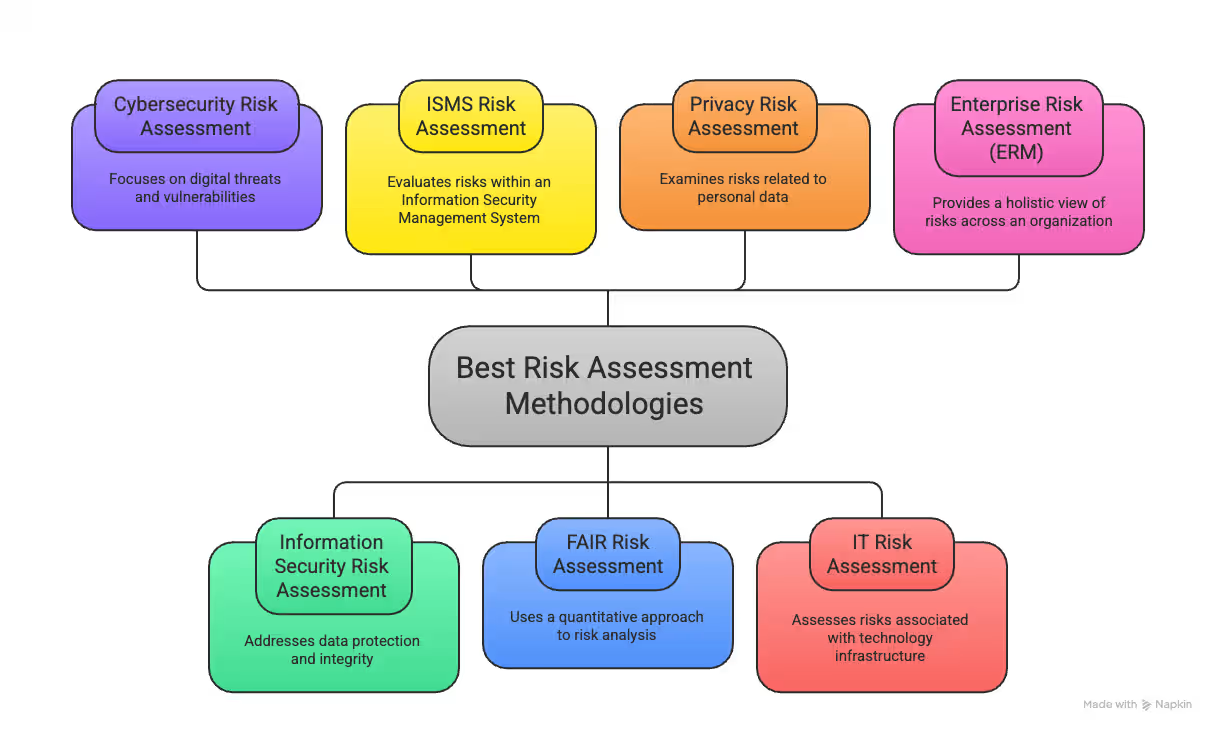
Let’s get into each methodology and see what makes it effective.
1. Cybersecurity Risk Assessment Methodology
Cybersecurity risk assessment is a structured approach to identify, analyze, and prioritize threats. It helps organizations focus on risks that truly impact systems, data, and business—not just noisy alerts.
What it assesses
This methodology looks at how cyber threats could realistically disrupt systems, data, and operations—not just what automated tools detect.
It typically assesses:
- Critical applications, infrastructure, and data supporting core business functions
- Relevant threat actors targeting your industry or technology stack
- Vulnerabilities across networks, endpoints, cloud services, and applications
- Effectiveness of existing security controls
- Operational, financial, and reputational impact of a cyber incident
It ensures focus on real threats and strengthens system, data, and operational resilience.
When to use it
This methodology is most valuable during periods of change, growth, or elevated threat activity.
Use it when:
- Launching new applications, systems, or cloud environments
- Expanding remote access, vendors, or third-party integrations
- Responding to incidents, near-misses, or threat intelligence
- Preparing for audits, insurance reviews, or board reporting
- Operating in highly targeted or regulated industries
Strengths and limitations
Cyber security risk assessment connects technical findings to business impact.
Strengths
- Addresses real-world cyber threats
- Prioritizes remediation and security investment
- Improves incident readiness and response
Limitations
- Can drift into vulnerability counting
- Relies on accurate threat intelligence
- Requires frequent updates
Cybersecurity risk assessment methodology works best when treated as a continuous business process, not a one-time exercise.
2. Information Security Risk Assessment Methodology
Information security risk assessment methodology takes a broader view than pure cyber risk. It evaluates how technical, human, and process-driven threats could compromise the confidentiality, integrity, and availability of information across the organization.
What it assesses
This methodology focuses on protecting information assets, regardless of where they reside or how they’re processed.
It typically assesses:
- Information assets such as customer data, intellectual property, financial records, and internal documents
- Threats including cyberattacks, insider misuse, human error, and process failures
- Vulnerabilities across people, processes, and technology—not just systems
- Administrative, technical, and physical security controls in place
- Business impact of data loss, unauthorized access, or service disruption
The emphasis is on information risk, not just tooling or infrastructure gaps.
When to use it
This methodology is most effective when information protection is a business priority.
Use it when:
- Defining or updating an information security program
- Preparing for ISO 27001 or similar certifications
- Managing sensitive, financial, or regulated data
- Aligning security controls with business processes
- Communicating risk to non-technical stakeholders
Strengths and limitations
This approach provides a holistic view of how information can be exposed.
Strengths
- Covers people, process, and technology risks
- Aligns well with governance and compliance efforts
Limitations
- Less detailed on technical attack paths
- Relies on accurate asset classification
This methodology works best when information—not infrastructure—is the primary asset being protected.
3. ISMS Risk Assessment Methodology (ISO 27001/ ISO 27000)
ISMS risk assessment methodology goes beyond compliance checklists—it’s a structured approach to protect an organization’s information assets. It identifies, evaluates, and prioritizes risks across people, processes, and technology, improving security posture and operational confidence.
What it assesses
This methodology hunts for weak spots across the organization. It typically assesses:
- Confidentiality, Integrity, Availability (CIA) – Ensures sensitive data is secret, accurate, and available.
- Threats – Cyberattacks, insider misuse, human error, and process failures.
- Vulnerabilities – Across people, processes, and technology, not just IT systems.
- Controls – Administrative, technical, and physical measures in place.
- Business impact – Consequences of data loss, unauthorized access, or service disruption.
The focus is on risk management, not just ticking boxes.
When to use it
Use this methodology when:
- Setting up or updating an ISMS.
- Preparing for ISO 27001 or similar certifications.
- Implementing major system changes.
- Post-incident reviews and mitigation.
- Communicating risk to management or auditors.
Strengths and limitations
ISMS risk assessment provides a clear view of organizational security risks.
Strengths
- Covers people, processes, and technology.
- Prioritizes resources effectively.
- Supports continuous improvement.
Limitations
- Time- and effort-intensive.
- Can feel rigid for unique contexts.
- Technical jargon may overwhelm newcomers.
ISMS risk assessment works best when security is treated as a strategic priority, not a checkbox exercise.
4. FAIR Risk Assessment Methodology
FAIR (Factor Analysis of Information Risk) speaks the language executives actually understand: money. It translates cyber threats into potential financial losses, helping organizations make data-driven risk decisions rather than relying on vague high/medium/low ratings.
What it assesses
FAIR breaks risks into measurable financial components:
-
Loss Event Frequency (LEF) – How often threats might materialize, considering threat contact, probability, and vulnerability.
-
Loss Magnitude (LM) – The potential impact in dollars, including:
- Primary losses – Asset value, productivity hits, direct damage.
- Secondary losses – Ripple effects on operations, reputation, or partners.
-
Risk building blocks – Combines frequency and magnitude for clear cost projections.
Unlike subjective ratings, FAIR provides concrete numbers, helping management understand exactly what a vulnerability could cost.
When to use it
FAIR is ideal when you need to:
- Communicate risk in financial terms to executives.
- Support decision-making on security investments.
- Supplement frameworks like ISO, NIST, or OCTAVE with quantitative data.
- Evaluate complex scenarios with multiple threats and impacts.
Strengths and limitations
FAIR provides a clear view of financial impacts from cyber risks.
Strengths
- Turns technical risk into dollars for business clarity.
- Helps prioritize spending where it matters most.
- Integrates with existing frameworks.
Limitations
- Requires detailed knowledge and judgment.
- Needs time, effort, and data to do properly.
- Best used alongside other risk methodologies, not alone.
FAIR makes cyber risk a business conversation, not just an IT concern.
5. Privacy Risk Assessment Methodology
Privacy risk assessment methodology focuses on protecting personally identifiable information (PII) and sensitive data, providing a structured methodology for privacy risk management across systems, processes, and third parties. It ensures organizations handle personal data responsibly, maintain compliance, and minimize the potential impact on individuals.
What it assesses
This methodology examines how data moves through an organization. Key areas include:
-
Personal data handling – How data is collected, processed, stored, shared, and retained.
-
Individual privacy rights – Whether users can control what happens to their information.
-
Processing activities – Identifying points where errors or misuse could occur.
-
Compliance – Alignment with GDPR, HIPAA, E-Government Act, and other regulations.
-
Business impact – Risks of fines, reputational damage, or regulatory penalties.
The goal is to protect individuals while supporting business operations, not just checking boxes.
When to use it
Run privacy risk assessments when:
- Launching new IT systems, products, or services handling PII.
- Conducting mergers or onboarding third-party services.
- Performing high-risk data processing (GDPR Article 35).
- During regular quarterly or annual compliance reviews.
Strengths and limitations
Privacy risk assessment provides a clear view of organizational privacy risks.
Strengths
- Identifies privacy risks early.
- Builds organizational trust.
- Supports informed decision-making and regulatory compliance.
Limitations
- Requires time, expertise, and specialized knowledge.
- Can become a checkbox exercise if not updated regularly.
- Standards and outcomes can vary without privacy professionals on staff.
Privacy risk assessment helps organizations balance data utility with individual protection, keeping privacy at the core.
6. IT Risk Assessment Methodology
IT risk assessment methodology focuses on safeguarding your technology infrastructure. It identifies threats, vulnerabilities, and impacts across hardware, software, networks, and data to ensure business continuity and operational resilience.
What it assesses
This methodology breaks risk down into Threat × Vulnerability × Asset and examines:
- Digital infrastructure security – Hardware, software, networks, and systems.
- Data protection – Customer information, financial records, intellectual property.
- Operational continuity – Ability to maintain business operations during disruptions.
- Compliance obligations – GDPR, HIPAA, PCI DSS, and other regulatory requirements.
- Vulnerabilities – Gaps in processes, technology, or people that could be exploited.
Assessments can be quantitative, qualitative, asset-, threat-, or vulnerability-focused..
When to use it
IT risk assessments are essential:
- Before rolling out new technology.
- After major changes like mergers or system upgrades.
- For routine compliance checks.
- Post-incident, to prevent recurrence.
- Regularly, at least annually, or more often in fast-changing environments.
Strengths and limitations
IT risk assessment ensures a clear view of technology risks.
Strengths
- Reduces guesswork and surprises.
- Helps prioritize resources effectively.
- Supports proactive issue mitigation and regulatory compliance.
Limitations
- Time-consuming and resource-intensive.
- Results can be complex and hard to interpret.
- Static assessments may miss rapidly evolving threats.
IT risk assessment ensures technology supports business objectives safely and consistently, keeping operations resilient.
7. Enterprise Risk Assessment Methodology (ERM)
ERM takes a big-picture approach to risk, connecting cyber, financial, operational, and reputational threats. It breaks down silos, giving organizations a unified view for smarter, strategy-aligned decisions.
What it assesses
ERM evaluates risks across all major organizational areas. It typically assesses:
- Strategic risks – Threats to achieving business objectives.
- Operational risks – Day-to-day operational challenges.
- Financial risks – Cash flow shortfalls, debt, or investments.
- Compliance risks – Regulatory and legal obligations.
- Reputational risks – Public perception and stakeholder trust.
ERM examines interconnections, not isolated risks, to guide resource allocation and decision-making.
When to use it
ERM is most effective when organizations need a cohesive, top-down perspective:
- During strategic planning to identify roadblocks.
- While developing risk management policies.
- To unify scattered departmental risk efforts.
- For annual compliance reviews and reporting.
- When spotting emerging risks across the organization.
Strengths and limitations
ERM offers a strategic lens on risk.
Strengths
- Creates shared understanding for better decisions.
- Protects assets, growth, and reputation.
- Cuts redundant processes, improving efficiency.
- Aligns risk response with strategy.
Limitations
- Can be defensive instead of proactive.
- Relies on management estimates.
- Time-intensive to implement.
- Difficult to quantify mitigation costs.
ERM works best when risk is treated as a strategic, organization-wide priority.
Organizations face risks across cyber, IT, privacy, finance, and enterprise strategy. Here’s a quick comparison table summarizing the key methodologies.
| Methodology | Focus | Key Assessment Areas | Best For |
|---|---|---|---|
| Cybersecurity Risk Assessment | Cyber threats & business impact | Critical systems/data, threat actors, vulnerabilities, controls, operational impact | Launching new systems, audits, high-risk industries, incident response |
| Information Security Risk Assessment | Information assets | Data assets, threats, vulnerabilities, controls, business impact | ISO 27001 prep, sensitive data protection, aligning security with business |
| ISMS (ISO 27001/27000) | Organizational security | CIA triad, threats, vulnerabilities, controls, business impact | ISO certification, ISMS setup, post-incident reviews |
| FAIR | Financial impact of cyber risk | Loss Event Frequency, Loss Magnitude, risk building blocks | Executive reporting, security budgeting, supplementing frameworks |
| Privacy Risk Assessment | Personal data protection | Data handling, privacy rights, processing activities, compliance | GDPR/HIPAA compliance, new systems, high-risk processing |
| IT Risk Assessment | Technology & operational risk | Infrastructure, data protection, operational continuity, compliance | New tech rollouts, post-incident, routine compliance |
| ERM (Enterprise Risk Management) | Enterprise-wide strategic risk | Strategic, operational, financial, compliance, reputational | Top-down risk management, strategic planning, cross-department alignment |
Each risk assessment methodology offers a unique lens on organizational risk. Together, they provide a comprehensive toolkit for identifying, analyzing, and prioritizing threats across cyber, information, privacy, IT, and enterprise domains.
How to Choose the Right Risk Assessment Methodology
You can’t just pick a risk assessment methodology off the shelf like groceries. The best risk assessment methodology is the one that matches where your organization actually is—not where it wishes it were.
Matching Methodology to Organizational Maturity
Your organization’s maturity shapes what kind of risk assessment will stick and deliver value.
-
Ad-Hoc (Level 1): Start with simple qualitative assessments. Quick, low-effort insights help new teams understand their risks.
-
Defined (Level 2–3): Structured qualitative methods, plus basic quantitative checks, give more clarity.
-
Leadership (Level 4–5): Mature enterprises can handle complex quantitative models and hybrid approaches.
Begin where you are. Scale with data, experience, and expertise. Trying advanced models too early wastes time and effort.
Compliance-Driven vs Decision-Driven Approaches
Some methodologies focus on ticking boxes; others focus on solving real business problems.
-
Compliance-driven: Meet requirements, follow rules, stay static and predictable.
-
Decision-driven: Turn abstract risks into actionable priorities that actually protect business value.
Compliance is safe. Decision-driven thinking is smart. Organizations that balance both respond faster and invest resources where it counts.
Combining Multiple Methodologies Safely
You don’t have to choose one. Blending approaches gives speed and precision.
- Start with qualitative methods for quick, high-level insights.
- Layer in quantitative methods for high-stakes or complex risks.
- Hybrid approaches let you balance speed with detail.
The methodology that works is the one your team will actually use consistently. Combining methods ensures actionable insights without overcomplicating the process.
Match methodology to maturity, balance compliance with decision-driven thinking, and blend qualitative and quantitative approaches for maximum clarity, speed, and impact.
Key Takeaways on Risk Assessment Methodologies
We’ve walked through seven risk assessment methodologies—each with unique strengths, blind spots, and ideal use cases. There’s no magic bullet. The real goal is picking the one that fits your organization, based on what you’re protecting, your available resources, and organizational maturity. Startups often do well with qualitative assessments, while large enterprises may need full quantitative rigor.
Compliance alone isn’t the goal—protection is. Regulations keep lawyers happy, but actually reducing risk keeps operations smooth and avoids costly cleanup later. Risk assessment isn’t a one-time task. Threats evolve, technology changes, and businesses grow, so your approach must adapt over time.
The smartest organizations start simple, then layer sophistication. Use qualitative assessments for quick insights, quantitative methods for high-stakes decisions, and specialized approaches for particular risks. Many teams blend methodologies to get the best of both worlds.
Most importantly, pick a methodology you’ll actually use. Risk management isn’t about eliminating every threat; it’s about understanding which risks to take, which to avoid, and which to prepare for. Master that, and you’re ahead of most organizations.
Build clarity into your risk assessments with UprootSecurity — turning frameworks and methodologies into actionable, decision-ready risk insights.
→ Book a demo today
Risk & Vendor Management