
Top 11 Security Frameworks and Standards That Prevent Data Breaches
Robin Joseph
Senior Security Consultant

Security frameworks and standards are structured sets of guidelines that define how organizations should protect information, manage risk, and respond to security incidents.
They give security teams a consistent way to assess their posture, design controls, and demonstrate to customers, auditors, and regulators that their security program is built on something more than good intentions.
Without a framework, security decisions tend to be reactive and fragmented. Controls get implemented inconsistently across teams, gaps accumulate quietly, and when an incident happens or an auditor arrives, the absence of structure becomes expensive very quickly.
This guide covers 11 of the most widely adopted security frameworks and standards, what each one covers, who it applies to, and how to think about which ones belong in your security program.
What Are Security Frameworks, Standards, and Regulations?
A framework gives your organization a structured way to think about risk, design controls, and measure security effectiveness over time. A standard goes a step further by defining specific, measurable requirements that can be audited and certified against.
Together they turn security from a collection of disconnected tools and policies into a program with clear ownership, measurable outcomes, and a defensible record of what was done and why.
Rather than treating each task as urgent, they help security teams prioritize where to focus limited resources by mapping controls to actual risk.
For organizations operating under regulatory requirements, they also provide the evidence trail that auditors and regulators expect to see.
Demonstrating that they're designed correctly, tested regularly, and continuously improved is what a well-implemented framework makes possible.
Choosing which ones apply to your organization depends on your industry, the type of data you handle, the markets you operate in, and what your customers and partners require. Most organizations end up implementing more than one, and the ones covered in this guide share enough common ground that satisfying one often contributes meaningfully to satisfying another.
Why Security Frameworks and Standards Matter?
Security frameworks bring structure to how organizations manage risk, implement controls, and measure effectiveness.
Here’s why they matter:
1. They replace reactive security with a structured approach Without a framework, security decisions are often made in response to incidents. Frameworks provide a defined path for identifying risks and implementing controls before issues arise.
2. They standardize how controls are implemented Teams follow a consistent set of guidelines, reducing gaps caused by uneven or ad hoc security practices across systems and departments.
3. They make security measurable Frameworks define what needs to be in place and how it should be evaluated. This allows organizations to track progress, assess effectiveness, and improve over time.
4. They support compliance and audit readiness For regulated industries, frameworks provide the structure and documentation required to meet legal and regulatory requirements and pass audits.
5. They help prioritize security efforts By mapping controls to real risks, frameworks help teams focus on what matters most instead of spreading resources across low-impact activities.
6. They build trust with customers and partners Demonstrating alignment with recognized frameworks shows that security practices are defined, tested, and maintained.
7. They create a repeatable security program Frameworks turn security into an ongoing process rather than a one-time effort.
11 Cybersecurity Frameworks and Standards Defining Security
In 2026, security isn't optional. Customers need assurance that their data is handled in the most secure way. Failing to stay compliant will lose a business its most loyal customers, and perhaps struggle to attain new ones.
Below is a list covering the most widely adopted standards used by organizations:
- ISO 27001 & ISO 27002
- NIST Cybersecurity Framework (NIST CSF)
- SOC 2
- PCI DSS
- HIPAA Security Rule
- CIS Critical Security Controls
- COBIT
- HITRUST CSF
- FISMA
- GDPR
- NIST SP 800-53
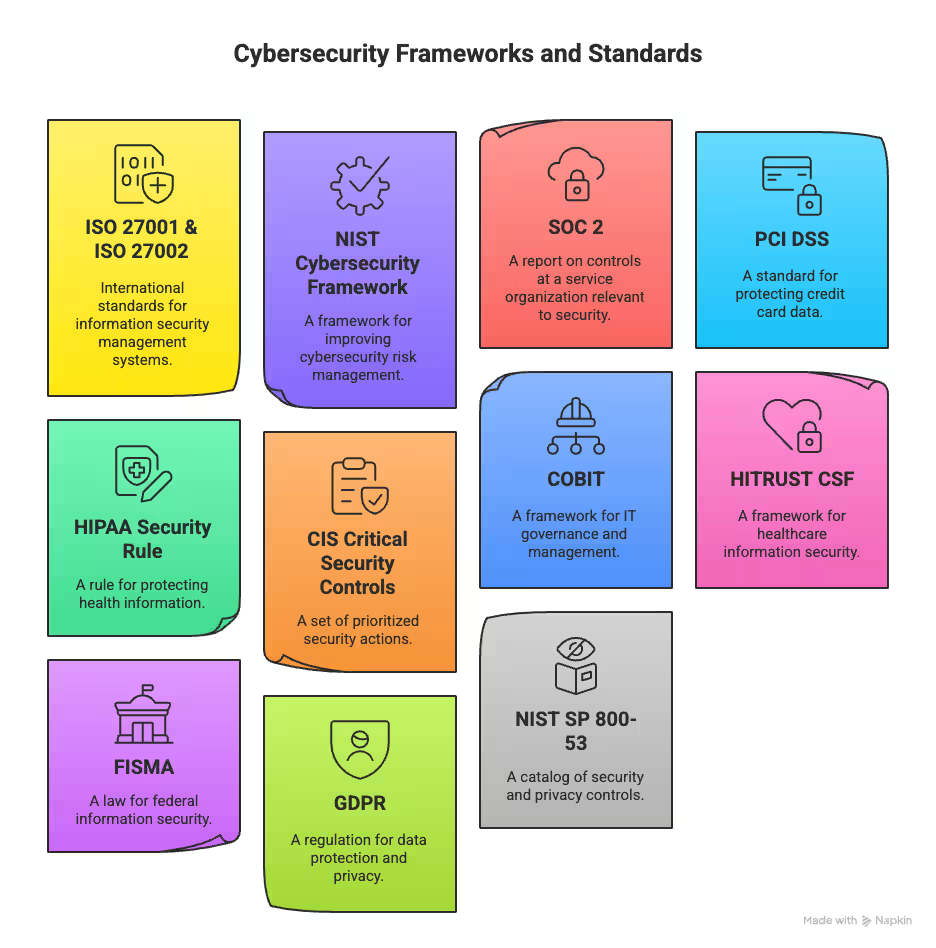
Together, these cybersecurity standards and frameworks define how security is planned, implemented, measured, and improved.
1. ISO 27001 and ISO 27002
ISO 27001 is the international standard for building and maintaining an Information Security Management System. It defines the requirements your organization must meet to achieve certification, meaning that the organization is capable of storing data it owns and handles.
ISO 27002 supports ISO 27001 as an implementation guide. It provides detailed guidance on the 93 controls that organizations can select based on their specific risk profile, organized across organizational, people, physical, and technical domains.
ISO 27001 is certifiable through accredited third-party auditors. Certification involves a two-stage audit followed by ongoing surveillance audits to confirm the ISMS continues to function as intended. For companies selling into enterprise markets globally, ISO 27001 certification is often a baseline expectation rather than a differentiator.
2. NIST Cybersecurity Framework (NIST CSF)
The NIST Cybersecurity Framework was originally developed for critical infrastructure sectors but has become one of the most widely adopted security frameworks across industries globally. It provides a risk-based approach to managing cybersecurity, organized around five core functions: Identify, Protect, Detect, Respond, and Recover.
What makes NIST CSF useful is its flexibility. It doesn't prescribe specific controls or technologies. Instead, it gives organizations a structured way to assess their current security posture, identify gaps, and prioritize improvements based on their specific risk environment and business priorities.
NIST CSF is not certifiable, but many organizations use it as the backbone of their security program and reference it in customer conversations and vendor assessments. Version 2.0, released in 2024, expanded its scope beyond critical infrastructure and added a sixth function, Govern, to address organizational accountability and strategy.
3. SOC 2
SOC 2 is an auditing standard developed by the American Institute of Certified Public Accountants (AICPA) that applies to service providers storing, processing, or transmitting customer data. It evaluates controls against five Trust Service Criteria: security, availability, processing integrity, confidentiality, and privacy.
There are two types of SOC 2 reports. A Type 1 report evaluates whether your controls are designed correctly at a point in time. A Type 2 report evaluates whether those controls have been operating effectively over a defined period, typically six to twelve months. Enterprise customers almost always ask for Type 2 because it demonstrates sustained operational security.
For SaaS companies and cloud service providers, SOC 2 has become a standard commercial requirement. Many enterprise procurement processes won't advance without it, which makes it less of a compliance exercise and more of a business enabler for companies selling into that market.
4. PCI DSS
[PCI DSS](https://www.uprootsecurity.com/blog/pci-compliance-certification-guide (Payment Card Industry Data Security Standard) applies to any organization that processes, stores, or transmits payment card data. It was developed by the major card networks, including Visa, Mastercard, and American Express, and compliance is enforced through those networks rather than a government body.
The standard covers twelve requirement areas including network security, access control, encryption, vulnerability management, monitoring, and incident response. PCI DSS 4.0, which became mandatory in 2024, introduced stricter requirements around multi-factor authentication, password policies, and web application security.
Compliance is validated differently depending on your transaction volume. Large merchants and service providers undergo assessments conducted by a Qualified Security Assessor. Smaller organizations can complete a Self-Assessment Questionnaire. Non-compliance carries financial penalties from the card networks and can result in losing the ability to process card payments entirely, which makes this one of the more consequential standards for any organization in the payment chain.
5. HIPAA Security Rule
The HIPAA Security Rule establishes standards for protecting electronic protected health information (ePHI), ensuring confidentiality, integrity, and availability of healthcare data.
It focuses on administrative, physical, and technical safeguards, including risk assessments, workforce training, access controls, encryption, audit logs, and incident response.
The rule applies to covered entities such as healthcare providers and insurers, as well as business associates that handle ePHI, including vendors and service providers.
HIPAA is not formally certifiable, but compliance is enforceable through audits and assessments. Organizations are expected to demonstrate that controls are implemented, maintained, and regularly reviewed.
By defining clear safeguards and accountability requirements, the HIPAA Security Rule enables structured and measurable protection of healthcare data.
6. CIS Critical Security Controls
CIS Critical Security Controls provide a prioritized set of actions to protect organizations from common cyber threats, helping reduce risk and improve overall security posture.
They focus on practical and actionable measures such as asset inventory, access control, vulnerability management, secure configuration, continuous monitoring, incident response, and malware protection. The controls are organized into 18 groups and can be scaled based on an organization’s size, risk profile, and available resources.
CIS Controls are applicable across industries and are designed to align security efforts with real-world risks and business priorities. Their structured approach helps teams focus on the most important areas first rather than spreading efforts too thin.
CIS Controls are not formally certifiable, but adherence is evaluated through audits and self-assessments. Organizations use them to measure security effectiveness and track progress over time.
By prioritizing high-impact actions, CIS Controls turn security into a set of clear, measurable, and repeatable practices.
7. COBIT
COBIT (Control Objectives for Information and Related Technologies) is a governance framework that helps organizations manage IT risk, ensure compliance, and align IT processes with business objectives.
It focuses on governance and management practices, covering areas such as risk management, performance measurement, policy enforcement, and process monitoring. COBIT provides structured control objectives that help organizations evaluate and improve how IT supports business goals.
COBIT is applicable to organizations of any size that rely on IT for operations. Its flexible structure allows it to scale across industries and varying levels of organizational maturity.
COBIT itself is not certifiable, but organizations assess governance maturity through audits and self-assessments. These evaluations provide measurable insights into how effectively IT risks are managed and controlled.
By defining clear governance structures and performance metrics, COBIT enables organizations to manage IT in a structured, auditable, and business-aligned way.
8. HITRUST CSF
HITRUST CSF is a certifiable framework that combines multiple security, privacy, and regulatory requirements into a single, prescriptive standard for managing risk.
It integrates controls from frameworks such as HIPAA, ISO, and NIST, covering areas like access control, data protection, risk management, and incident response. The framework is structured into domains that support continuous monitoring, assessment, and improvement.
HITRUST CSF is commonly used in healthcare and other regulated industries that handle sensitive data, including ePHI. Its scalable approach allows organizations to apply controls based on their size, complexity, and risk profile.
Compliance is validated through formal certification conducted by HITRUST-approved assessors. Certification provides measurable assurance of security and privacy controls and is often used to demonstrate trust to customers and partners.
By consolidating multiple requirements into a single framework, HITRUST CSF simplifies compliance and enables structured, auditable security practices.
9. FISMA
FISMA (Federal Information Security Management Act) establishes a framework for protecting U.S. federal government information systems, operations, and data against cybersecurity threats.
It aligns with NIST standards and focuses on risk-based controls such as access management, incident response, continuous monitoring, and contingency planning. It also requires security categorization and formal system authorization.
FISMA applies to federal agencies and contractors that handle government data. It ensures that information systems meet defined security requirements and are continuously monitored for risk.
Compliance is enforceable through audits and federal oversight, with agencies required to report on their security posture. These assessments provide measurable insights into risk management effectiveness and accountability.
By standardizing how federal systems are secured and evaluated, FISMA enables structured, auditable, and enforceable cybersecurity practices.
10. GDPR
GDPR (General Data Protection Regulation) is legal framework that governs how organizations collect, process, and protect the personal data of EU residents.
It focuses on privacy and data protection through requirements such as data mapping, consent management, access controls, breach notification, and data minimization. It also emphasizes accountability and proper handling of personal data throughout its lifecycle.
GDPR applies to any organization that processes the personal data of EU citizens, regardless of where the organization is based. It covers both data controllers and processors across industries.
GDPR is not certifiable, but compliance is enforceable through regulatory audits and penalties. Organizations must demonstrate that appropriate controls are in place to protect personal data and uphold user rights.
By defining clear rules for data protection and accountability, GDPR ensures that privacy is managed in a structured and enforceable way.
11. NIST SP 800-53
NIST SP 800-53 provides a comprehensive set of security and privacy controls for federal information systems and organizations, supporting risk management and data protection.
It organizes controls into families covering areas such as access control, audit and accountability, incident response, and system protection. These controls span technical, operational, and management safeguards and support continuous monitoring and improvement.
NIST SP 800-53 is primarily used by federal agencies and organizations that manage sensitive data. Its flexible structure allows controls to be selected based on system sensitivity and risk level.
Compliance is assessed through formal evaluations and audits, which measure how effectively controls are implemented and maintained. These assessments provide assurance of security and privacy practices.
By offering a detailed control catalog, NIST SP 800-53 enables organizations to implement structured, measurable, and risk-based security programs.
With these 11 frameworks covered, here’s a quick cybersecurity frameworks comparison to highlight their scope, focus, and certification approach at a glance.
| Framework | Scope | Focus | Certification / Audit |
|---|---|---|---|
| ISO 27001 & ISO 27002 | Organizations of any size/industry | ISMS, risk management, governance | ISO 27001 certifiable; audits & surveillance |
| NIST CSF | Cross-industry, critical infrastructure | Cyber risk management, continuous improvement | Not certifiable; maturity assessments |
| SOC 2 | Service providers handling customer data | Trust criteria: security, availability, integrity, confidentiality, privacy | Certifiable via third-party audit |
| PCI DSS | Payment card processors | Cardholder data security | Auditable and certifiable; QSA validation |
| HIPAA Security Rule | Healthcare entities and business associates | ePHI protection, administrative/technical safeguards | Compliance enforceable via audits; not certifiable |
| CIS Controls | Organizations of all sizes | Prioritized cybersecurity actions | Not certifiable; adherence via audits/self-assessments |
| COBIT | Organizations using IT for business operations | IT governance, risk, performance | Not certifiable; governance maturity assessed |
| HITRUST CSF | Healthcare & regulated industries | Risk, compliance, privacy, security | Certifiable via HITRUST assessors |
| FISMA | Federal agencies & contractors | Federal IT security, risk management | Compliance enforced via audits/oversight |
| GDPR | Organizations processing EU personal data | Data privacy, protection, accountability | Not certifiable; compliance enforceable via audits |
| NIST SP 800-53 | Federal agencies & sensitive systems | Security & privacy controls, risk management | Compliance assessed via formal audits/evaluations |
Use this as your cheat sheet. Pick what fits your situation, not what sounds impressive on paper.
The Bottom Line: Stop Playing Security Roulette
Choosing the right cybersecurity frameworks is about building a security program that works under real conditions. Each framework serves a specific purpose. ISO 27001 supports broad security governance, NIST CSF provides a flexible risk-based model, SOC 2 enables trust with customers, PCI DSS secures payment data, and HIPAA governs healthcare information.
Most organizations don’t rely on just one. They combine frameworks based on the data they handle, the markets they operate in, and what customers and regulators expect. Used together, these frameworks create structure, improve visibility into risk, and provide a clear record of how security is implemented and maintained.
Ignoring them introduces gaps that only surface during audits or incidents. Regulatory penalties, lost deals, and reputational damage are common outcomes when security lacks structure.
Security programs require ongoing evaluation. Teams need to assess their posture, identify gaps, and validate that controls are working as intended.
Uproot Security helps organizations test and validate their security controls through pentesting and continuous assessment.
- Connect with 100+ cloud services to automatically gather and organize evidence.
- Ready-to-Use Policy Templates. Our library of customizable policies aligns perfectly with ISO 27001 requirements.
- Map controls across ISO, SOC 2, and more to avoid double work.
→ Book a demo today with Uproot Security and stay compliant without the hassle of extra paperwork.