Cyber Security Risk Assessment: Definition, Steps & Framework

Robin Joseph
Senior pentester

Cyber security risk assessment isn’t a checkbox anymore. It’s survival.
Businesses now face an average of 1,130 cyber attacks every single week. That’s not a distant headline—it’s a constant barrage. And while most organizations agree that threats are rising, many still don’t know where they’re actually vulnerable.
Here’s the hard truth: 60% of small businesses shut down within six months of a major cyber attack. Not because they didn’t care. But because they didn’t see it coming.
Threats don’t break in through the front door. They slip through misconfigurations, forgotten assets, excessive permissions, and third-party gaps no one bothered to assess. Without a clear view of what you own, what’s exposed, and what matters most, security becomes guesswork.
A well-executed cyber security risk assessment replaces guesswork with clarity. It turns scattered risks into measurable priorities and helps you make decisions based on impact—not fear. Because in 2025, the question isn’t whether you’ll be targeted. It’s whether you’ll be prepared.
Understanding Cyber Security Risk Assessment
Cyber security risk assessment isn’t a checklist exercise. It’s a structured way to understand what could realistically disrupt your business—and how badly.
At its core, it’s the process of identifying, analyzing, and prioritizing threats and vulnerabilities across your IT environment. This means examining your systems, applications, data, and third-party connections to uncover weak points attackers could exploit.
Think of it as your organization’s security compass. You start by identifying critical assets. Then you evaluate the threats targeting them, the vulnerabilities that expose them, and the potential impact if something goes wrong. Risk stops being abstract and starts becoming measurable.
According to NIST, the goal of a risk assessment is to inform decision-makers by identifying relevant threats, internal and external vulnerabilities, potential harm, and the likelihood of that harm occurring. In simple terms, it replaces assumptions with evidence—so security decisions are driven by impact, not fear.
Why Are Cyber Security Risk Assessments Important?
The threat landscape isn’t slowing down—it’s accelerating. Cloud expansion, AI-powered attacks, and growing third-party dependencies mean your attack surface evolves faster than most teams can track. Ignoring risk doesn’t pause it. It compounds it.
The global average cost of a data breach has reached USD 4.88 million. For many organizations, that’s not just a financial setback—it’s operational disruption, customer distrust, and long-term reputational damage. Regular cyber security risk assessments help identify weak points early, reducing the chances of costly incidents and prolonged downtime.
They also strengthen resilience. Organizations that assess risk consistently experience fewer surprises because they understand where their critical assets are and how they could be exploited. That clarity drives smarter security investments and faster response times.
Beyond protection, risk assessments support compliance with standards like HIPAA and PCI DSS. They reduce legal exposure, financial penalties, and regulatory scrutiny. You can’t control what you don’t measure—and risk assessments make security measurable.
What Makes a Cyber Security Risk Assessment Effective?
A cyber security risk assessment is only as strong as the foundation behind it. Follow a process without structure, and you get reports. Build it on the right components, and you get defensible, repeatable risk management.
These are the core elements that make a cyber security risk assessment truly effective:
- Governance and Executive Alignment
- Defined Risk Scoring Methodology
- Comprehensive Documentation
- Cross-Functional Stakeholder Involvement
- Continuous Review and Improvement
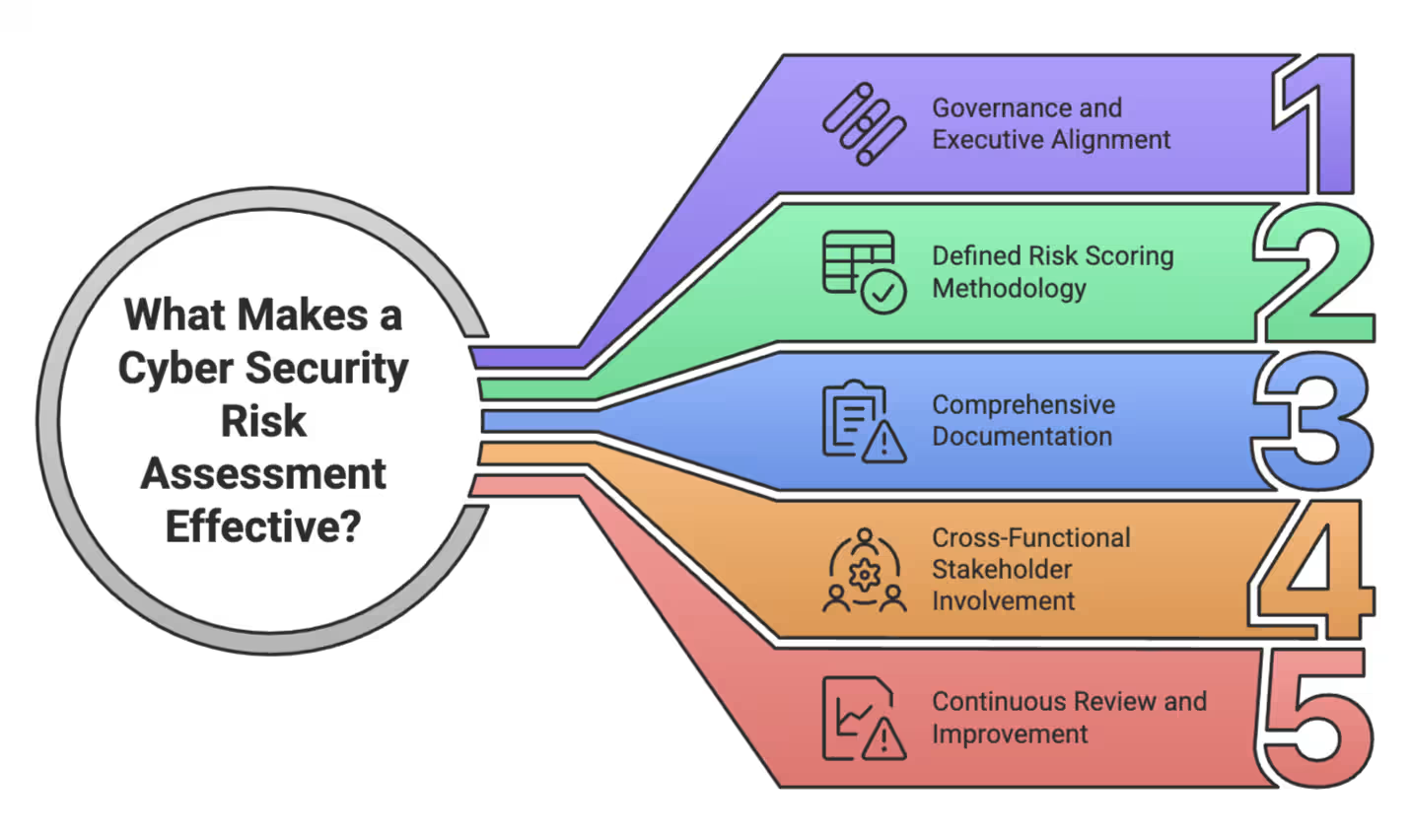
Let’s break each of these down in detail.
1. Governance and Executive Alignment
Strong risk management starts at the top. Governance ensures accountability and decision-making authority are clearly defined, making risk assessment a true business priority.
- Define risk ownership and approval authority across teams
- Establish reporting lines to executives and board stakeholders
- Align remediation priorities with overall business strategy
With leadership aligned, risk assessment becomes an organizational priority—not just a security task.
2. Defined Risk Scoring Methodology
Consistency builds credibility. A structured scoring model ensures risks are evaluated uniformly across teams and assessment cycles.
- Use qualitative, quantitative, or hybrid scoring models
- Clearly define impact and likelihood criteria
- Document assumptions and evaluation logic
A clear methodology transforms subjective opinions into measurable, actionable insights.
3. Comprehensive Documentation
Clarity depends on thorough records. Documentation preserves context, rationale, and evidence for every identified risk and decision.
- Record all identified risks, scores, and prioritization outcomes
- Document mitigation strategies and residual risk
- Maintain audit-ready evidence for compliance
Documentation ensures assessments are defensible, repeatable, and usable for long-term planning.
4. Cross-Functional Stakeholder Involvement
Cyber risk affects more than IT. Engaging multiple teams ensures risks reflect operational and business realities.
- Include finance, legal, operations, and compliance teams
- Validate business impact assumptions
- Align mitigation efforts with operational realities
Broad participation ensures risk insights are grounded in real-world processes.
5. Continuous Review and Improvement
Risk is dynamic, so assessments must evolve. Continuous review keeps defenses relevant and effective.
- Schedule periodic reassessments
- Update scoring models as threats evolve
- Refine controls and response strategies
Ongoing improvement turns risk assessment from a one-time task into a lasting organizational advantage.
How to Perform a Cyber Security Risk Assessment?
A cyber security risk assessment isn’t something you improvise. It’s a structured process. Skip steps, and you create blind spots. Follow a clear methodology, and you create control.
Here’s how to perform a cyber security risk assessment effectively:
- Define Scope and Objectives
- Identify and Document Assets
- Identify Threats and Vulnerabilities
- Analyze Risk Impact and Likelihood
- Prioritize and Treat Risks
- Document Findings and Monitor Continuously
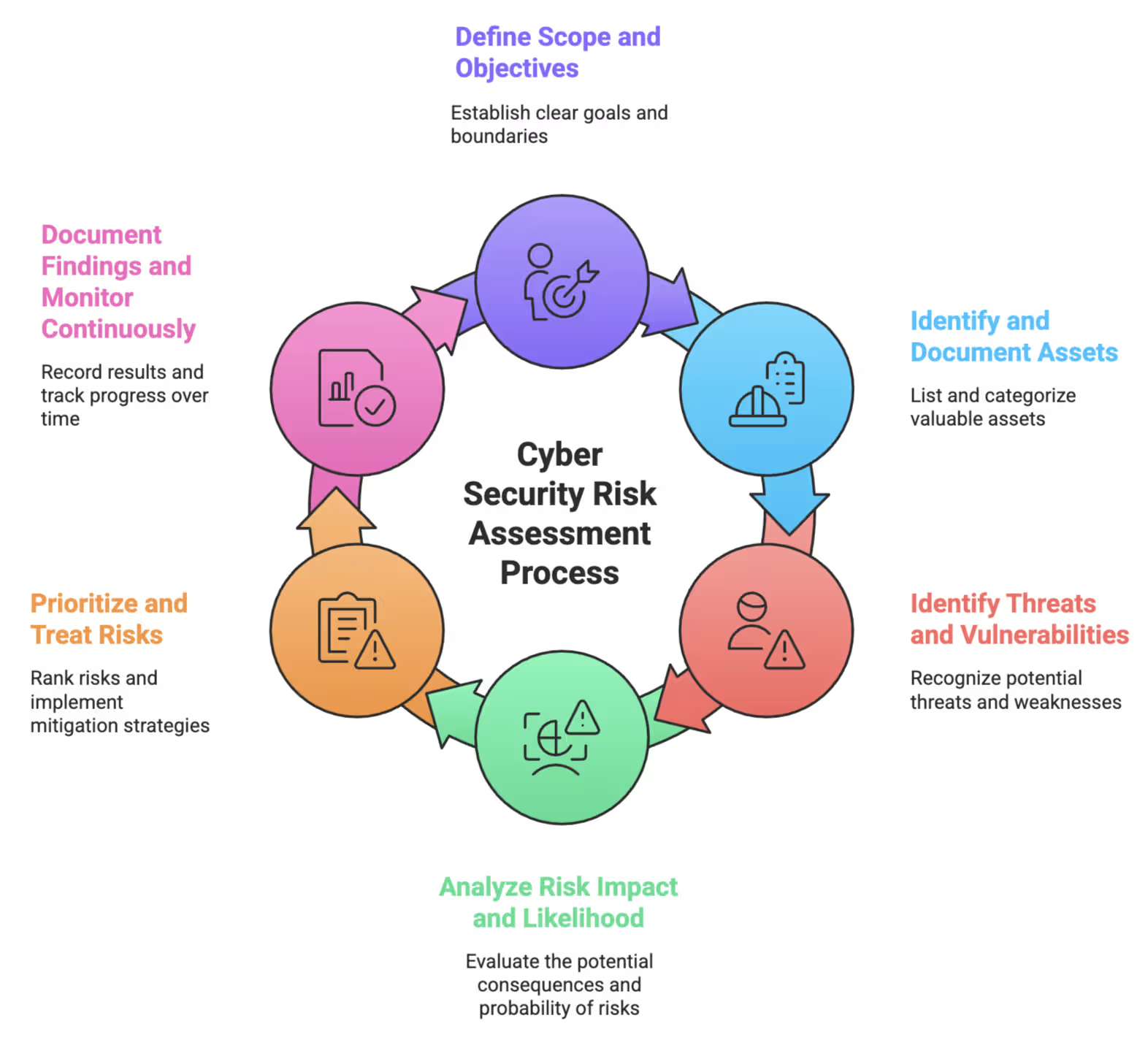
Let’s break this down step by step.
1. Define Scope and Objectives
Before scanning anything, clearly define what you’re assessing and why it matters to the business.
- Determine assessment boundaries (systems, locations, departments)
- Align objectives with business goals and compliance requirements
- Identify stakeholders and decision-makers across technical and leadership teams
Clear scope prevents wasted effort, reduces confusion, and keeps the assessment focused on what truly matters.
2. Identify and Document Assets
Visibility comes next. You need a complete, accurate record of what exists in your environment today.
- Catalog hardware, software, cloud services, and third-party integrations
- Identify sensitive data and map data flows across systems
- Classify assets by business criticality and operational dependency
Without accurate documentation, risk analysis becomes fragmented, unreliable, and strategically incomplete.
3. Identify Threats and Vulnerabilities
Now examine how assets could realistically be compromised in your current threat landscape.
- Conduct vulnerability scans and configuration reviews across environments
- Identify external threats like ransomware, phishing, and DDoS attacks
- Evaluate internal risks such as excessive access or weak processes
This stage connects potential attackers directly to exploitable weaknesses inside your infrastructure.
4. Analyze Risk Impact and Likelihood
Not every vulnerability is urgent. You must measure risk with context and discipline.
- Estimate financial, operational, and reputational consequences of exploitation
- Evaluate likelihood based on exposure and existing security controls
- Consider impact on confidentiality, integrity, and availability of systems
This transforms technical findings into clear, defensible business language leadership.
5. Prioritize and Treat Risks
You can’t fix everything at once, especially with limited security resources.
- Rank risks by severity, probability, and potential business disruption
- Select mitigation strategies — reduce, transfer, accept, or avoid
- Implement technical and administrative controls with clear accountability
Action is what turns assessment into measurable, sustained protection.
6. Document Findings and Monitor Continuously
Risk assessment isn’t one-and-done. It’s an ongoing governance discipline.
- Record findings, decisions, and detailed remediation plans
- Track progress and assign ownership to responsible teams
- Schedule regular reassessments aligned with infrastructure or threat changes
Threats evolve. Your assessment process must continuously evolve with them.
Common Cybersecurity Risks and Threats
You can’t assess risk in isolation — only against real threats. Cyber risks are active, automated, and evolving. Most breaches don’t require zero-days; they exploit basics like weak passwords, misconfigurations, excessive permissions, and unpatched systems.
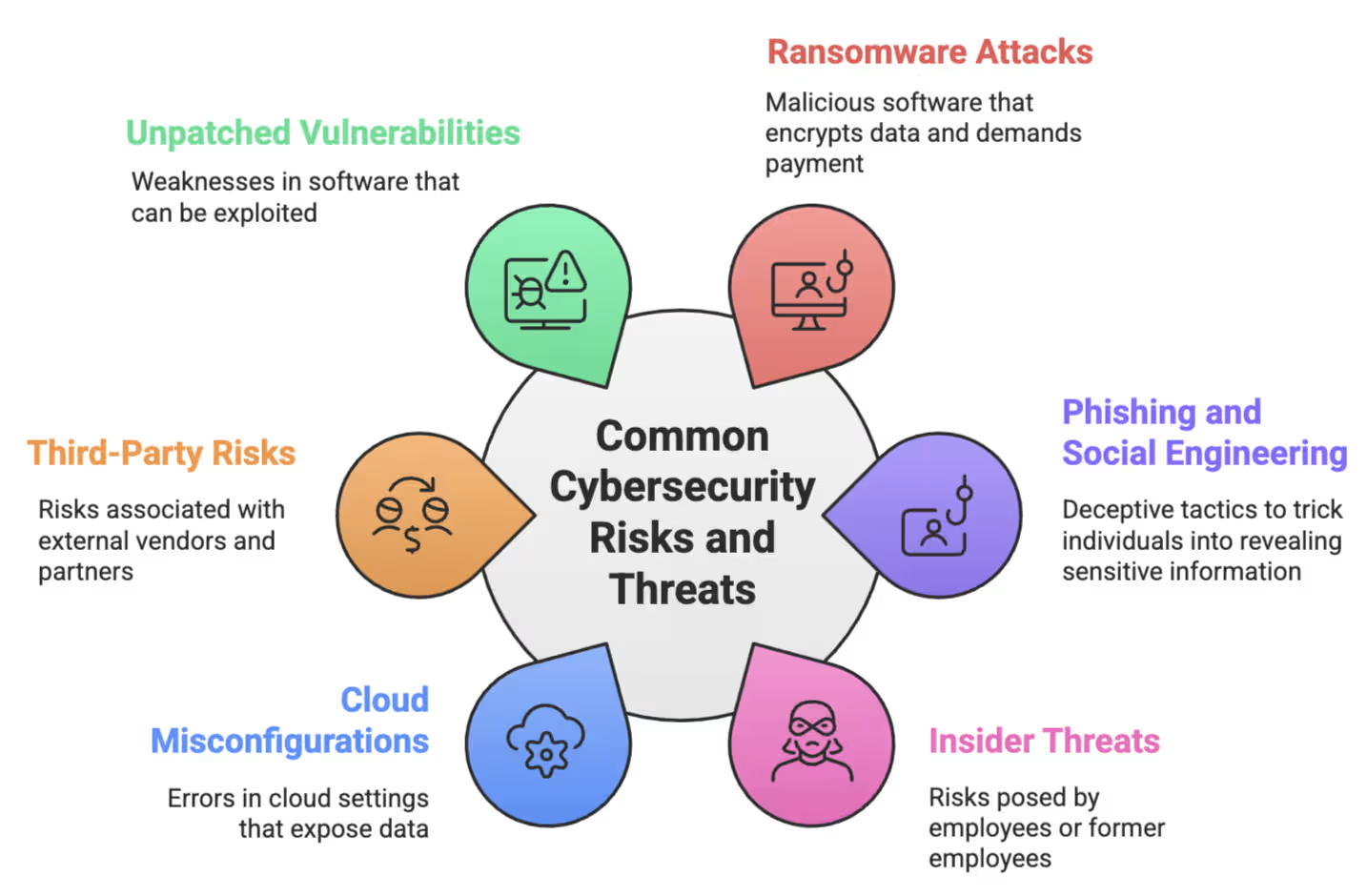
Here are the most common cybersecurity risks and threats organizations face today:
1. Ransomware Attacks
Ransomware remains one of the most disruptive threats. Attackers encrypt critical systems and demand payment, often halting operations entirely. Modern ransomware doesn’t just lock files — it exfiltrates data first, increasing pressure through double extortion. Downtime, regulatory penalties, and reputational damage quickly follow.
2. Phishing and Social Engineering
Humans remain the most exploited vulnerability in any organization. Phishing emails, fake login portals, business email compromise, and impersonation scams trick employees into revealing credentials or approving fraudulent transactions. AI-generated messages now mimic tone and context convincingly, making detection harder and attacks more scalable.
3. Insider Threats
Not every breach starts outside the perimeter. Employees, contractors, and vendors with legitimate access can intentionally misuse data or accidentally expose it. Excessive privileges, lack of monitoring, and weak offboarding processes increase the likelihood of insider-driven incidents that often go unnoticed for months.
4. Cloud Misconfigurations
Cloud infrastructure introduces flexibility — but also complexity. Misconfigured storage buckets, publicly exposed APIs, weak IAM policies, and poor access governance create silent entry points. Many modern breaches occur not because of sophisticated exploits, but because basic cloud security configurations were never properly hardened.
5. Third-Party and Supply Chain Risks
Your organization inherits the vulnerabilities of its vendors. Compromised SaaS providers, software updates, managed service partners, or outsourced developers can become indirect gateways into your systems. Supply chain attacks are attractive to adversaries because one compromise can impact hundreds of downstream organizations.
6. Unpatched Vulnerabilities
Threat actors continuously scan the internet for outdated systems and known exploitable flaws. When patches are delayed, ignored, or inconsistently applied, attackers gain predictable access paths. Many high-profile breaches trace back to vulnerabilities that had fixes available long before exploitation occurred.
Understanding these threats gives context to your risk assessment. Because you’re not preparing for “something.” You’re preparing for very specific, very real attack patterns.
Benefits of Cyber Security Risk Assessment
A cyber security risk assessment isn’t just about avoiding worst-case scenarios. It’s about building control, clarity, and confidence into how your organization operates. When structured correctly, it becomes a strategic asset — not just a security activity.
Clear Visibility Into Your Risk Landscape
Most organizations operate with partial visibility. A formal risk assessment eliminates assumptions by documenting assets, exposures, dependencies, and vulnerabilities in one structured view. Instead of reacting to scattered alerts, you gain a mapped risk landscape tied directly to business impact. That clarity changes how decisions are made.
Smarter Allocation of Security Resources
Budgets are finite. Time is limited. Without prioritization, teams chase low-impact issues while critical risks remain unresolved. A cyber security risk assessment ranks vulnerabilities by likelihood and potential damage, ensuring investments are directed where they reduce meaningful risk — not just technical noise.
Reduced Probability of Costly Incidents
Identifying weaknesses early significantly lowers the chance of breaches, ransomware disruptions, regulatory penalties, and prolonged downtime. Prevention is operationally cheaper than recovery. By addressing gaps before they’re exploited, organizations avoid financial loss and reputational damage that can take years to rebuild.
Stronger Compliance and Audit Readiness
Regulatory frameworks increasingly demand documented risk management practices. A structured assessment demonstrates due diligence and supports alignment with standards such as ISO 27001, NIST, HIPAA, and PCI DSS. This reduces legal exposure while strengthening trust with customers and partners.
Improved Operational Resilience
Understanding critical systems and their dependencies improves incident response and business continuity planning. When disruptions occur, organizations with documented risk insights recover faster and contain impact more effectively.
Executive-Level Decision Support
Perhaps most importantly, a cyber security risk assessment translates technical findings into business language. Leadership gains measurable data to guide digital transformation, vendor selection, expansion strategies, and long-term investment decisions.
Risk assessment isn’t just about protection. It’s about enabling secure, sustainable growth.
Turning Cyber Risk Into Business Strength
Cyber security risk assessment isn’t optional anymore. It's an operational discipline. In an environment where threats evolve daily and digital footprints expand without warning, guessing is dangerous. You either measure your exposure deliberately — or discover it painfully.
Threats are faster. Attack surfaces are wider. Dependencies are deeper. Hoping your controls are “good enough” isn’t a strategy — its exposure. A structured risk assessment forces you to confront weaknesses before attackers do, on your terms, not theirs.
When done right, it replaces assumptions with evidence. You gain visibility into critical assets, fragile processes, and real business impact. Instead of reacting to incidents, you start preventing them. Instead of spreading resources thin, you prioritize what actually reduces risk.
More importantly, risk assessment connects security to strategy. It supports compliance, protects revenue, strengthens resilience, and equips leadership with defensible data. Because the question isn’t whether threats exist — it’s whether you understand your exposure well enough to control it.
Risk & Vendor Management