AICPA · Trust Services Criteria · Type I & Type II
FRAMEWORKSOC 2 is an audit report, issued by a licensed CPA firm, describing how you protect customer data against the AICPA's Trust Services Criteria. Security is the only required criterion.
Median time to readiness: 38 days
Big-Four and boutique auditors supported
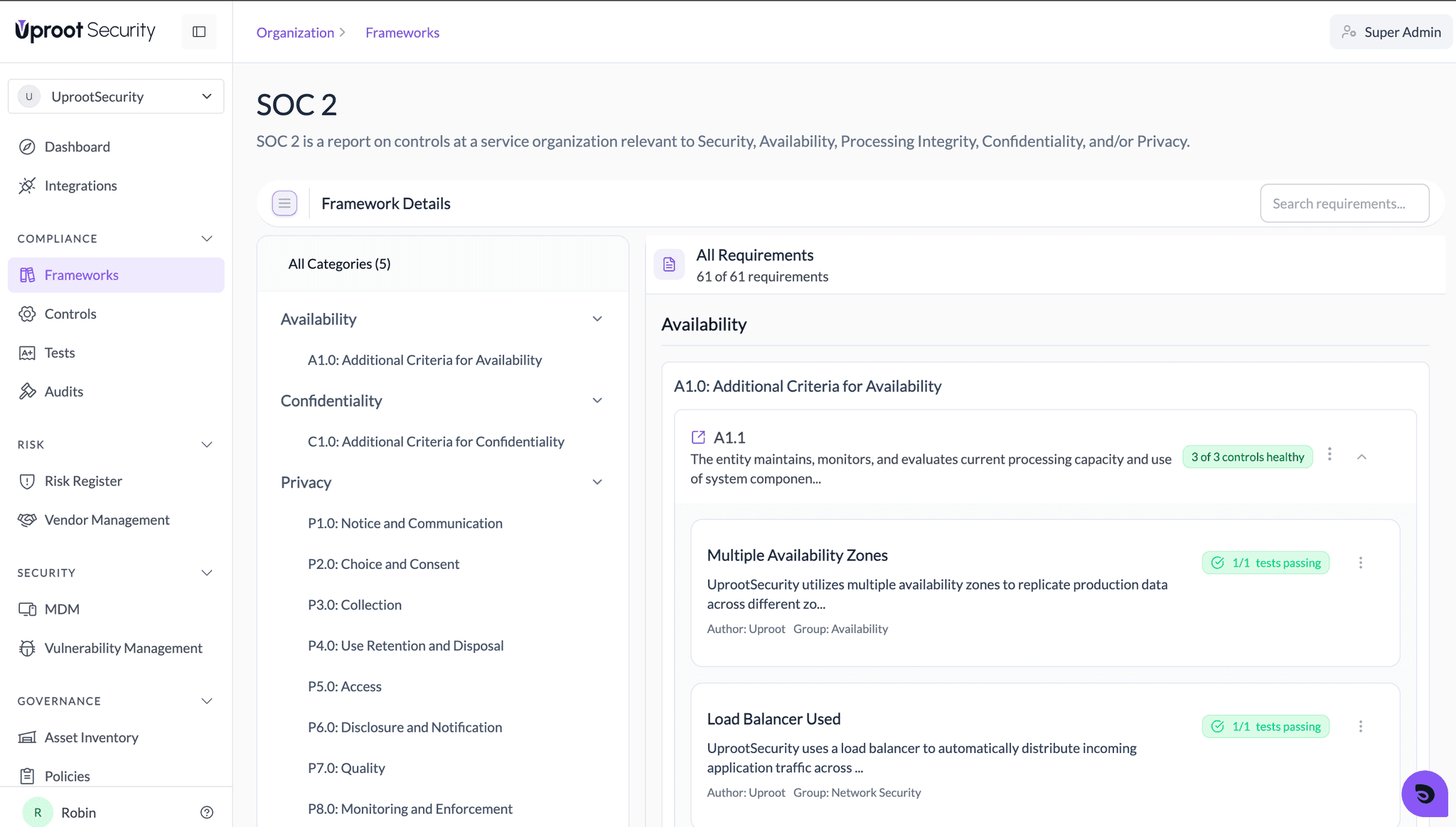
Trust Services Criteria
5Security is required. Availability, Confidentiality, Processing Integrity, and Privacy are scoped to fit.
Common Criteria controls
33/ 61CC1 through CC9. The same controls every SOC 2 report carries Uproot ships them pre-mapped.
Type II observation
3–12monthsWe default to 3 months for your first Type II. Continuous evidence makes it cheap to extend.
Authority
AICPASSAE-18 attestation, performed by a licensed CPA firm. Not a certification.
Renewal cadence
AnnualMost enterprise customers expect a current Type II report (≤ 12 months old) on request.
Security is the only required category. The rest Availability, Confidentiality, Processing Integrity, Privacy are opt-in.
Security
Access, change management, risk, and incident response the Common Criteria behind every SOC 2 report.
Availability
Capacity, monitoring, and recovery whether customers can reach the product, and what happens when they can't.
Confidentiality
Confidential customer data protected at rest, in transit, and through secure disposal.
Processing Integrity
Processing that's complete, accurate, timely, and authorized for billing, transaction, and pipeline products.
Privacy
Personal information handled per a stated privacy notice and the GAPP framework.
A real timeline from a real Series-B customer. Most teams move faster after the first one.
Day 0 · Mon
Connect 6 systems
OAuth or service account in your terminal. AWS, Okta, GitHub, Jamf, Datadog online in under an hour.
Day 1 · Tue
Auto-map controls
Uproot maps 61 SOC 2 controls against what your stack already enforces. Day-one readiness: typically 60–70%.
Day 2–14
Close real gaps
Findings are issued as tickets to the right team, with the diff. Engineering closes them; policies follow, not lead.
Day 15–38
Audit-ready
Posture is provable. Auditor is invited to a read-only portal. Type I report can be issued here, if you need one.
Day 38 → 128
Observation
3-month Type II window starts. Evidence accumulates on autopilot. You ship product; we collect proof.
Day ~145
Report delivered
Auditor issues the SOC 2 Type II. You ship it to the customer who asked. Then it just keeps running.
Spreadsheet of 61 controls maintained by hand, drifting from your stack by the day
Screenshots from the IdP, the cloud console, the MDM. Re-collected every quarter, every renewal, every prospect.
An engineer-week per month donated to compliance prep and a panicked one before the auditor’s site visit
A 90-day Type II readiness sprint that takes 9 months and consumes a quarter’s roadmap
Controls are computed from your real systems, recomputed every 15 minutes
Evidence is API-pulled, hashed, and timestamped auditor reads from the portal, never your inbox
Findings ship as tickets to the right team, with the resource, the diff, and the rollback path
First Type II in under five months end-to-end; renewals take a week of attention
A Type II report rests on ~1,800 evidence artifacts directional, from the Uproot customer survey, 2025 · 12-company reference set, not a guarantee. Here is a partial map of which system owns each one, and what Uproot pulls from it.
Logical access
Okta · MFA enrollment
312
Okta · session policy
1
AWS · IAM role-trust
14
GitHub · org members + SSO
84
Jamf · device posture
198
Operations
Datadog · prod monitors
218
PagerDuty · on-call rotation
12w
Sentry · error budget
99.94%
Statuspage · incident log
3 / yr
AWS GuardDuty · findings
live
Change management
GitHub · PR approval trail
14 / d
GitHub · branch protection
main
CircleCI · deploy log
live
Linear · change tickets
132 / q
Terraform Cloud · plan diff
live
Vendor & risk
Vanta-migrate · vendor inventory
42
Snowflake · DPA + SOC 2
on file
Jira · risk register
28
Stripe · PCI subprocessor
linked
Only a licensed CPA firm can issue a SOC 2 report. Independent firms typically move faster and cost less than the largest practices, and the report carries identical weight the opinion is what your customer reads, not the letterhead. Uproot is auditor-agnostic bring yours, or pick from the network below.
Auro Security
CPA FIRM
Atom Audit
CPA FIRM
Cert Pro
CPA FIRM
Johanson Group
CPA FIRM
Prescient Security
CPA FIRM
Tempo audits
CPA FIRM
A-lign
CPA FIRM
MJD Advisors
CPA FIRM
Attinkom
CPA FIRM
Darata
CPA FIRM
Glocert
CPA FIRM
+ 23 more
on request
15 articles
SOC 2 readiness, audit process, Type I vs Type II, controls and auditor selection.
No. Type I is a point-in-time attestation useful if a customer needs proof now and you don't have an observation window yet. If you can wait for a Type II (3-month minimum), skip Type I. About 60% of our customers go straight to Type II.
Three months is the AICPA-acceptable minimum. We default to it. After your first report, most teams extend to a rolling 12-month window because continuous evidence makes it free.
SOC 2 is a US attestation report; ISO 27001 is an international certification. They share roughly 70% of their controls. Uproot maps them against the same underlying evidence implementing one buys you most of the other.
Yes. Evidence is pulled from the source system, hashed with SHA-256, timestamped, and stored immutably. Auditors get the population, sample selection, and chain of custody what they’d ask for anyway, only without the email back-and-forth.
Uproot imports your existing controls, policies, evidence library, and vendor inventory overnight. Most migrations from Vanta or Drata complete in a single weekend, with cryptographic continuity.
Uproot for SOC 2 starts at $8k / year for a single entity, single framework, up to 200 employees. Auditor fees are separate and paid to the CPA firm directly typically $15k–$35k for a first Type II. We don't take a cut.
Connect your first system in five minutes. See your real readiness by lunch. Invite the auditor when you're ready they'll have nothing left to ask for.
