PII, PHI, and PCI: Essential Differences for Data Protection

Robin Joseph
Senior Security Consultant
Ever notice how every breach headline feels worse than the last? Organizations now lose an average of $3.92 million when payment data is exposed — and 2024 turned PII, PHI, and PCI breaches into a full-blown epidemic.
AT&T’s March incident exposed data from 73 million customers. Dell followed with 49 million records leaked. Bank of America? A ransomware attack revealed Social Security numbers and credit card details for over 57,000 customers. Healthcare isn’t safe either — one-third of hospitals reported ransomware, phishing, or PHI theft last year.
This isn’t just an acronym quiz. Knowing the difference between PII, PHI, and PCI determines how you protect the data your business depends on. Yet 87% of organizations know it matters, and only 56% classify these data types correctly.
Understanding what PII, PHI, and PCI stand for isn’t optional. Let’s break down each category, decode compliance rules, and show how to keep your systems — and your customers — safe from the next breach.
What Does PII Stand For and Why Does It Matters?
PII stands for Personally Identifiable Information – basically any data that can point back to a specific person, either by itself or when you mix it with other info. The PII acronym gets thrown around a lot, but most businesses underestimate how broad it actually is.
Sounds simple, right? Nope. Here's where it gets tricky.
What PII Includes: Common Identifiers and Sensitive Data
PII comes in two flavors, and most people only think about one:
- Direct identifiers: These scream "Hey, this is John Smith!" (passport numbers, driver's license, SSN)
- Indirect identifiers: Sneaky stuff that seems harmless alone (age, ZIP code, gender)
Ever wondered how risky “harmless” identifiers can be? Just gender, ZIP code, and birth date can identify 87% of US citizens.
Businesses rely on PII, but one mistake can expose millions of records, wiping out years of trust in seconds.
Sensitive vs Non-sensitive PII
Here's what can really hurt you if it gets out:
- Social Security numbers and government IDs
- Financial account information
- Biometric data (fingerprints, retinal scans)
- Medical records
Then there's non-sensitive PII – names, phone numbers, ZIP codes. Seems harmless, right?
Wrong. Context changes everything.
Your name on a business card? No big deal. Your name on a clinic's HIV patient list? Now we're talking sensitive territory.
PII Compliance Under GDPR and CCPA
GDPR keeps it broad: "any information relating to an identified or identifiable natural person." They want you protecting everything – even political opinions and physical characteristics.
CCPA casts an even wider net covering:
- Direct identifiers (real name, email address)
- Indirect identifiers (unique identifiers, usernames)
- Biometric data
- Geolocation data
- Protected class data
Examples of PII in Business Operations
Your business handles PII everywhere:
- Customer data: Names, contact details, payment info
- Employee records: SSNs, health records, payroll details
- Supplier information: Business contacts, contracts
Here's the truth: most companies keep sensitive personal information in their files. Protecting it isn't just about compliance checkboxes – it's about staying in business.
Because without proper safeguards, PII becomes a weapon for fraud, identity theft, and financial disasters.
What Does PHI Stand For?
PHI stands for Protected Health Information — the most tightly controlled category of personal data in healthcare, regulated under the Health Insurance Portability and Accountability Act (HIPAA). It isn’t just data; it’s the backbone of patient trust and healthcare integrity.
PHI vs PII: Legal and Operational Differences
While PII covers personal information broadly, PHI applies only to health information created, received, maintained, or transmitted by HIPAA-covered entities or their business associates.
- Hospital ECG report? PHI
- Same reading from a smartwatch? PII
Context matters. PHI protections even extend 50 years after death, highlighting the long-term responsibility healthcare organizations carry.
The 18 HIPAA Identifiers That Classify Data as PHI
HIPAA defines 18 identifiers that transform health information into PHI:
- Personal details: Name, address, birth date, phone numbers, email
- ID numbers: Social Security, medical record, health plan, and account numbers
- Digital identifiers: Device IDs, IP addresses, URLs, biometrics
- Visual identifiers: Photos and comparable images
- Other unique traits: Any other number or characteristic identifying a patient
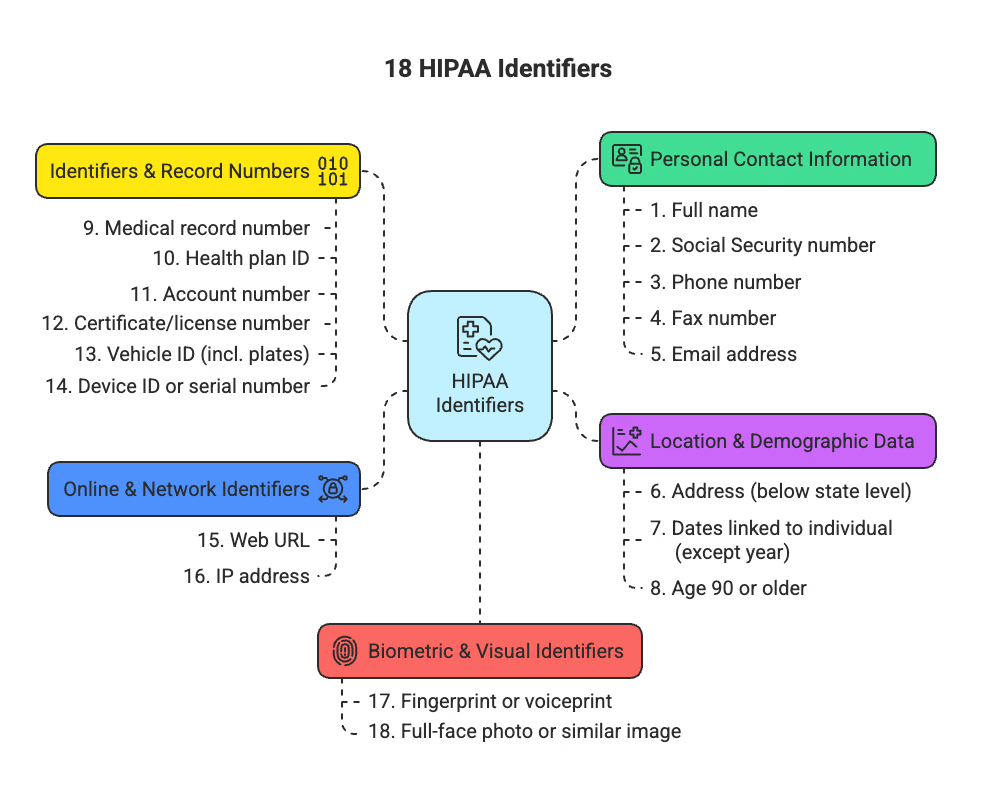
To de-identify data, all 18 identifiers must be removed.
ePHI and Electronic Transmission Rules
Electronic PHI (ePHI) is any PHI stored, received, created, or transmitted electronically. HIPAA protects it with:
- Administrative safeguards: Policies, training, risk assessments
- Physical safeguards: Secured facilities and hardware
- Technical safeguards: Encryption, access controls, audit logs
Paper faxes and phone calls escape ePHI rules if the information never existed digitally.
PHI Compliance Requirements in Healthcare
Healthcare organizations must:
- Keep ePHI confidential, intact, and available
- Protect against foreseeable threats
- Prevent unauthorized access and disclosures
- Ensure workforce compliance through training and controls
Following the HIPAA Privacy Rule restricts PHI sharing and requires patient consent for anything beyond treatment, payment, or healthcare operations.
Proper PHI handling safeguards sensitive information, preserves patient trust, and ensures healthcare operations remain secure.
What Does PCI Stand For?
Credit card fraud? Yep, it’s the #1 type of identity theft. No wonder PCI (Payment Card Industry) data security keeps business owners up at night. The PCI full form — Payment Card Industry — matters because it defines the exact scope of data the standard protects.
Understanding PCI in Data Security
PCI stands for Payment Card Industry — basically, every organization that touches payment card information. The big credit card companies teamed up and formed the PCI Security Standards Council (PCI SSC), creating the PCI Data Security Standard (PCI DSS) to set the baseline for protecting payment data.
Think of PCI DSS as the ultimate rulebook for keeping payment environments secure. But here’s the catch: it’s not enforced by the government. Instead, payment brands and acquirers decide compliance based on contracts with merchants and service providers.
PCI DSS 4.0 Compliance Requirements
PCI DSS 4.0 dropped in March 2022, and it’s tougher than ever. It focuses on six key areas:
- Build and maintain secure networks and systems
- Protect cardholder data
- Maintain vulnerability management programs
- Implement strong access control measures
- Regularly monitor and test networks
- Maintain information security policies
On top of that, organizations now need controls for payment page scripts, automated web application solutions, enhanced monitoring, and targeted risk analysis.
Examples of PCI Data: PAN, CVV, and More
PCI data splits into two buckets:
-
Cardholder Data (CHD)
- Primary Account Number (PAN) — your card number
- Cardholder name
- Expiration date
- Service code
-
Sensitive Authentication Data (SAD)
- Card verification codes (CVV/CVC/CVV2/CID)
- Full magnetic stripe data
- PINs and PIN blocks
Here’s the golden rule: you can store cardholder data if it’s protected properly. Sensitive authentication data? Never store it after authorization — unless you’re the card issuer.
PCI vs PII: When Personal Data Becomes Financial
PII and PCI often overlap, especially during payments. The difference comes down to context:
- PII covers personal identifiers broadly
- PCI focuses specifically on payment-related information
PCI data gets stricter treatment because it’s tied to money. When personal info mixes with payment details, treat it as one protected dataset.
Your customer’s name on a driver’s license? That’s PII. The same name on a credit card? Now it’s PCI data. Boom — context matters.
Comparing PII, PHI, and PCI
Most people get this wrong: they think PII, PHI, and PCI are just about the data itself. It's not. It's about context — and context changes everything.
PII vs PHI: Contextual Classification
The exact same information can flip between PII and PHI depending on where it lives:
- Heart rate on your fitness app? PII.
- Same heart rate in your medical file? PHI.
Context matters: 75% of organizations that classify data correctly spot misuse within minutes. The rest? They wait days (43%) or even months (29%) to catch problems.
PHI vs PII: Key Distinctions in Healthcare
All PHI counts as PII, but not all PII becomes PHI. PHI requires:
- Connection to healthcare services (treatment, payment, operations)
- Storage by a HIPAA-covered entity or business associate
- At least one of the 18 HIPAA identifiers
PII vs PCI: Financial vs General Identifiers
PCI data is basically PII with a payment twist. Key differences:
- Scope: PII covers any personal identifier; PCI only cares about payment data
- Rules: PII follows privacy laws like GDPR; PCI follows PCI DSS
- Examples: Your name alone is PII, but on a credit card, it becomes PCI data
Data Classification Challenges in Hybrid Datasets
Organizations struggle because:
- Data lives everywhere (cloud, on-premises, hybrid)
- Regulations keep changing
- Manual classification creates mistakes
The solution? Automated discovery tools that label data consistently, no matter where it goes. Getting classification wrong isn’t just a compliance issue — it’s a business killer.
Here’s a quick summary to visualize the differences:
| Aspect | PII | PHI | PCI |
|---|---|---|---|
| Scope | Any personal identifier | Personal health information in healthcare context | Payment card data |
| Regulations | GDPR, CCPA | HIPAA | PCI DSS |
| Examples | Name, email, phone, SSN | Medical records, health plan numbers, lab results | Credit card number, CVV, expiration date |
| Sensitivity | Low to high depending on context | Always high | Always high (financial risk) |
| Storage Rules | Must protect per privacy laws | HIPAA safeguards: administrative, physical, technical | PCI DSS compliance; sensitive auth data must not be stored post-authorization |
| Risk of Breach | Identity theft, fraud | Patient safety, legal penalties | Financial theft, fraud |
Classifying data correctly helps organizations detect misuse faster, reduce penalties, and protect both business and customer trust.
Legal Frameworks and Compliance Requirements
The legal world of data protection? It's messy. Really messy.
Different data types follow different rules. And those rules weren't exactly designed to play nice with each other.
HIPAA for PHI Protection
HIPAA doesn't mess around when it comes to PHI. Here's what you're dealing with:
-
Privacy Rule: Spells out exactly when you can use PHI. Want to use it for anything beyond treatment, payment, or healthcare operations? You better get authorization first
-
Security Rule: Demands you lock down electronic PHI with administrative, physical, and technical safeguards
-
Enforcement: Penalties start at USD 100 and go up to USD 50,000 per violation. Repeat offenders? You're looking at USD 1.5 million annually
PHI remains protected for 50 years after death.
GDPR and CCPA for PII
Both want to protect PII. But they couldn't be more different in approach:
GDPR (The European Approach):
- Doesn't matter where your company is – process EU residents' data and you're in
- Explicit opt-in consent required before you touch personal data
- Six legal bases for processing data. Pick one that actually applies
CCPA (The California Way):
- Revenue over USD 25 million or handling personal information from 50,000+ Californians? You're covered
- Opt-out focused instead of requiring upfront consent
- Gives people the right to access, delete, and limit how you use their information
PCI DSS for Cardholder Data
PCI DSS governs organizations handling payment card information. Here's what you need to know:
- Five major credit card companies (Visa, Mastercard, Discover, JCB, American Express) created these rules
- Four merchant levels based on how many transactions you process yearly
- Process 6+ million transactions? You're getting a full assessment by Qualified Security Assessors
No government agency enforces this. It's all contractual agreements between payment companies and merchants
Cross-Regulation Overlaps and Conflicts
Here's where things get really fun. Multiple frameworks often apply to the same data:
- Healthcare organizations processing payments? Welcome to HIPAA + PCI DSS hell
- European companies with PCI breaches face double trouble – GDPR violations too. That's "€20 million or 4% of annual global turnover" territory
- Data minimization pops up everywhere – only collect what you actually need
Bottom line? You need a strategy that handles overlapping requirements without losing your mind.
Because compliance isn't just about checking boxes. It's about staying in business.
How to Actually Protect PII, PHI, and PCI Data
Look, data breaches cost an average of USD 4.40 million per incident. That's not pocket change. So how do you stop your organization from becoming the next headline? Here's what actually works to protect your PII, PHI, and PCI data.
Data Encryption, Masking, and Tokenization
Tokenization is like giving hackers fake IDs instead of the real thing. It replaces sensitive data with worthless tokens that have zero exploitable value.
Why tokenization rocks:
- Shrinks your PCI DSS compliance scope (less headache for you)
- Keeps PII and PHI protected while your systems keep running
- Gets service providers off the compliance hook
Format-preserving tokenization keeps data usable for systems but useless for attackers. Masking and encryption protect data at rest, in transit, and in use, making breaches far less damaging.
Access Control and Identity Management
Most organizations mess up access control. Identity and access management should:
- Give people only what they need for their job (least privilege isn’t just a buzzword)
- Stop over-permissioning madness
- Automatically update when someone’s role changes
Use conditional IAM policies that grant or deny access based on data sensitivity. Permissions adjust automatically when sensitivity changes. Monitoring and auditing access regularly ensures no one accumulates excessive privileges.
Automated Discovery and Classification Tools
Legacy tools miss 60–80% of sensitive data — like a security guard asleep on the job. You need:
- AI-powered discovery that actually finds everything
- Pattern matching with 98% accuracy
- Automated policies that fix issues without constant oversight
Audit Trails and Compliance Monitoring
Audit trails track who did what, when, and where — like security camera footage for your data.
They provide:
- Evidence when things go wrong
- Transparency for audits
- A deterrent effect (people behave better when watched)
Employee Training and Awareness Programs
Employees can be your weakest link or strongest defense. PCI compliance training ensures everyone knows how to handle payment data. Cover:
- Proper data handling
- Recognizing social engineering attempts
- Steps to take when something goes wrong
Multi-layered protection isn’t optional anymore. Pick the right tools, train your teams thoroughly, and stay vigilant. The cost of doing nothing? Far higher than acting proactively — financially, legally, and reputationally.
Why Understanding PII, PHI, and PCI Matters
Data protection isn’t getting easier. It’s messier, more complex, and far costlier when you get it wrong. Context changes everything: a heart rate on your fitness tracker is harmless PII. The same number in a hospital file? PHI — completely different rules, completely different stakes.
Organizations that get this right don’t treat data classification as a checkbox. They see it as the foundation of trust, safety, and business integrity. PHI falls under HIPAA. Payment info is PCI DSS territory. Any personal data? GDPR and CCPA apply. Knowing these distinctions is the first step toward strong data governance.
Smart companies layer protections: encryption, tokenization, access controls, employee training, and automated discovery tools. Manual processes miss most sensitive data, leaving gaps for attackers. Hospitals, for example, face ransomware, phishing, and data theft — one-third have already been compromised.
Perfect security doesn’t exist. But understanding PII, PHI, and PCI gives you the clarity to protect what matters. Your customers trust you with their health, finances, and personal lives — a trust you prove every day.
Protect sensitive data, cut compliance headaches, and stay breach-ready with UprootSecurity — built for teams that can’t afford mistakes.
→ Book a demo today
HIPAA & Healthcare