SOC 2 Type 1: What It Is and When It's Enough

Yadunath R
Senior Growth Marketer

A SOC 2 Type 1 report shows whether your security controls were set up correctly on one specific day, nothing more. It's enough if your customer only needs proof the work is done. If they need proof it keeps working over time, you'll need a Type 2 instead.
If you're still working out what is SOC 2 compliance at a broader level before narrowing in on Type 1 specifically, our full guide to what SOC 2 is covers the basics.
What Is a SOC 2 Type 1 Report?
A SOC 2 Type 1 report looks at the design of your controls as of one date. The auditor checks your policies, your access management, your monitoring setup, and gives an opinion on whether those controls are built the right way to meet the Trust Services Criteria that apply to you. That single fact, whether the controls were designed correctly, is one of the core building blocks of what is SOC 2 compliance more broadly. Worth clearing up early: soc 1 vs soc 2 is a different comparison than Type 1 vs Type 2. SOC 1 covers financial reporting controls, SOC 2 covers security and operational controls, so if you're reading this, SOC 2 is almost certainly the one you need.
What it doesn't do is check whether those controls actually worked over time. That's the whole difference from a Type 2 report, and it's why a Type 1 audit usually wraps up in weeks, not months. For a full breakdown of the five criteria a Type 1 report can cover, see our guide to the SOC 2 Trust Services Criteria.
What Auditors Actually Look At
In a Type 1, the auditor isn't watching your systems run for months. They're checking that the right pieces exist and are set up correctly as of the report date. That means confirming access is role-based and enforced, encryption is applied where sensitive data lives, an incident response plan actually exists on paper, and monitoring and logging are switched on, not just described in a policy nobody follows. If there's an obvious gap in the design, it shows up here, before you get anywhere near the harder work of a Type 2 observation period.
SOC 2 Type 1 vs Type 2: The Real Difference
It comes down to design versus operation. A Type 1 report answers one question: were the controls built correctly on this date? A Type 2 report answers a harder one: did those controls actually work as designed over a stretch of time, usually three to twelve months?
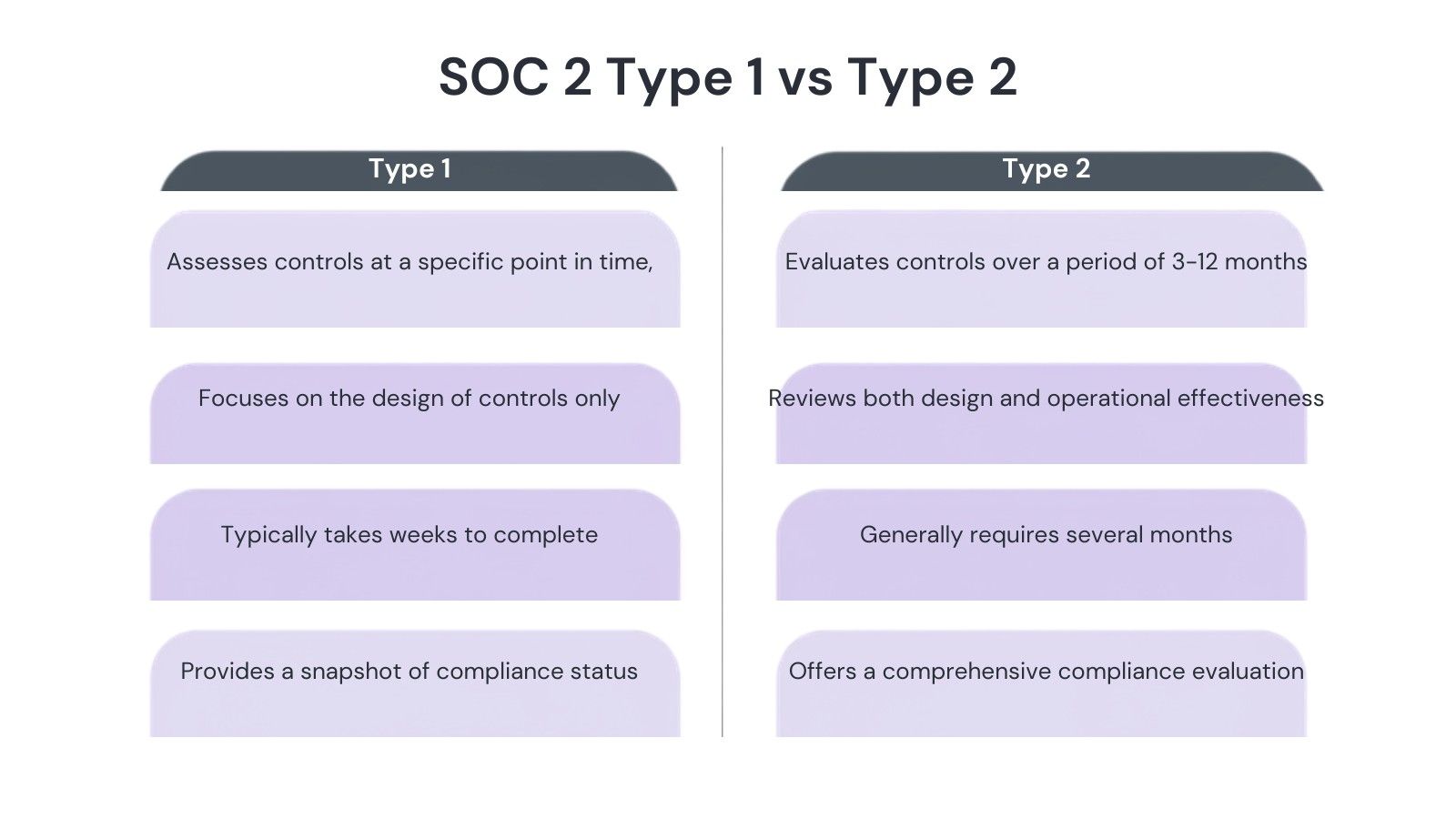
That stretch of time is the real cost of a Type 2. You can't rush it, because the auditor has to watch the controls function in practice, not just read about them on paper. Most enterprise buyers already know this, which is why they ask for Type 2 by name. A Type 1 tells them what you built. It doesn't tell them it held up.
When Is a Type 1 Report Actually Enough?
Whether a Type 1 is enough depends on who's asking and how much time you have, not on how mature your company is. It's not a weaker version of SOC 2. In the right situation, it's the correct call.
Early-Stage Deals Under Time Pressure
If a deal is stuck waiting on proof of security controls and you don't have six to twelve months for a Type 2 observation period, a Type 1 gets the conversation moving again. It shows the buyer you've actually built the controls, and that's often enough to keep the deal alive while you start the clock on Type 2.
When Buyers Will Insist on Type 2
Bigger enterprise buyers, regulated industries, and anyone with a mature vendor risk process will usually ask for Type 2 outright, or accept a Type 1 only as a stopgap with a firm date attached for the Type 2. If most of your customers are enterprise, plan for Type 2 from day one instead of treating Type 1 as the finish line.
What Does a SOC 2 Type 1 Audit Cost?
SOC 2 Type 1 cost is usually the first question once a company decides to move forward, and the audit fee is only part of the answer. A Type 1 is generally cheaper, since there's no months-long observation period for the auditor to bill for. Total cost, including readiness work and the audit fee, tends to land at the lower end of what a first SOC 2 usually runs, and the audit fee itself is often a fraction of what a Type 2 costs for the same scope. The bigger expense isn't the audit fee anyway, it's the internal time spent getting policies and controls in shape before the auditor shows up. Our SOC 2 audit cost guide breaks down the full range for both report types.
Moving From Type 1 to Type 2
Most companies weighing SOC 2 Type 1 vs Type 2 don't have to pick one forever, they start with a Type 1 on purpose, as a first step toward Type 2, not as a place to stop. The control design work from your Type 1 mostly carries over: same policies, same access setup, same scope, usually the same auditor. What resets is the clock. Your Type 2 observation period starts fresh once you begin it, typically three to twelve months of the auditor watching those same controls actually run, not just reading about them.
Plan for that transition before you need it. Companies that treat Type 1 as a box to check, and only think about Type 2 once a buyer demands it, lose months they didn't have to lose. Our SOC 2 audit process guide walks through the full cycle end to end, and our SOC 2 compliance checklist covers the prep work either report type needs.
Frequently Asked Questions
Is a SOC 2 Type 1 report enough for enterprise sales?
Sometimes, as a bridge. Smaller deals or early evaluations may take a Type 1. Most enterprise buyers with a real vendor risk process will ask for Type 2, or take a Type 1 only with a firm date for the upgrade.
How long does a SOC 2 Type 1 audit take?
A few weeks to a couple of months in most cases. There's no observation period to sit through. The auditor is checking design at one point in time, not watching it run for months.
Do I need a Type 1 before I can get a Type 2?
No. Plenty of companies go straight to Type 2 to avoid paying for two audits. A Type 1 is a faster first step some companies choose, not something you're required to do first.
Does a SOC 2 Type 1 report include a penetration test?
No. Neither Type 1 nor Type 2 requires a penetration test by default, though many audits include one as supporting evidence. A Type 1 specifically only reviews control design, nothing operational.
How much does a SOC 2 Type 1 audit cost?
SOC 2 Type 1 cost is usually less than a Type 2 for the same scope, since there's no extended observation period to audit. The bigger variable is the internal readiness work beforehand, not the audit fee.
Is SOC 1 vs SOC 2 the same comparison as Type 1 vs Type 2?
No. Soc 1 vs soc 2 is about which report you need, SOC 1 covers financial reporting controls, SOC 2 covers security and operational controls. Type 1 vs Type 2 is a separate question about how thoroughly whichever report you choose gets tested.
A Type 1 report proves you built the right controls. A Type 2 proves they held up. A penetration test proves they'd survive a real attack. UprootSecurity covers all three, so you're not switching vendors every time your compliance program grows up. → Book a demo today
SOC 2