Unbiased Sprinto Review: Features, Pricing & Limitations

Robin Joseph
Senior Security Consultant

Compliance isn’t a once-a-year exercise anymore. For modern SaaS companies, it’s an ongoing requirement tied directly to customer trust and revenue growth. Frameworks like SOC 2 and ISO 27001 have become baseline expectations, especially when selling to enterprise clients. Yet many teams still depend on manual tracking, scattered documentation, and last-minute audit preparation that pulls attention away from building and scaling products.
This pressure has driven organizations toward compliance automation platforms. Sprinto aims to keep controls monitored in the background while reducing the operational load on internal teams. The idea is straightforward: stay audit-ready without turning compliance into a full-time job.
But as with most automation tools, the real test isn’t the promise — it’s how well the platform fits into everyday workflows once teams start using it.
Introducing Sprinto
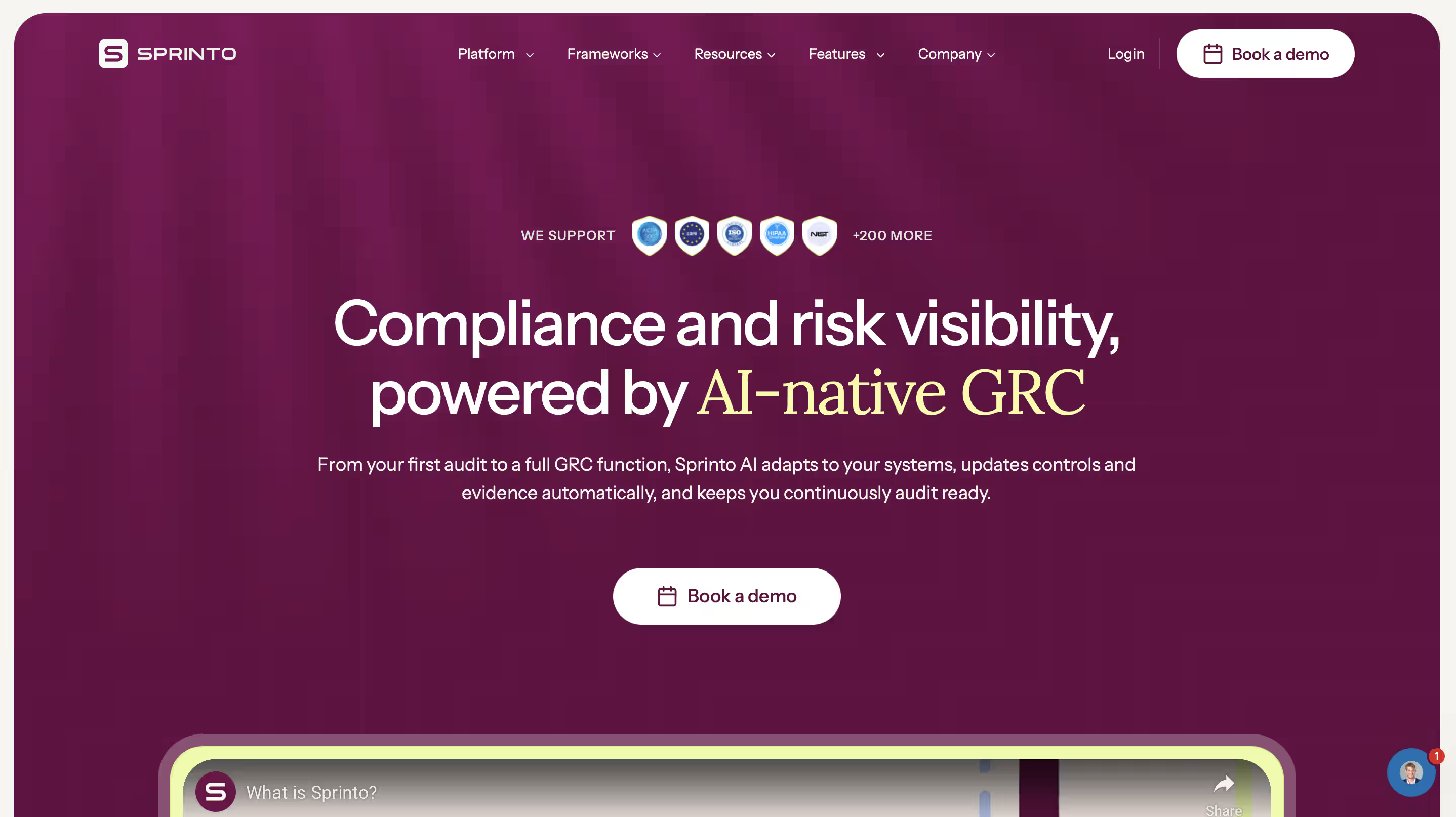
Sprinto is a compliance automation platform designed for companies that need certifications like SOC 2 or ISO 27001 without turning compliance into a manual, spreadsheet-heavy process. Rather than approaching audits as one-off events, Sprinto treats compliance as something that runs continuously in the background alongside everyday operations.
The platform connects with cloud infrastructure, identity systems, HR tools, and development environments to monitor controls and collect evidence automatically. Instead of chasing screenshots before an audit, teams get ongoing visibility into their compliance posture as systems change and scale. In practice, this shifts compliance from reactive preparation to steady, ongoing maintenance.
Sprinto is largely adopted by startups and scaling SaaS companies that don’t have dedicated governance teams but still need enterprise-level assurance. The goal isn’t just passing audits — it’s reducing the operational drag compliance often creates for engineering and security teams.
Sprinto Features: What the Platform Actually Offers
Sprinto organizes compliance around continuous operations instead of one-time audits. By combining monitoring, risk tracking, and documentation into a single workflow, the platform helps organizations stay audit-ready without disrupting everyday business operations.
Audit Management
Sprinto’s audit management features focus on reducing the coordination effort that usually slows certification projects.
- Centralizes audit documentation, evidence, and control mapping in one workspace
- Enables direct collaboration between internal teams and external auditors
- Maintains organized records throughout the year instead of last-minute collection
- Simplifies recurring audits by preserving historical audit trails
By keeping preparation ongoing, audits become structured reviews rather than stressful catch-up exercises.
Risk Management
Risk management connects compliance requirements with real operational risks across systems and processes.
- Tracks risks linked to compliance controls and security configurations
- Uses integration data to surface gaps as environments change
- Allows teams to document, assess, and monitor risks continuously
- Aligns risk visibility with compliance posture instead of separate tracking tools
This helps organizations understand evolving security exposure instead of relying on periodic risk reviews.
Policy Management
Policy management ensures compliance documentation stays active, updated, and traceable.
- Create, distribute, and manage security policies from a centralized system
- Track employee acknowledgments automatically for audit records
- Maintain version control and approval workflows within the platform
- Reduce dependence on manual tracking or external document tools
Keeping policies operational rather than static makes ongoing compliance easier to maintain.
Continuous Monitoring
Continuous monitoring forms the backbone of Sprinto’s automation approach.
- Connects with cloud, identity, and operational tools to monitor controls continuously
- Detects configuration changes and compliance deviations in real time
- Generates alerts that help teams resolve issues early
- Maintains visibility between audit cycles instead of periodic checks
This steady monitoring reduces surprises during audit preparation.
Vendor Risk Management
Sprinto extends compliance oversight to third-party vendors and external dependencies.
- Manage vendor assessments and supporting documentation centrally
- Track third-party risks alongside internal compliance controls
- Maintain structured records for audits and security reviews
- Improve visibility into the broader vendor ecosystem
As organizations rely more on external services, vendor oversight becomes a critical part of maintaining overall compliance readiness.
Sprinto Pricing: Plans and Cost Analysis
Before committing to a compliance automation platform, understanding how Sprinto structures pricing is important. Sprinto does not publicly list fixed pricing, but verified customer disclosures provide realistic estimates. Costs typically depend on infrastructure complexity, integrations, and compliance scope rather than employee count. Below is a practical breakdown of how Sprinto pricing generally works across different organizational stages.
Starter Plan: ~$7,000–$8,000/year
The Starter plan is built for early-stage companies working toward their first certification, usually SOC 2 or ISO 27001. It focuses on simplifying initial compliance setup without requiring dedicated governance teams.
Includes:
- Policy templates with guided implementation workflows
- Automated evidence collection from connected systems
- Core integrations with cloud providers and identity tools
- Employee training and policy acknowledgment tracking
- Unlimited users without per-seat pricing
Limitations:
- Best suited for single-framework compliance programs
- Limited customization for complex environments
- Advanced reporting and multi-entity controls not included
This tier works well for startups seeking structured audit readiness without building compliance processes from scratch.
Growth / Advanced Plans: ~$8,000–$15,000/year
Designed for scaling organizations, Growth plans support multiple frameworks and more operational complexity.
Includes:
- Editable workflows with granular access permissions
- Expanded integrations and enhanced reporting visibility
- Entity-based management for multiple teams or products
- Evidence reuse across frameworks like SOC 2, ISO 27001, and HIPAA
- Improved collaboration with auditors
Limitations:
- Pricing increases as frameworks and integrations expand
- May require onboarding effort for teams new to automation
Bundled framework support often makes this tier cost-efficient for companies expanding compliance programs.
Enterprise Plan: Starting at ~$20,000/year
The Enterprise plan targets organizations managing large infrastructures or multiple business units.
Includes:
- Multi-entity and complex infrastructure support
- Full API access for deeper integrations
- Dedicated onboarding and priority support
- Advanced administrative controls and customization
- Flexible deployment and contract structures
Limitations:
- Higher upfront investment
- Pricing varies significantly based on deployment scale
Value for Money Assessment
Sprinto delivers strong value for teams aiming for continuous compliance rather than one-time audit preparation. Automation reduces manual tracking, minimizes consultant reliance, and keeps organizations audit-ready year-round. Unlimited users and framework bundling further improve long-term cost efficiency for growing companies.
Setting Up Sprinto: Implementation Experience
Sprinto follows a structured implementation approach designed to move organizations toward audit readiness quickly. Instead of months-long deployments typical of traditional GRC platforms, setup focuses on connecting systems, activating controls, and enabling continuous monitoring within weeks.
Initial Onboarding Process
Implementation begins by assigning an internal owner with system access to coordinate setup alongside Sprinto’s onboarding specialists. The process includes initiating policy acknowledgments, configuring controls, running vulnerability checks, and collecting evidence through automated workflows. Pre-built templates and mapped controls remove the need to design compliance programs from scratch, allowing teams to focus on operational adoption rather than documentation creation.
Sprinto’s onboarding experience often feels closer to working with a compliance partner than deploying standalone software. Many users describe the process as gaining guided compliance expertise without hiring additional staff, helping teams transition quickly from purchase to active compliance operations.
Integration Setup and Timeline
Account creation takes only seconds, while integrations are enabled through guided, click-based connections. Sprinto links with cloud infrastructure, identity providers, HR platforms, and ticketing tools without heavy configuration. For unsupported systems, the Open API allows organizations to push data using standard HTTP clients or automated workflows.
This flexibility supports custom environments and asynchronous data collection without manual uploads. As a result, implementation timelines typically shrink from traditional three-to-four-month compliance rollouts to a matter of weeks, significantly reducing operational disruption.
User Experience Challenges
Despite streamlined setup, the platform’s feature-dense dashboard can feel overwhelming initially. New users may experience a learning curve when navigating modules or configuring workflows. Limited visual progress tracking and nested interface elements sometimes make it harder to understand remaining setup steps.
Teams without prior compliance experience may also need additional guidance when selecting training or framework-specific configurations, as contextual explanations within certain modules remain minimal.
Support and Success Management
Sprinto offsets usability challenges through strong onboarding and customer success support. Dedicated account managers assist with setup, daily operations, and audit preparation, providing direct guidance without lengthy escalation processes.
Ongoing communication, proactive product updates, and hands-on assistance during certification milestones help teams maintain momentum, making Sprinto function more like an extension of internal compliance operations than a traditional compliance tool.
Real User Experience: Sprinto Reviews and Performance
Sprinto’s real-world performance is often judged by how quickly organizations move from zero compliance to audit readiness. User feedback consistently points to faster timelines, reduced manual effort, and clearer audit preparation compared to traditional compliance approaches that rely heavily on spreadsheets and periodic reviews.
Compliance Achievement Timeline
Many users report reaching SOC 2 Type I readiness within 25–30 days, far faster than conventional compliance programs that often take several months. Once integrations are enabled, automated evidence collection runs continuously, reducing last-minute audit preparation and documentation stress.
Teams typically follow a predictable rollout: integrations during the first few days, control implementation shortly after, and evidence accumulation beginning immediately. By week three, most organizations already have structured documentation ready for audit review, which reduces uncertainty around audit expectations.
Customer Support Quality
Support quality is frequently highlighted as a key strength. Users describe responsive and knowledgeable assistance that helps resolve issues quickly without complex escalation. The onboarding experience often feels closer to working with an internal compliance partner than adopting standalone software.
During implementation and audit phases, rapid responses help teams maintain progress without operational slowdowns, especially for organizations navigating compliance certifications for the first time.
Platform Stability and Speed
Users report stable performance across daily workflows, particularly when compliance monitoring runs alongside active development environments. Integrations with tools like Jira, Slack, and GitHub allow compliance tasks to operate in the background without disrupting engineering work.
Centralized dashboards provide continuous visibility into compliance posture, enabling teams to manage multiple frameworks simultaneously while maintaining consistent performance.
User Satisfaction Ratings
Sprinto maintains strong satisfaction scores, including 4.8/5 on G2 and 4.7/5 on Capterra. Reviews frequently emphasize reduced audit stress, improved visibility, and significant time savings. Many users value the platform’s ability to maintain continuous audit readiness rather than forcing reactive preparation before certification deadlines.
Sprinto Limitations: Where It Falls Short
No compliance platform is without trade-offs, and Sprinto is no exception. While the platform simplifies many compliance operations, recurring feedback highlights a few areas where teams may experience friction, particularly during customization, pricing evaluation, and early adoption stages.
Customization Constraints
Sprinto works best within standardized compliance workflows, which helps accelerate implementation but limits flexibility for organizations with highly specialized operational or regulatory requirements. Teams needing deeply customized risk models, policy workflows, or control structures may find the predefined framework restrictive when adapting processes beyond typical SOC 2 or ISO 27001 setups.
Unpredictable Pricing Structure
Because Sprinto does not publish fixed pricing, organizations often face uncertainty during budgeting. Quotes vary based on infrastructure complexity, integrations, and framework scope rather than employee count alone, meaning companies with similar sizes can receive different pricing estimates, making early financial planning more difficult for startups.
Sync and Integration Issues
Despite offering a broad integration ecosystem, some users report challenges when configuring advanced workflows beyond basic connections. Integrations with platforms like Jira or ServiceNow may require additional engineering effort, and certain API capabilities remain limited to higher-tier plans, reducing automation flexibility for smaller deployments.
Interface and Notification Overload
Sprinto consolidates extensive compliance functionality into a single dashboard, which improves visibility but creates an initial learning curve. New users can feel overwhelmed by dense navigation and frequent alerts, particularly during onboarding, before becoming familiar with how controls, risks, and monitoring workflows connect within the platform.
Final Verdict: Is Sprinto Right for Your Business?
Sprinto delivers strong results for organizations looking to replace manual compliance processes with continuous automation. Its biggest advantage lies in reducing audit preparation effort while helping teams move from initial setup to certification readiness in weeks rather than months. Automated evidence collection and hands-on onboarding support make compliance feel operational instead of overwhelming, especially for companies navigating their first major framework.
However, pricing variability can create uncertainty during evaluation. Costs typically fall within a mid-range compliance budget, but quote differences based on infrastructure complexity may complicate planning for early-stage teams without established compliance spending.
Sprinto is best suited for growing SaaS companies pursuing SOC 2 or ISO 27001 that value guided workflows and structured implementation. The platform’s standardized approach removes much of the ambiguity that slows first-time compliance programs, supported by consistently strong customer support feedback.
Organizations with highly customized compliance requirements or complex internal processes may encounter flexibility limitations. Ultimately, Sprinto works best for teams prioritizing speed, clarity, and operational simplicity over deep customization and granular control.
Streamline compliance, reduce risk, and build trust with UprootSecurity — where GRC turns checklists into real operational confidence.
→ Book a demo today
Vendor Evaluation & Alternatives
![Top 5 Secure Alternatives to Delve for Compliance [2026]](https://s3.us-east-1.amazonaws.com/static-production.uprootsecurity.com/website/strapi-content/uploads/delve_alternatives_2026_2b0ff79510.png)