Unbiased Secureframe Review: Features, Pricing & Insights

Robin Joseph
Senior Security Consultant

TLDR: Secureframe is a strong compliance automation platform for teams managing multiple frameworks. It reduces manual work and speeds up audits, but comes with higher costs and requires setup effort. It works best for scaling companies, not early-stage teams with simple needs.
Secureframe is a compliance automation platform that helps organizations achieve and maintain certifications like SOC 2, ISO 27001, HIPAA, PCI DSS, and GDPR by automating evidence collection, continuous monitoring, and audit preparation across their existing tech stack.
Over 6,000 companies use it, including Nasdaq, Ramp, and AngelList. The platform connects directly to your cloud infrastructure, HR systems, and developer tools to pull compliance evidence automatically, monitor controls in real time, and flag issues before auditors do.
But automation claims are common in compliance software. What matters is whether the platform actually reduces operational work or just reorganizes it. This review covers what Secureframe does, where it delivers, where it falls short, and whether it's the right fit for your organization.
What Is Secureframe?
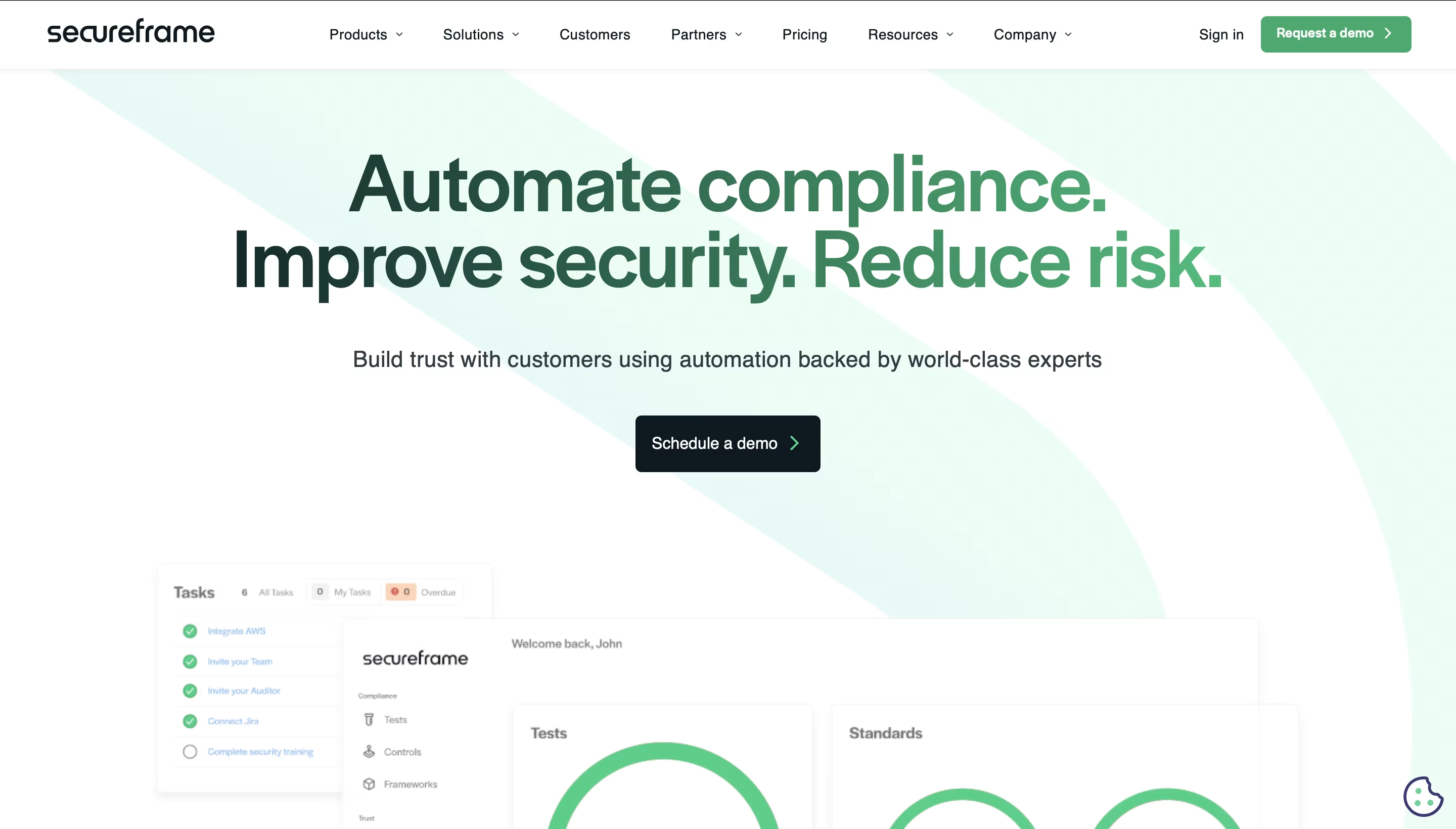
Secureframe is a compliance automation platform that connects directly to your existing tools and pulls compliance-relevant data automatically. Instead of manually collecting screenshots, chasing documentation, and assembling evidence before each audit, Secureframe integrates with AWS, Google Cloud, Okta, GitHub, and 300 other platforms to keep evidence continuously collected and organized throughout the year.
The platform covers 40 plus compliance frameworks including SOC 2, ISO 27001, HIPAA, PCI DSS, GDPR, NIST, FedRAMP, and CMMC. Common controls are mapped across frameworks automatically, which means satisfying one requirement can contribute to multiple certifications without duplicating the underlying work.
Beyond evidence collection, Secureframe handles real-time control monitoring, AI-assisted risk assessments, policy creation, security questionnaire automation, and vendor risk management. A Trust Center gives customers and prospects self-serve access to your security documentation without your team having to field individual requests.
The platform is supported by a team of 30 plus in-house compliance experts and former auditors who provide guidance throughout the certification process. Users across engineering, IT, security, HR, and leadership can collaborate within the platform, with task management and alerts keeping the right people informed when something needs attention.
Secureframe Features
Secureframe isn’t just a checkbox tool—it’s a compliance operating system running continuously in the background. It automates monitoring, evidence collection, risk management, and audit preparation so your team can focus on building, not scrambling for documentation.
Continuous Monitoring and Automated Testing
Secureframe monitors your infrastructure continuously rather than running periodic checks. Automated tests validate configurations, permissions, and security settings around the clock and send real-time alerts when something drifts out of compliance. When a control fails, ComplyAI generates remediation steps directly in the console so your team knows exactly what to fix without having to interpret the finding themselves. A no-code editor also lets you build custom automated tests for resources that aren't covered by the default test library.
Policy Management and Control Mapping
Managing multiple frameworks separately creates duplicate work. Secureframe maps shared controls across SOC 2, ISO 27001, HIPAA, PCI DSS, and other certifications automatically, so one control implementation contributes to multiple frameworks without your team running separate workstreams for each. Pre-built policy templates cover 40 plus frameworks, and smart versioning propagates updates across related policies when changes are made. Custom controls can be added for requirements that don't map cleanly to standard frameworks.
Integration Library: 150+ Tool Connections
The platform connects to 150 plus tools natively and supports 300 plus platforms in total through API and CSV imports. AWS, Azure, Google Cloud, GitHub, Okta, and most standard SaaS tools connect with minimal setup. Resource types are auto-detected and normalized, which means evidence flows into the platform without requiring developer effort to configure. Daily automatic syncs keep data current, and manual syncs run in seconds when needed.
Trust Center and Security Questionnaire Automation
Secureframe reduces the administrative burden of questionnaires and documentation.
Secureframe uses machine learning to auto-complete security questionnaires with over 90 percent accuracy, drawing answers from your existing compliance documentation. This removes the manual work of responding to vendor assessments and customer security requests from scratch each time. The Trust Center provides a public portal where customers and prospects can access your certifications and security documentation directly, without your team needing to coordinate individual sharing requests.
Risk Register and Vendor Management
ComplyAI calculates inherent and residual risk scores, tracks treatment plans, and follows ISO 27005 methodology for risk management. Shadow IT detection flags unauthorized applications through SSO monitoring. Vendor monitoring alerts you when third-party certifications expire so gaps in your supply chain don't surface during an audit.
Personnel and Asset Tracking
Secureframe imports personnel data through HR, SSO, and MDM integrations and automates onboarding and offboarding compliance tasks. Device compliance is tracked across encryption, screen locks, and firewall settings, with ownership assigned automatically. An asset inventory consolidates employee devices, cloud resources, and code repositories into a single view that can be exported for audit purposes.
Secureframe Reviews: What Real Users Say About the Platform
Secureframe holds a 4.7 star rating on G2 from 786 reviews and 4.8 stars on Capterra. The overall satisfaction score across platforms sits at 4.8 out of 5.
What Users Consistently Praise
The most common theme across reviews is time saved on audit preparation. Users frequently cite automated evidence collection across AWS, Google Workspace, and Okta as the feature that eliminates the most manual work. Integrations are described as reliable and straightforward to set up, and the real-time dashboard gives both technical and non-technical stakeholders a clear view of compliance progress without requiring them to dig into the platform.
Support response times come up repeatedly in positive reviews. Secureframe reports a median email response time of 49 minutes and live chat responses in 30 seconds, with 51 percent of issues resolved in a single interaction. Users say fast support combined with automation keeps audits on track even when unexpected issues surface.
The measurable outcomes users report are worth noting. Across customer surveys, 97 percent reported a stronger security and compliance posture, 95 percent saved time obtaining and maintaining compliance, and 85 percent reported cost savings. These figures come from Secureframe's own customer data, so they should be read with that context in mind, but the consistency with independent G2 reviews suggests the core efficiency claims hold up.
Where Users Run Into Friction
Pricing frustration is the most consistent complaint, particularly among startups. The lack of published pricing means teams spend time on sales calls before they can evaluate whether the platform fits their budget.
Annual renewal increases of 5 to 15 percent catch some finance teams off guard, especially when they weren't negotiated upfront.
The learning curve is a secondary complaint. The platform covers a lot of ground, and newer compliance teams sometimes find it takes time to understand how controls, evidence, and automated tests connect before they can use it efficiently. This isn't a fundamental platform problem, but it does mean the first few weeks require more internal investment than some teams anticipate.
Enterprise vs Startup Experiences
Company size shapes how users perceive value. Enterprises managing multiple frameworks find the cost easy to justify when labor savings are factored in. Startups pursuing their first SOC 2 certification sometimes feel the platform does more than they need, and that the price reflects capabilities they won't use for some time. Both perspectives are valid and worth factoring into your evaluation based on where your organization is today.
Key Considerations Before Choosing Secureframe
Secureframe can simplify compliance, but it’s not the right fit for every organization. Before adopting it, evaluate how well it aligns with your requirements, systems, and internal processes.
Scope of compliance requirements Secureframe delivers the most value when managing multiple frameworks such as SOC 2, ISO 27001, and GDPR. If your goal is a single certification, the platform may be more complex and costly than necessary.
Level of system integration The platform depends on integrations with your existing tools—cloud providers, identity systems, and endpoint management solutions. Limited integrations or fragmented systems can reduce automation benefits and increase manual effort.
Internal ownership and resources Although Secureframe reduces manual work, it still requires internal ownership. Teams need to manage policies, review controls, and respond to audit requirements. Without clear ownership, implementation can stall.
Time to implement and operational overhead Initial setup involves configuring integrations, mapping controls, and aligning policies. For organizations with limited bandwidth, this can slow down adoption and delay compliance timelines.
Cost vs. long-term value Secureframe is typically priced for scaling companies. The value comes from reducing ongoing audit effort and maintaining continuous compliance. For smaller teams or one-time audits, the cost may outweigh the benefits.
Audit readiness vs. real security validation Secureframe helps centralize evidence and streamline audits. However, like most compliance platforms, it focuses on documentation and control tracking. It does not validate whether controls are effective under real-world conditions.
Final Verdict: Is Secureframe Right for Your Business?
Secureframe works best for teams managing multiple compliance frameworks who want to reduce manual effort and maintain continuous audit readiness.
It delivers strong value through automation, integrations, and centralized control mapping. For mid-sized and enterprise companies, the time savings and operational efficiency often justify the cost.
However, it may not be the right fit for every organization.
Teams pursuing a single certification or operating with limited budgets may find it expensive relative to their needs. The platform’s breadth can also introduce complexity during initial setup.
Secureframe is most effective when:
- you manage multiple frameworks
- your systems are already integrated
- you need continuous compliance, not one-time audits
If your goal is basic compliance or a single certification, simpler tools or manual approaches may be sufficient.
Compliance tools help you prepare for audits. But they don’t guarantee your controls actually work under real conditions.
Uproot Security helps you validate your security posture through continuous testing and real-world assessments, so you’re not just audit-ready—you’re actually secure.
Vendor Evaluation & Alternatives
![Top 5 Secure Alternatives to Delve for Compliance [2026]](https://s3.us-east-1.amazonaws.com/static-production.uprootsecurity.com/website/strapi-content/uploads/delve_alternatives_2026_2b0ff79510.png)