ISO 27001 Requirements: Understanding the 93 Annex A Controls

Robin Joseph
Senior Security Consultant
Last reviewed: September 2026.
ISO 27001 requirements are the rules an organization follows to build, run, and maintain an Information Security Management System (ISMS), published by ISO and IEC and used in over 150 countries.
These requirements are split into two parts. First, the clauses (4 to 10) define how your ISMS should run, covering scope, leadership, risk assessment, documentation, and continuous improvement. They ensure your security program is structured and repeatable, not dependent on guesswork. Second, Annex A includes 93 controls across organizational, people, physical, and technological areas. You don't implement all of them. You select controls based on your risks and document them in your Statement of Applicability.
Is ISO 27001 Certification Mandatory?
No law requires ISO 27001 certification. In practice, it's often non-negotiable anyway.
Enterprise buyers, government contracts, and financial-sector vendors routinely make it a condition of doing business, not a nice-to-have on a vendor questionnaire. If your sales team keeps losing deals to a security review, or a security review keeps stalling a deal already in motion, that's usually the real trigger, not a compliance team's own initiative.
Smaller companies sometimes get by with a SOC 2 report instead, since it covers similar ground for a US-based buyer. ISO 27001 tends to matter more once you're selling into Europe, the public sector, or regulated industries where an internationally recognized certification carries more weight than a SOC 2 report alone. If you're still deciding whether now's the time, our guide on ISO 27001 for startups covers the signals worth watching.
What Are ISO 27001 Requirements and Why Do They Matter?
ISO 27001 requirements are the rules organizations follow to build, implement, and maintain an Information Security Management System (ISMS). They help you identify risks, apply the right controls, and continuously improve how you protect sensitive information.
The 7 ISO 27001 Clauses at a Glance
| Clause | Name | What It Requires |
|---|---|---|
| 4 | Context of the Organization | Define the ISMS scope and the internal/external issues that affect it |
| 5 | Leadership | Top management commits, sets policy, and assigns responsibility |
| 6 | Planning | Risk assessment, risk treatment, and measurable security objectives |
| 7 | Support | Resources, competence, awareness, communication, and documented information |
| 8 | Operation | Execute the risk treatment plan and control operational processes |
| 9 | Performance Evaluation | Monitor, measure, run internal audits, and conduct management review |
| 10 | Improvement | Handle nonconformities and continually improve the ISMS |
Clause 6 gets the deepest look below because it's one of the areas auditors flag most often, usually a mismatch between the risk methodology, the risk register, and the Statement of Applicability (common audit findings). That doesn't make the other six optional. Skipping Clause 7's competence and awareness records, or Clause 10's nonconformity log, is as much an audit finding as a missing Annex A control.
ISO 27001 Clause 6 Risk Assessment and Planning Framework
This is where ISO 27001 stops being theory and starts working. Clause 6 turns risk into action, forcing you to assess threats, plan responses, and define measurable goals that actually reduce exposure.
Understanding ISO 27001 Clause 6 Risk Assessment
ISO 27001 Clause 6 risk assessment is the process used to identify, analyze, and evaluate information security risks within your ISMS. It ensures risks are handled through a structured, repeatable method rather than guesswork. Clause 6.1.2 requires you to define risk criteria, assess likelihood and impact, and determine what level of risk is acceptable.
Start with an asset register covering hardware, software, data, people, and locations. Assign a single owner to each asset. Then evaluate risks by assigning likelihood and impact values, calculate risk scores, and compare them against your acceptance criteria to decide next steps.
Creating a Risk Treatment Plan
Once risks are identified, you have four options: terminate, treat, transfer, or tolerate. The choice depends on your risk appetite and business priorities, but every decision must be justified and documented clearly.
Your risk treatment plan connects risks to controls. It outlines what action you'll take, why you chose it, who's responsible, timelines, resources, and how success will be measured. This is where strategy turns into execution.
Auditors rely heavily on this document because it shows your methodology isn't just theoretical. It's applied consistently across real risks and controls.
Setting Measurable Security Objectives
Clause 6.2 requires organizations to define security objectives that align with their ISMS policy and risk landscape. These objectives must be measurable where possible, monitored regularly, and clearly communicated across teams.
Use the SMART framework to make them effective. Avoid vague goals like "improve security." Instead, define targets such as "patch critical vulnerabilities within 48 hours" or "maintain 99.9% uptime."
Each objective should include actions, ownership, timelines, and metrics. Clear objectives keep teams focused and prove your ISMS is delivering measurable results.
ISO 27001 Mandatory Documents and ISMS Policy Requirements
Documentation is where ISO 27001 gets real. Auditors don't trust claims, they want proof. Every decision, control, and process must be backed by clear, consistent records that show your ISMS actually works.
ISO 27001 ISMS Policy Requirements
Clause 5.2 requires an information security policy tailored to your organization, not a generic template. It must define or reference security objectives, commit to meeting requirements, and ensure continual improvement of the ISMS. Management must approve it, document it, and communicate it internally while making it available to relevant stakeholders.
Beyond this, you need supporting policies for areas like access control, supplier security, acceptable use, and data classification. Each policy requires approval, periodic review, and evidence of communication. Without this, your ISMS lacks structure and accountability.
ISO 27001 Statement of Applicability
The Statement of Applicability (SoA) connects your risk assessment to the controls you implement. Auditors rely on it to understand your decisions. For each of the 93 Annex A controls, you must define status, inclusion or exclusion, justification, and link it to supporting evidence.
Skipping controls or providing weak justification leads to nonconformities. The SoA should clearly explain how controls address risks and why some are excluded. It acts as your security blueprint and must reflect real business decisions, not assumptions.
Risk Assessment and Treatment Reports
Risk assessment reports capture your methodology, identified risks, likelihood and impact scores, and final risk levels. They provide a structured view of how risks are identified and evaluated across the organization.
Treatment reports go further by showing how controls address those risks. They connect Annex A controls to business processes, explain exclusions, assign ownership, and provide evidence. Together, these documents prove your decisions are consistent and defensible.
Internal Audit and Management Review Records
Clause 9.2 requires internal audits at planned intervals to verify your ISMS is working. You must define scope, criteria, and maintain records showing audits were conducted, findings reported, and actions tracked.
Clause 9.3 requires management reviews covering performance, risks, incidents, and improvement opportunities. These reviews must show real decisions, ownership, and timelines. Without substance, your documentation fails to demonstrate control.
ISO 27001 Certification Process, Timeline, and Cost
Knowing the requirements is one thing. Getting certified against them is another, and it's the question most buyers actually have.
The Certification Process
Certification runs through an external audit in two stages, conducted by an accredited certification body, not by ISO itself.
- Stage 1 (documentation review): the auditor checks that your ISMS documentation, policies, risk assessment, and Statement of Applicability exist and meet the standard's requirements.
- Stage 2 (implementation audit): the auditor tests whether the controls you documented are actually operating, through interviews, evidence sampling, and system checks.
- Certification decision: pass both stages and the certification body issues your ISO 27001 certificate, valid for three years.
- Surveillance audits: shorter audits in years 1 and 2 confirm the ISMS is still operating as certified.
- Recertification audit: a full audit in year 3 renews the certificate for another three-year cycle.
For the full step-by-step rollout, including how to prepare for each stage, see our ISO 27001 certification process guide.
How Long ISO 27001 Certification Takes
Most first-time organizations take 6 to 12 months from starting implementation to certification, depending on company size, how mature existing security practices already are, and how many Annex A controls apply. Smaller, cloud-native startups with few systems can move faster; regulated or multi-location organizations usually take longer.
How Much ISO 27001 Certification Costs
Costs vary by company size, auditor, and scope, but budget for three buckets:
| Cost Area | Typical Range | What It Covers |
|---|---|---|
| Preparation | $15,000 to $40,000+ | Gap assessment, policy writing, risk assessment, internal resourcing or consultants |
| Certification audit | $8,000 to $20,000 | Stage 1 and Stage 2 audits by the certification body |
| Ongoing maintenance | $5,000 to $15,000/year | Surveillance audits, internal audits, policy upkeep |
Compliance automation platforms reduce the preparation cost and timeline most, since manual evidence collection and spreadsheet-based risk registers are what usually stretch a project past 12 months.
Breaking Down the ISO 27001 Annex A Controls List
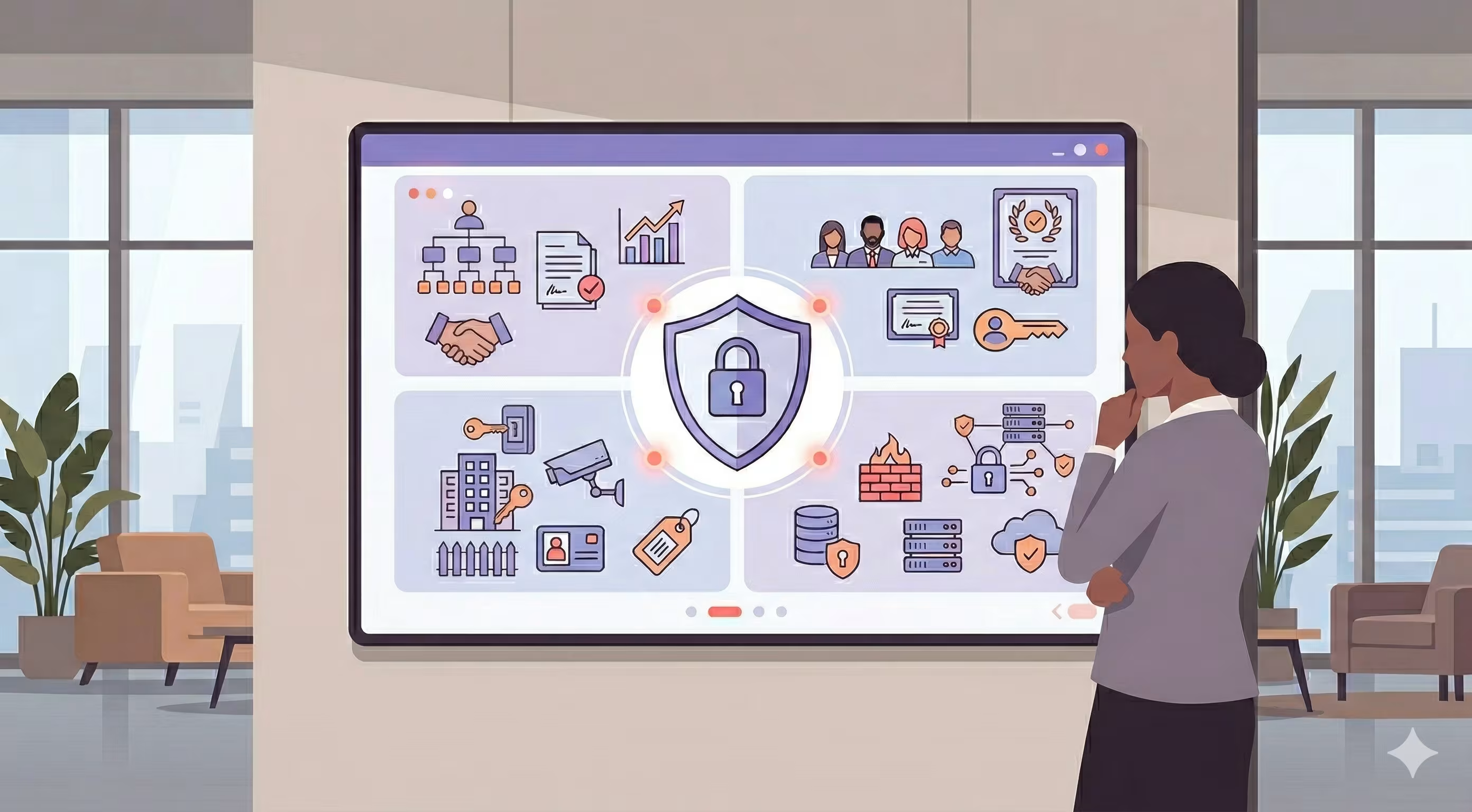
ISO 27001 Annex A controls are a structured list of 93 security measures used to manage information risks. These controls are grouped into four domains: organizational, people, physical, and technological, so you can map risks to the right safeguards. You don't implement all controls blindly. You select what applies to your risks and justify it in your Statement of Applicability.
| Domain | Controls | What It Covers |
|---|---|---|
| Organizational (A.5) | 37 | Policies, governance, supplier security, incident response |
| People (A.6) | 8 | Hiring, training, behavior, offboarding |
| Physical (A.7) | 14 | Facilities, equipment, environmental protection |
| Technological (A.8) | 34 | Systems, networks, encryption, monitoring |
Organizational Controls (37 Controls)
This is your governance layer, where structure, policies, and accountability come together.
| Control | Name | What It Covers |
|---|---|---|
| A.5.1 | Policies for Information Security | Define how security is managed |
| A.5.2 | Information Security Roles and Responsibilities | Assign accountability for security tasks |
| A.5.3 | Segregation of Duties | Prevent conflicts of interest in sensitive tasks |
| A.5.4 | Management Responsibilities | Ensure leadership actively supports the ISMS |
| A.5.5 | Contact With Authorities | Maintain contact with regulators and law enforcement |
| A.5.6 | Contact With Special Interest Groups | Stay current with security forums and associations |
| A.5.7 | Threat Intelligence | Identify emerging risks |
| A.5.8 | Information Security in Project Management | Build security into every project from the start |
| A.5.9 | Inventory of Information and Other Assets | Track critical assets |
| A.5.10 | Acceptable Use of Assets | Define rules for handling assets |
| A.5.11 | Return of Assets | Recover company property when access ends |
| A.5.12 | Classification of Information | Label data by sensitivity |
| A.5.13 | Labelling of Information | Mark information per its classification |
| A.5.14 | Information Transfer | Secure data movement between parties |
| A.5.15 | Access Control | Define access rules |
| A.5.16 | Identity Management | Manage user identities through their lifecycle |
| A.5.17 | Authentication Information | Protect passwords and credentials |
| A.5.18 | Access Rights | Grant, review, and revoke access appropriately |
| A.5.19 | Information Security in Supplier Relationships | Manage third-party risks |
| A.5.20 | Security in Supplier Agreements | Put security terms in contracts |
| A.5.21 | Security in the ICT Supply Chain | Secure the technology supply chain |
| A.5.22 | Monitoring of Supplier Services | Track supplier performance and changes |
| A.5.23 | Cloud Services Security | Secure cloud usage |
| A.5.24 | Incident Management Planning | Prepare a response plan before incidents happen |
| A.5.25 | Assessment of Security Events | Decide which events count as incidents |
| A.5.26 | Response to Incidents | Handle security events |
| A.5.27 | Learning From Incidents | Improve controls based on past incidents |
| A.5.28 | Collection of Evidence | Preserve evidence for investigations |
| A.5.29 | Security During Disruption | Maintain security during outages or crises |
| A.5.30 | ICT Readiness for Business Continuity | Support business continuity |
| A.5.31 | Legal and Regulatory Requirements | Track applicable legal obligations |
| A.5.32 | Intellectual Property Rights | Protect IP and licensing compliance |
| A.5.33 | Protection of Records | Keep records accurate and tamper-proof |
| A.5.34 | Privacy and Protection of PII | Safeguard personal data |
| A.5.35 | Independent Review of Security | Get outside validation of the ISMS |
| A.5.36 | Compliance With Policies and Standards | Verify internal policies are actually followed |
| A.5.37 | Documented Operating Procedures | Keep IT operations documented and repeatable |
Without strong governance, controls become inconsistent and ineffective.
People Controls (8 Controls)
These controls address risks caused by human actions and behavior.
| Control | Name | What It Covers |
|---|---|---|
| A.6.1 | Screening | Verify trust before granting access |
| A.6.2 | Terms and Conditions of Employment | Set security expectations in employment contracts |
| A.6.3 | Security Awareness, Education and Training | Train employees regularly |
| A.6.4 | Disciplinary Process | Handle violations |
| A.6.5 | Responsibilities After Termination | Remove access promptly |
| A.6.6 | Confidentiality or Non-Disclosure Agreements | Bind staff and contractors to confidentiality |
| A.6.7 | Remote Working | Secure distributed teams |
| A.6.8 | Information Security Event Reporting | Make it easy for staff to report suspicious activity |
People remain one of the most unpredictable risk factors in security.
Physical Controls (14 Controls)
These controls protect facilities and physical assets from threats.
| Control | Name | What It Covers |
|---|---|---|
| A.7.1 | Physical Security Perimeters | Define secure boundaries |
| A.7.2 | Physical Entry | Restrict access |
| A.7.3 | Securing Offices, Rooms and Facilities | Protect workspaces from unauthorized access |
| A.7.4 | Physical Security Monitoring | Detect suspicious activity |
| A.7.5 | Protecting Against Physical and Environmental Threats | Prevent damage |
| A.7.6 | Working in Secure Areas | Set rules for restricted zones |
| A.7.7 | Clear Desk and Clear Screen | Reduce exposure |
| A.7.8 | Equipment Siting and Protection | Position and protect hardware from risk |
| A.7.9 | Security of Assets Off-Premises | Protect devices used outside the office |
| A.7.10 | Storage Media | Control removable media |
| A.7.11 | Supporting Utilities | Protect power, cooling, and other utilities |
| A.7.12 | Cabling Security | Prevent interception or damage to cabling |
| A.7.13 | Equipment Maintenance | Keep hardware properly serviced |
| A.7.14 | Secure Disposal or Re-Use of Equipment | Destroy data safely |
Physical weaknesses can bypass even the strongest digital defenses.
Technological Controls (34 Controls)
These controls secure systems, networks, and data.
| Control | Name | What It Covers |
|---|---|---|
| A.8.1 | User Endpoint Devices | Secure endpoints |
| A.8.2 | Privileged Access Rights | Limit admin rights |
| A.8.3 | Information Access Restriction | Restrict access based on need |
| A.8.4 | Access to Source Code | Protect source code from unauthorized changes |
| A.8.5 | Secure Authentication | Use strong login and verification methods |
| A.8.6 | Capacity Management | Plan system capacity to avoid failures |
| A.8.7 | Protection Against Malware | Prevent threats |
| A.8.8 | Management of Technical Vulnerabilities | Identify and patch vulnerabilities |
| A.8.9 | Configuration Management | Maintain secure setups |
| A.8.10 | Information Deletion | Securely erase data no longer needed |
| A.8.11 | Data Masking | Limit exposure |
| A.8.12 | Data Leakage Prevention | Prevent data loss |
| A.8.13 | Information Backup | Ensure data can be recovered |
| A.8.14 | Redundancy of Processing Facilities | Build in failover for critical systems |
| A.8.15 | Logging | Track activity |
| A.8.16 | Monitoring Activities | Watch for abnormal behavior in real time |
| A.8.17 | Clock Synchronization | Keep system clocks aligned for accurate logs |
| A.8.18 | Use of Privileged Utility Programs | Restrict powerful system tools |
| A.8.19 | Software Installation on Operational Systems | Control what software runs in production |
| A.8.20 | Networks Security | Protect communications |
| A.8.21 | Security of Network Services | Secure the services running on your network |
| A.8.22 | Segregation of Networks | Separate networks to limit blast radius |
| A.8.23 | Web Filtering | Block harmful sites |
| A.8.24 | Use of Cryptography | Protect sensitive data |
| A.8.25 | Secure Development Life Cycle | Build security into every stage of development |
| A.8.26 | Application Security Requirements | Define security requirements before building |
| A.8.27 | Secure System Architecture | Design systems securely from the ground up |
| A.8.28 | Secure Coding | Follow secure coding standards |
| A.8.29 | Security Testing in Development | Test for vulnerabilities before release |
| A.8.30 | Outsourced Development | Apply security standards to contracted development work |
| A.8.31 | Separation of Dev, Test and Production | Keep environments isolated |
| A.8.32 | Change Management | Control how changes are made to systems |
| A.8.33 | Test Information | Protect data used in testing |
| A.8.34 | Protection of Systems During Audit Testing | Prevent audits from disrupting live systems |
Your security is only as strong as your weakest control. Control A.8.29 in particular is where a periodic penetration test earns its keep: it's the most direct piece of evidence an auditor can point to for "security testing in development" actually happening, rather than being a policy statement with nothing behind it.
Critical Annex A Controls: Access Control and Asset Management
Access control and asset management are where most ISO 27001 failures happen. Weaknesses here lead to audit issues, unauthorized access, and security incidents that are difficult and expensive to fix.
ISO 27001 Access Control Requirements
ISO 27001 access control is built on four core principles: Need to Know, Least Privilege, Segregation of Duties, and Role-Based Access Control. These ensure users only access what they need and nothing beyond their role.
Annex A.5.15 defines your policy, while A.5.16 and A.5.18 manage the full lifecycle: granting, reviewing, and removing access. Strong access control prevents misuse and reduces exposure to internal and external threats.
User Access Provisioning and Deprovisioning
The Joiner-Mover-Leaver lifecycle ensures access stays aligned with roles as employees join, change positions, or leave. Timely provisioning and immediate removal of access are critical to maintaining security.
Regular access reviews help identify permission creep, where users accumulate unnecessary access over time. Automation tools can streamline updates, but consistent monitoring ensures access remains accurate and controlled.
ISO 27001 Asset Management Framework
Asset management ensures you know exactly what you own and what needs protection. Control A.5.9 requires maintaining an inventory of assets, including hardware, software, and data.
Each asset must have a single owner responsible for its lifecycle. This accountability ensures assets are tracked, protected, and properly managed from creation to disposal.
Information Classification and Handling
Information classification defines how data is handled based on its sensitivity and business impact. Control A.5.12 requires classification frameworks that guide how information is stored, shared, and protected.
Control A.5.13 requires clear labeling so users understand handling requirements. Proper classification reduces the risk of accidental exposure and ensures consistent data protection practices.
Advanced Security Controls: Cryptography and Supplier Security
Your external security perimeter depends on two things: strong encryption and secure suppliers. Weak controls here expose sensitive data and create backdoors that bypass even the strongest internal defenses.
ISO 27001 Cryptography Controls and Key Management
Cryptography under ISO 27001 ensures sensitive data is protected through defined encryption standards and secure key management practices. Annex A.8.24 requires clear policies on algorithms, key sizes, and how encryption is implemented.
Keys must be generated securely, stored in HSMs or cloud KMS platforms, and protected with multi-factor authentication. Avoid hardcoding keys in applications. Rotate keys regularly, and immediately after any suspected compromise.
Secure Data Transfer and Storage Encryption
Data must be protected both in transit and at rest to prevent interception or unauthorized access. Encryption ensures confidentiality across systems, networks, and storage environments.
Use HTTPS/TLS with strong configurations for data in transit, and enforce encryption across APIs and endpoints. For data at rest, apply standards like AES-256 across databases, backups, and logs. Automation helps maintain consistency and reduce errors.
ISO 27001 Supplier Relationship Security
Supplier security ensures third parties do not become weak links in your security posture. ISO 27001 includes multiple controls to manage risks across the supplier lifecycle.
Controls A.5.19 to A.5.23 cover supplier relationships, agreements, ICT supply chains, monitoring, and cloud services. Organizations must define expectations, document requirements, and ensure suppliers meet security standards consistently.
Third-Party Risk Assessment and Monitoring
Third-party risk management focuses on evaluating, monitoring, and controlling supplier risks over time. Initial assessments ensure suppliers meet security expectations before engagement.
Ongoing monitoring and audits verify continued compliance. Contracts must clearly define access controls, data handling, and security responsibilities. Without continuous oversight, suppliers can quickly become a major security risk.
ISO 27001 2022 Updates to Annex A Controls
October 2022 reshaped ISO 27001, going beyond minor updates to restructure how organizations manage security. If you're on the 2013 version, you must revisit controls, documentation, and risk treatment.
Key Changes in Control Structure
The number of Annex A controls dropped from 114 to 93, but the structure became more streamlined and easier to use. The old 14 domains were consolidated into four: Organizational, People, Physical, and Technological.
Behind the scenes, several controls were merged, updated, or renamed to remove duplication and improve clarity. The result is a more practical framework that aligns better with how modern organizations operate and manage risk.
New and Revised Controls in ISO 27001:2022
The 2022 update introduced new controls focused on areas like cloud security, monitoring, and data protection, reflecting today's threat landscape.
- A.5.7: Threat intelligence
- A.5.23: Cloud services security
- A.5.30: ICT continuity readiness
- A.7.4: Physical security monitoring
- A.8.9: Configuration management
- A.8.10: Information deletion
- A.8.11: Data masking
- A.8.12: Data leakage prevention
- A.8.16: Monitoring activities
- A.8.23: Web filtering
- A.8.28: Secure coding
These additions target gaps that were not fully addressed in earlier versions.
Mapping Old Controls to Updated Controls
Organizations transitioning from ISO 27001:2013 must remap all controls to the updated 2022 structure, as old references no longer align. Existing mappings become outdated and unreliable.
This impacts risk registers, policies, procedures, and supporting documentation. Every control must be reviewed, updated, and correctly mapped to maintain consistency, ensure proper risk treatment, and stay fully prepared for certification and transition audits.
Implications for Risk Assessment and Treatment
The risk assessment process remains unchanged, but the updated control set directly impacts how risks are evaluated and treated within your ISMS. Organizations must reassess how controls map to identified risks.
Your Statement of Applicability must be updated to reflect the new 93 controls. Without proper alignment, outdated mappings can lead to gaps in risk treatment and potential audit nonconformities.
Preparing Your ISMS for the Updated Standard
The transition deadline was October 31, 2025, after which ISO 27001:2013 certificates are no longer valid. Organizations must act to remain compliant.
This includes conducting gap assessments against the new controls, updating the Statement of Applicability, revising risk assessments, and aligning ISMS policies with the 2022 structure. Proper preparation ensures a smooth transition and avoids certification disruptions or audit failures.
Frequently Asked Questions
93 controls, organized into four themes: Organizational (37), People (8), Physical (14), and Technological (34). This replaced the 114 controls across 14 categories in the 2013 version.
No. You select the controls that apply to your actual risks and document the inclusion or exclusion of each one, with justification, in your Statement of Applicability. Most organizations exclude at least some controls that don't apply to their environment.
The control count dropped from 114 to 93, and the 14 categories were consolidated into four domains: Organizational, People, Physical, and Technological. Several controls were merged or renamed, and eleven new controls were added to cover gaps like cloud security and threat intelligence.
In your Statement of Applicability (SoA). It lists all 93 controls, whether each is included or excluded, the justification for that decision, and a link to supporting evidence.
At minimum: an ISMS policy (Clause 5.2), a documented risk assessment and treatment methodology with the resulting reports, a Statement of Applicability covering all 93 Annex A controls, measurable security objectives, internal audit records (Clause 9.2), and management review minutes (Clause 9.3). Supporting policies such as access control and acceptable use are also expected wherever your risk assessment shows a need for them.
ISO doesn't publish an official checklist. What people usually mean by it is the set of mandatory documents above, plus a completed Statement of Applicability. A practical checklist starts from those two: track every mandatory document as done or outstanding, and mark every one of the 93 Annex A controls as included, excluded, or in progress, with a reason.
Not legally, in most industries. It's frequently a contractual requirement from enterprise customers, government agencies, and financial-sector clients, which makes it effectively mandatory for companies selling into those markets.
Budget $15,000 to $40,000+ for preparation, $8,000 to $20,000 for the certification audit itself, and $5,000 to $15,000 a year for ongoing surveillance audits and maintenance. Exact costs depend on company size and how mature your existing security practices already are.
Most first-time organizations take 6 to 12 months from starting implementation to certification. Smaller, cloud-native companies with fewer systems in scope tend to move faster than regulated or multi-location organizations.
Certifying your organization is an audit, not an exam, so its difficulty depends on how well you prepared, not on passing a test. Stage 1 reviews your documentation and Stage 2 tests whether your controls actually work. If you mean the Lead Implementer or Lead Auditor exams, those are separate training courses for individuals, with their own formats and pass marks, and they only matter if you plan to build or audit ISMS programs yourself.
Turning ISO 27001 Into Real Security
You don't need all 93 controls. You need the right controls for your risks. That's the core of ISO 27001, and where most organizations either overcomplicate things or completely miss what actually matters in practice today.
We've covered control categories, mandatory documents, risk frameworks, the certification process, and the 2022 updates. But compliance isn't about knowing the standard. It's about connecting risks to the right controls, and proving it with clear, consistent, auditable evidence that stands up during audits and real-world scenarios.
If you were on the 2013 version, the October 2025 deadline changed everything. Now it's about aligning your ISMS with the updated structure, running gap assessments, updating your Statement of Applicability, and fixing documentation gaps. This isn't just about certification. It's about protecting your data, systems, reputation, and the trust your customers place in you every day.
Strengthen your information security and stay audit-ready with UprootSecurity, making ISO 27001 compliance simple and practical. See how it fits together on our ISO 27001 compliance page.
ISO 27001