Unbiased Delve Review: Features, Pricing & Insights
Robin Joseph
Senior Security Consultant

Ever watched your engineering team lose months to compliance work that feels like endless digital paperwork? Evidence collection, screenshots, policy tracking, audit prep — all of it pulling focus away from actually building products. For many growing companies, compliance becomes less about security and more about survival.
That’s the problem Delve set out to solve. Instead of adding more manual processes, the platform uses AI agents to automate evidence collection, monitoring, and security workflows. The goal is simple: help companies achieve certifications like SOC 2 faster without overwhelming internal teams.
The result is a shift from reactive audit scrambling to continuous compliance — where preparation happens automatically in the background instead of becoming a last-minute fire drill.
What Is Delve?
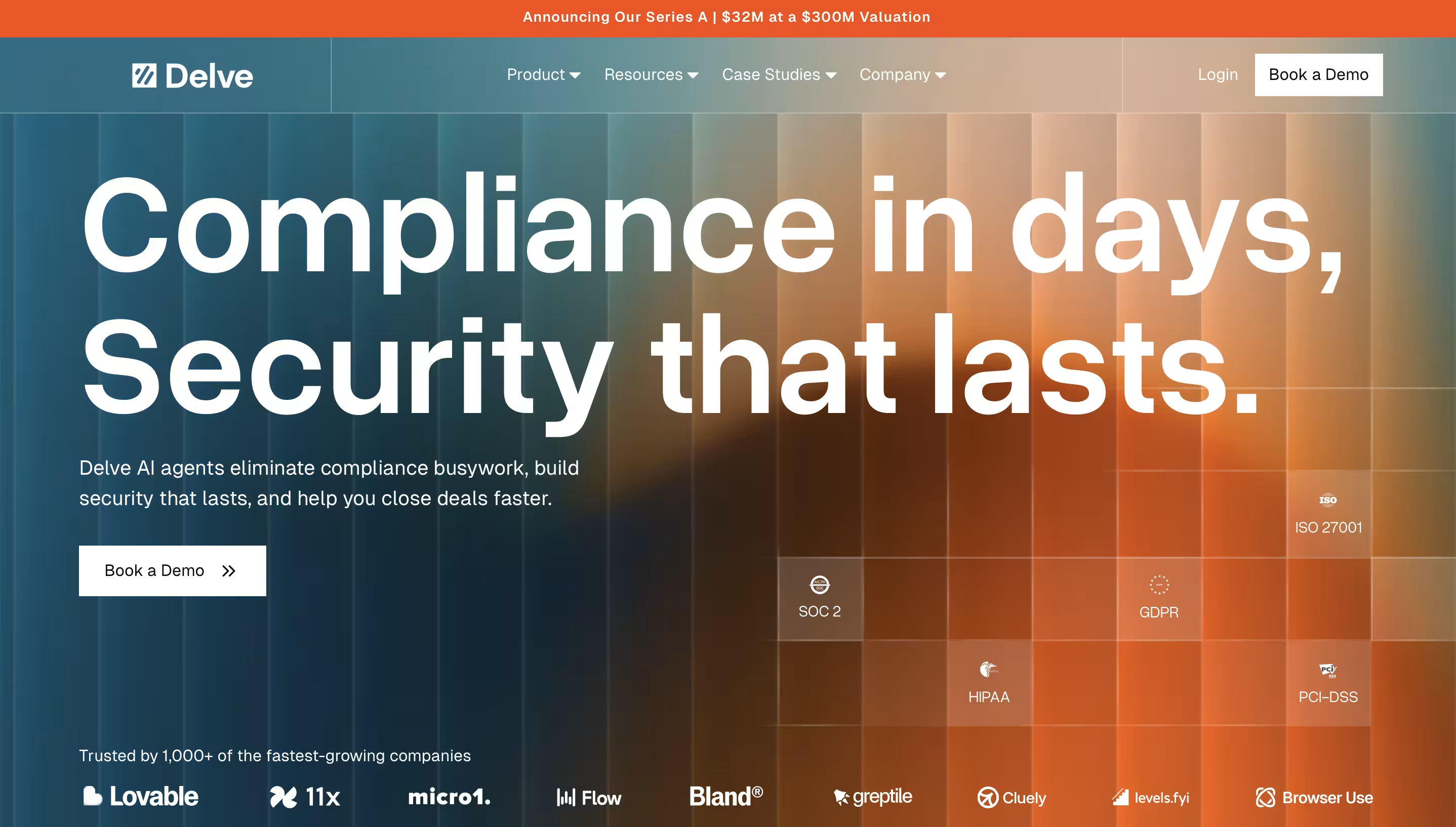
Delve is an AI-driven compliance automation platform built to remove the manual chaos behind security certifications. Instead of relying on spreadsheets, screenshots, and last-minute audit preparation, it automates much of the operational work tied to frameworks like SOC 2, ISO 27001, and HIPAA, helping teams stay continuously compliant rather than periodically prepared.
The platform was created by Karun Kaushik and Selin Kocalar after they experienced compliance friction firsthand while building a healthcare AI startup at MIT. Their goal wasn’t to simplify checklists — it was to eliminate the repetitive work compliance usually demands.
Delve integrates directly with tools such as AWS, GitHub, and Slack to monitor environments in real time, automatically collect audit evidence, and flag risks early. AI agents handle ongoing documentation and validation, allowing engineering teams to stay focused on product development instead of compliance administration.
The result is compliance that operates quietly in the background instead of slowing growth.
Who Delve Is Best for (and Who It Isn’t)?
Delve is best for early-stage startups and scale-ups racing toward their first SOC 2 or HIPAA certification without a dedicated compliance team — and a weaker fit for enterprises juggling multiple frameworks or needing granular, customized control mapping. Not every compliance platform fits every growth stage, so here’s where Delve works best, where it struggles, and when it makes the most sense.
Best Fit for
Delve delivers the strongest value when speed, simplicity, and guided workflows matter more than deep customization or complex governance design.
- Startups and scale-ups pursuing their first SOC 2 or HIPAA certification
- Teams needing compliance quickly to unblock enterprise sales opportunities
- Companies with limited in-house compliance expertise
- Engineering teams looking to reduce manual audit work through automation
- Organizations operating on standard cloud-based technology stacks
For growing teams balancing product delivery with compliance pressure, Delve removes much of the operational friction that typically slows progress.
May Not Be Ideal for
While automation is a major advantage, Delve can feel limiting for organizations with advanced governance needs or highly complex environments.
- Enterprises managing multiple frameworks simultaneously
- Companies requiring heavy customization and granular control mapping
- Mature compliance teams that prefer fully in-house processes
- Organizations expecting completely hands-off automation
- Businesses with complex integrations requiring significant manual configuration
In these situations, the platform may feel more structured and guided than flexible.
Typical Use Cases
Most organizations adopt Delve when compliance shifts from a long-term goal into an immediate business requirement.
- Startups preparing for their first enterprise security audit
- SaaS and AI companies accelerating trust with enterprise customers
- Teams transitioning from reactive compliance toward continuous monitoring
- Organizations seeking faster audit readiness without expanding compliance teams
At its core, Delve works best for companies prioritizing fast certification and operational efficiency over deep customization or highly tailored compliance programs.
Delve Features: Complete Breakdown
Most compliance platforms highlight problems and leave teams scrambling. Delve flips that model — automation does the heavy lifting. AI agents continuously gather evidence, monitor environments, and resolve risks early, keeping audits calm, not chaotic. Here’s how its capabilities work.
AI-Powered Compliance Automation
This is where Delve separates itself from traditional checklist-driven compliance tools.
- AI agents automatically remediate common compliance issues, including infrastructure misconfigurations
- Security risks in pull requests are identified through built-in code scanning
- Vendor security questionnaires are completed using AI-driven policy context
- Screenshots, reports, and audit evidence are generated automatically
Instead of engineers spending hours documenting controls, much of the repetitive work happens quietly in the background.
Continuous Control Monitoring
Compliance isn’t a one-time milestone, and Delve treats it as an always-on process.
- Daily compliance testing scans environments for compliance issues
- Real-time alerts detect configuration drift and IAM policy changes
- Environment-specific remediation guidance helps teams resolve issues faster
- Continuous monitoring reduces last-minute audit surprises
Problems are identified early, turning compliance from reactive cleanup into routine maintenance.
Framework Support
Delve focuses on frameworks companies typically need as they begin scaling into enterprise markets.
- Support includes SOC 2, ISO 27001, HIPAA, GDPR, PCI DSS, and ISO 42001
- CMMC requirement support with structured assessment preparation
- Overlapping controls managed across frameworks to reduce duplicate work
- Custom frameworks can be mapped when necessary
This allows organizations to expand compliance coverage without rebuilding processes each time a new certification is required.
Risk Management and Policy Automation
Risk management adapts as infrastructure changes instead of remaining locked in static assessments.
- Dynamic risk scoring updates continuously as environments evolve
- AI-assisted policy generation aligned with recognized industry standards
- Fully editable policies tailored to organizational needs
- Ongoing visibility into emerging risks and control gaps
Teams can focus on current threats rather than maintaining outdated risk documentation.
Integrations and Evidence Collection
Compliance evidence lives inside operational tools, and Delve connects directly to them.
- Integrations across cloud providers, identity platforms, and business applications
- Automated evidence collection through APIs and browser-based agents
- Evidence mapped directly to compliance controls
- Audit-ready documentation maintained continuously
Automation replaces manual screenshots and scattered files with centralized, always-ready records.
Audit Management and Reporting
Audit preparation is designed to reduce friction between internal teams and external auditors.
- Multi-layer validation ensures evidence accuracy before audits
- Built-in pre-audit reviews within the platform
- Real-time auditor collaboration and approval workflows
- Centralized reporting tied directly to compliance controls
Instead of preparing for audits in bursts, organizations remain continuously audit-ready throughout the year.
Delve Pricing: Plans and Value Analysis
Delve’s pricing reflects a common compliance-tool tradeoff: strong automation paired with limited transparency. Most costs sit behind demo calls, making fast budgeting and side-by-side comparisons harder than they need to be.
Startup Plan
The entry tier is designed for companies pursuing early certifications and trying to move quickly without building a full compliance function.
- Estimated SOC 2 pricing ranges between $10,000–$15,000 annually based on user reports
- Some founders report paying around $12,000 per year including platform access and audit support
- Focused on fast audit readiness with guided automation
- Bundled audit assistance reduces reliance on expensive consultants
Compared to platforms like Vanta or Drata, users often describe Delve as the more cost-efficient option at this stage. For startups prioritizing speed and affordability, the value proposition is straightforward.
Midmarket Plan
As compliance needs grow, Delve expands automation and framework coverage through its mid-tier offering.
- Pricing reportedly rises toward ~$20,000 annually, based on aggregated user reports, depending on infrastructure complexity
- Supports multiple compliance frameworks beyond SOC 2
- Custom AI workflows improve automation depth
- Slack-based expert support helps teams navigate implementation
This tier balances automation with guided support, keeping audits and platform access bundled while reducing manual oversight.
Enterprise Plan
The Enterprise tier targets organizations managing larger environments and overlapping compliance requirements.
- Designed for multi-framework compliance programs
- Dedicated AI workflows and advanced risk management features
- Direct access to compliance engineers through Slack
- Control overlap management reduces duplicate compliance work
Although pricing increases, it generally remains below traditional enterprise-focused compliance competitors.
Custom Pricing and Add-Ons
The all-inclusive model can expand after onboarding depending on requirements.
- Some integrations restricted to higher tiers
- Additional fees for failed or repeated audits
- Evidence review limits tied to upgrades
- Vendor management modules priced separately
- Penetration testing not included in base plans
Total ownership costs can reach roughly $22,000 annually when add-ons and internal setup effort are included. While automation delivers value, the demo-first pricing approach makes side-by-side comparison harder than necessary.
Delve Reviews: What Real Users Say
Getting clear, unbiased feedback on Delve takes some digging. When we went looking, we found its presence on major review platforms is still small, so most of our read came from scattered founder discussions, Reddit threads, and limited listings on G2, Gartner, and Capterra.
Ratings Across Platforms
Public reviews remain limited, which affects transparency for potential buyers. G2 and Reddit discussions show generally positive but mixed experiences. Many founders highlight how quickly Delve helped them reach SOC 2 or HIPAA readiness, often in weeks rather than months. Gartner and Capterra contain very few detailed reviews, leaving gaps in structured feedback. As a result, buyers often piece together opinions from community threads, comparison posts, and first-hand founder accounts rather than relying on broad rating averages.
User Experience Highlights
Onboarding consistently stands out as a major strength. Several users report completing compliance prep in far less time than traditional methods. The platform’s interface is guided and intuitive, with step-by-step workflows that reduce confusion for teams new to compliance. Support also receives strong praise, especially Slack-based assistance, where users get fast, practical help resolving audit issues or coordinating directly with auditors.
Common Praise
Across discussions, several positive themes appear repeatedly:
- Faster certification timelines compared to traditional compliance approaches
- Responsive, human-led support instead of purely automated help centers
- Startup-friendly pricing compared to larger competitors
- Guided workflows that simplify compliance for first-time teams
Many users emphasize that combining automation with hands-on support makes compliance feel achievable rather than overwhelming.
Frequently Mentioned Limitations
The experience isn’t entirely friction-free. Some users still encounter manual screenshot requests despite automation expectations. Integration challenges with tools like GitHub, Azure, and Microsoft 365 appear in multiple discussions. AI-generated guidance sometimes requires human correction, and a few reviewers feel that sales demos set expectations slightly ahead of the platform’s current maturity.
Delve Setup and Implementation
Setting up Delve isn’t fully documented publicly. Users share insights on account setup, integrations, control mapping, and audit prep — the practical steps teams need to understand before committing.
Account Setup and Initial Configuration
Documentation on Delve’s initial setup is scarce. Onboarding appears straightforward: create an account, define your compliance scope, and add your team. The unknowns are bigger — how long setup actually takes, what technical roadblocks might appear, and how much guidance their support provides. Demo calls are the best place to clarify these details and see the real setup process in action.
Integrating Cloud Services and Business Tools
Integrating cloud services and business tools is often one of the trickiest parts of compliance. Users reference connecting GitHub, Microsoft 365, and Azure, but there’s little public guidance on which runs smoothly and which might cause issues. Feedback shows Delve’s support is hands-on and responsive, so while some trial and error is expected, teams can navigate integrations effectively with a bit of extra planning.
Control Mapping and Policy Deployment
Mapping controls to internal processes and rolling out policies is central to achieving compliance. Delve’s guided workflows simplify the process compared to building everything from scratch, but some manual tweaks are often necessary. Users report that a mix of automation and hands-on guidance helps ensure controls truly align with business operations, making policy deployment more accurate and manageable for teams of all sizes.
Audit Preparation and Evidence Collection Workflow
Evidence collection and audit prep remain the least transparent part of the process. Users praise Delve for speeding up readiness, but concrete timelines aren’t available. Screenshots, report exports, and data verification are likely steps, though how much is automated versus manual remains unclear. Direct discussions and demos provide the clearest picture of what actual audit preparation will look like for your team.
Key Considerations Before Choosing Delve
Before committing to Delve, there are three key factors to understand. Skipping these can lead to slow setup, hidden costs, or unexpected compliance friction.
Ease of Implementation and Onboarding Experience
Delve’s onboarding is fast—10–15 hours to audit-ready status—far quicker than platforms requiring weeks. Concierge support via Slack connects you directly with compliance specialists who respond quickly, helping first-time teams move efficiently. Simple setups benefit most; complex tech stacks or unusual architectures may hit limits with the AI-driven setup. Demo calls and walkthroughs are essential to see how your environment will actually be handled.
Supported Compliance Frameworks and Automation Depth
Delve handles initial SOC 2 and HIPAA certifications and supports six frameworks, including ISO 27001, GDPR, PCI DSS, and ISO 42001. Single frameworks run smoothly, but cross-framework management can be tricky, as adding a second certification often feels like starting over due to limited control mapping. Integration is narrower too—Delve has a focused connector library, so teams must weigh depth versus breadth for their stack.
Pricing Transparency and Long-Term Scalability
Delve’s demo-gated pricing makes independent budgeting tricky, with total annual costs averaging around $22,000 when factoring hidden fees for failed audits, evidence limits, and extra modules. It scales well for small-to-medium teams running multiple audits, but enterprise setups with complex governance or granular access may feel restricted. Concierge support helps guide teams, though those wanting direct auditor collaboration or full platform transparency might find it limiting.
Final Verdict: Is Delve Worth It for Your Business?
Delve delivers where it matters most. By Delve’s own published figures, customers reach audit readiness roughly 8.7x faster and have saved a combined 43,000+ hours — vendor-reported numbers, but ones that line up with the founder accounts we reviewed for this piece. Fast, human-led Slack support responding in minutes instead of days makes compliance far less stressful, especially for first-time teams.
Pricing and integrations are the main trade-offs. Costs are gated behind demo calls, which slows budgeting, and total annual spend can average $22,000 once you factor in hidden fees. The integration library is narrower than competitors offering 200+ connections, which could be limiting for complex tech stacks.
For first-time SOC 2 or HIPAA teams who need guidance and want certification quickly, Delve is an excellent fit — particularly if you’re racing toward enterprise contracts. Larger organizations juggling multiple frameworks, complex governance, or enterprise-scale compliance workflows may hit limits, so those teams should consider platforms designed for scale from day one. For smaller teams, Delve simply gets the job done.
Take control of compliance, reduce risk, and build trust with UprootSecurity — where GRC goes beyond checklists and becomes real security.
→ Book a demo today
Vendor Evaluation & Alternatives

![Top 5 Secure Alternatives to Delve for Compliance [2026]](https://s3.us-east-1.amazonaws.com/static-production.uprootsecurity.com/website/strapi-content/uploads/delve_alternatives_2026_2b0ff79510.png)