
GRC Framework: Types, Examples, and How to Build One
A GRC framework connects governance, risk management, and compliance into one system, so an organization moves from reacting to problems to preventing them.
Robin Joseph
Senior Security Consultant
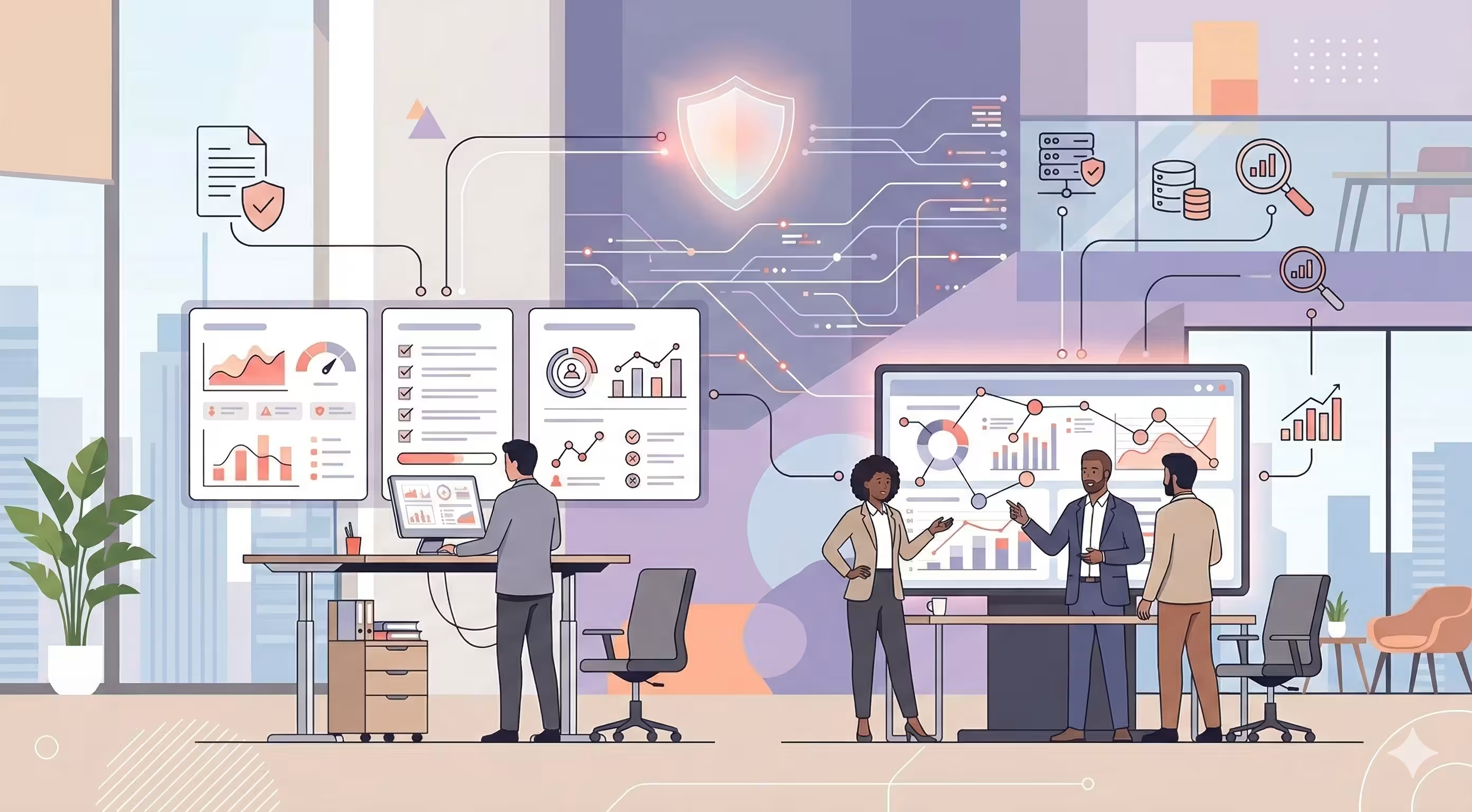
GRC stands for governance, risk, and compliance. It is a structured system that connects governance, risk management, and compliance, so they run as one program instead of three separate efforts. Most companies start without one. Risk goes unnoticed until it becomes an incident.
This guide explains what a GRC framework is, shows the main types and examples, and walks through how to choose a GRC framework and how to build a GRC framework step by step. It is written for startups and growing companies that need SOC 2, ISO 27001, or similar proof for their customers.
What Is a GRC Framework?
A GRC framework ties three jobs together:
- Governance defines who makes decisions and who is accountable.
- Risk management finds threats and reduces their impact.
- Compliance proves that your processes meet legal, regulatory, and customer requirements.
When the three work together, a company moves from reacting to problems to preventing them. When they work apart, teams repeat the same work, miss the same gaps, and argue over whose report is right.
GRC Framework vs Standard vs Strategy vs Tool
These four terms get mixed up all the time. Here is how they differ.
| Term | What it is | Example | Question it answers |
|---|---|---|---|
| GRC framework | The system that connects governance, risk, and compliance | OCEG GRC Capability Model, COSO ERM | How do we run GRC? |
| Standard | A set of requirements you can be assessed against | ISO 27001, SOC 2, HIPAA | What must our controls cover? |
| GRC strategy | Your plan: which standards, who owns what, and when | Our GRC strategy for startups guide | What do we do first? |
| GRC tool | Software that runs the work | SAP GRC, ServiceNow GRC, compliance automation platforms | What do we use to run it? |
So SAP and ServiceNow are tools, not frameworks. A framework like COSO or ISO 27001 says what good looks like. A tool helps you run it and prove it.
GRC Framework Examples
These GRC framework examples fall into two different kinds. Mixing them up is the most common source of confusion.
- Operating-model frameworks describe how you structure GRC inside your company: roles, processes, and how risk is scored and tracked.
- Domain-specific standards define the actual controls you need, mostly in security and compliance. Many teams use them as their working GRC framework.
| Framework | Type | Best for | Certifiable? |
|---|---|---|---|
| OCEG GRC Capability Model | Operating model | Designing how GRC itself should run | No |
| COSO Enterprise Risk Management | Operating model | Enterprise-wide risk tied to strategy | No |
| Three Lines Model (IIA) | Operating model | Splitting duties between management, risk teams, and internal audit | No |
| ISO 31000 | Operating model | Risk management principles for any company size | No, guidance only |
| COBIT | IT governance | Governing and managing enterprise IT | No |
| NIST Cybersecurity Framework 2.0 | Domain (security) | Describing cybersecurity risk in business terms | No |
| NIST SP 800-53 | Domain (security controls) | A detailed control catalog, common in US federal work | No |
| ISO 27001 | Domain (security) | A certifiable information security management system | Yes |
| SOC 2 | Domain (security) | SaaS companies selling to US enterprise buyers | Audit report, not a certification |
| ISO 42001 | Domain (AI) | Companies building or using AI | Yes |
| CMMC | Domain (defense) | Contractors working with the US Department of Defense | Yes |
Most growing companies do not need an operating-model framework on day one. They need the right domain-specific standard for what their customers ask for, and then an operating model built around it as they scale. For a SaaS company, that is usually SOC 2, ISO 27001, or both.
How a GRC Framework Works
Most GRC frameworks follow the same loop. The OCEG GRC Capability Model, which AWS also describes in its guide to GRC, names four phases: learn, align, perform, and review.
- Learn. Understand your context: your goals, your risks, and what customers and regulators expect.
- Align. Set objectives, policies, and roles so that governance, risk, and compliance point at the same goals.
- Perform. Run the controls, collect evidence, and handle risks day to day.
- Review. Measure results, fix gaps, and feed what you learned back into the first step.
GRC Maturity: Where Most Teams Start
Maturity describes how well the three parts work together. A simple way to think about it:
- Ad hoc. Work happens when someone remembers. Evidence is collected right before an audit.
- Defined. Policies and owners exist, but governance, risk, and compliance still run in separate files.
- Integrated. One risk register, one control library, and shared reporting.
- Optimized. Monitoring is continuous, and results change how leadership decides.
This is our own simple scale. OCEG and other groups use their own. Most startups sit between ad hoc and defined, and that is fine. The goal is to move one step at a time.
Types of GRC Frameworks and When to Use Them
The types of GRC frameworks below range from operating models to security standards. You do not choose one because it is popular. You choose it because it fits your risk, your customers, and your size.
COSO Enterprise Risk Management
COSO ties risk management to business strategy. It has five components: governance and culture, strategy and objective-setting, performance, review and revision, and information, communication, and reporting. It suits organizations that need enterprise-wide risk visibility.
NIST Cybersecurity Framework (NIST GRC Framework)
The NIST Cybersecurity Framework 2.0 came out in February 2024. It has six functions: Govern, Identify, Protect, Detect, Respond, and Recover. The new Govern function shows how much governance now sits at the center. It is often the shared language between security teams and leadership. Teams often search for it as the "NIST GRC framework".
NIST SP 800-53 and the Risk Management Framework
These two are easy to confuse. SP 800-53 is a catalog of security and privacy controls. The NIST Risk Management Framework is the process for choosing, applying, and checking those controls. Federal agencies and their contractors use both together.
ISO 27001 for a Certifiable Security System
ISO 27001 is the international standard for an information security management system. Unlike the NIST framework, you can be certified against it by an accredited body. Buyers in Europe and many enterprise customers ask for it. See our ISO 27001 guide for the process and controls.
SOC 2 for US Enterprise Sales
SOC 2 is an audit report, not a certification. A licensed CPA firm issues it against the AICPA's Trust Services Criteria. Most US enterprise buyers ask for it by name. Our SOC 2 guide covers cost, timeline, and Type 1 vs Type 2.
COBIT for IT Governance
COBIT, from ISACA, is the best-known IT GRC framework for governing and managing enterprise IT. It is common in larger organizations and audit teams. It helps link IT goals to business goals.
ISO 31000 and the Three Lines Model
ISO 31000 gives flexible risk management principles instead of fixed controls. The Three Lines Model from the Institute of Internal Auditors explains who does what: management runs controls, risk and compliance teams oversee them, and internal audit checks both. Both help you set up roles before you pick controls.
ISO 42001 for AI
ISO 42001 is the standard for an AI management system. If your product uses AI, customers may soon ask for it. Read our ISO 42001 guide to see what it covers.
CMMC for Defense Contractors
CMMC sets cybersecurity requirements for companies that work with the US Department of Defense. It is built largely on NIST SP 800-171. Without it, a contractor can lose eligibility for DoD contracts, so start early.
How to Choose a GRC Framework
Start with who is asking. Then check your size and your goals.
| If this is you | Start with |
|---|---|
| SaaS company selling to US enterprise buyers | SOC 2 |
| Selling internationally, or buyers want a certificate | ISO 27001 |
| Handling health data | HIPAA |
| Working with the US Department of Defense | CMMC |
| Need one shared language for security risk | NIST CSF 2.0 |
| Need enterprise-wide risk tied to strategy | COSO ERM or ISO 31000 |
| Building or using AI in your product | ISO 42001 |
Then ask four more questions:
- What do your regulators and customers already require? Work backward from their requests so you are not retrofitting later.
- How big and complex are you? A small team with simple processes does not need enterprise complexity.
- What is your risk appetite? Define what is acceptable so teams know where to be careful.
- Will it connect to your tools? A framework that adds manual work gets ignored. Look for one that supports several frameworks at once. Our guide on how to choose a security compliance framework goes deeper.
Benefits of a GRC Framework
- Clearer risk visibility. Leaders see risk, compliance, and governance in one place, not in three reports.
- Faster audits. Evidence is collected all year, so audit prep stops being a fire drill.
- Clear ownership. Everyone knows who owns which risk, policy, and control.
- Fewer surprises. Gaps are caught early, before an incident forces the issue.
How to Build a GRC Framework in 7 Steps
This is the short version. For a full plan with timelines, see our GRC implementation roadmap.
- Define objectives. "We need GRC" is not a plan. Name the risks and pressures behind it, and set a goal you can measure, such as cutting audit prep time in half in six months.
- Assign roles. Use a RACI model so each area has one accountable owner.
- Run a gap analysis. Compare how you work today against the standard you are targeting, and write the gaps down honestly. That list becomes your roadmap.
- Write policies and controls. Keep policies short and enforceable. Link each policy to a control, and each control to a requirement.
- Choose tools. Pick tools that connect to what you already run. Tools that add steps get ignored. Our guide to GRC tools explains the options.
- Train and roll out. Start with a small group, fix friction, then expand. Teams adopt a framework when it reduces their own work.
- Monitor and improve. Set review cycles, track a few metrics, and run internal audits. A framework is never finished.
Handling Multiple Frameworks at Once
Most companies end up with more than one standard. The way to keep this simple is to map each control once and reuse it. One access-control policy, for example, can support SOC 2, ISO 27001, and HIPAA. Keep one control library, one risk register, and one list of owners. Compliance automation software can then collect evidence for all of them together. Our guide to how compliance automation works shows how.
GRC Roles and Responsibilities
Ownership is where most frameworks fail. Here is a simple split for a growing company.
| Role | What they own |
|---|---|
| Executive sponsor (CEO, COO, or CISO) | Sets risk appetite, approves the budget, and reviews results |
| Security or GRC lead | Runs the program, the control library, and reporting |
| Risk owners | Own specific risks and their treatment plans |
| Compliance lead | Tracks standards, audits, and evidence |
| Engineering and IT | Run technical controls and fix findings |
| HR and Legal | Handle onboarding, training, policies, and contracts |
| Internal audit or outside auditor | Checks that controls work as described |
Six GRC KPIs to Track
You cannot improve what you do not measure. Six numbers are enough to start.
| KPI | What it tells you |
|---|---|
| Share of controls tested and passing | How healthy your controls are |
| Open high-risk items, and their age | Whether risks are being closed or piling up |
| Time to close audit findings | How fast you fix problems |
| Policy acknowledgment rate | Whether people have read and accepted the rules |
| Overdue vendor reviews | Third-party risk you have not looked at |
| Incidents caused by a control failure | Whether your controls work in practice |
Common GRC Framework Challenges and Mistakes
- Working in silos. Governance, risk, and compliance teams keep separate files and duplicate work.
- Starting too big. Teams try to cover everything at once and stall. Start with one high-impact problem.
- Treating it as paperwork. Policies that nobody follows do not reduce risk.
- Picking tools before the process. Software cannot fix unclear ownership.
- No executive support. Without a sponsor, budget and attention fade.
- Inconsistent monitoring. If you check controls only before an audit, gaps stay hidden for months. You then find them under pressure, and evidence from different periods may not match.
AI in GRC
AI is now used to speed up evidence collection, flag control gaps, draft policies, and answer security questionnaires. It saves time on repetitive work. It does not replace judgment. A person still decides which risks are acceptable and signs off on the results. If your product uses AI, the standard to watch is ISO 42001. For more, read our guide on AI in GRC.
GRC Tools: What They Do and When You Need One
You can run a small GRC program in spreadsheets for a while. At some point the manual work grows faster than the team. Tools usually fall into a few groups: policy and control management, risk registers, evidence and audit automation, continuous monitoring, and portals for auditors and vendors. Enterprise suites such as ServiceNow, SAP, and Archer cover governance and risk broadly. Compliance automation platforms focus on collecting evidence and monitoring controls for standards like SOC 2 and ISO 27001. See our compliance software comparison to compare options.
Frequently Asked Questions
GRC stands for governance, risk, and compliance. Governance sets who decides and who is accountable. Risk management finds and reduces threats. Compliance proves that processes meet legal, regulatory, and customer requirements. A GRC framework connects the three.
Governance, risk management, and compliance. Governance defines decisions and accountability. Risk management identifies and reduces threats to the business. Compliance shows that you meet the rules that apply to you. A GRC framework connects the three into one system instead of three separate efforts.
There is no single ranked list, because the right tool depends on your size and goal. Names that come up often include ServiceNow GRC, Archer, SAP GRC, and LogicGate for broad enterprise GRC. Compliance automation platforms, including UprootSecurity, focus on evidence and monitoring for SOC 2 and ISO 27001. Match the tool to your problem first.
ServiceNow GRC is one example. It manages policies, risks, and audits in one platform. A compliance automation platform is another kind. It connects to your cloud and HR tools, collects evidence, and monitors controls against standards like SOC 2.
SAP sells a GRC software product, but GRC itself is not part of SAP. GRC is a discipline. SAP GRC and ServiceNow GRC are tools that help you run it. A framework like COSO or ISO 27001 defines what good looks like. The tool helps you run it and prove it.
NIST Cybersecurity Framework, ISO 27001, and SOC 2 are three of the most widely used. NIST CSF is a common language for security risk. ISO 27001 is certifiable. SOC 2 is the report US enterprise buyers ask for. The best one is the one your customers and regulators ask for.
No. NIST SP 800-53 is a catalog of security and privacy controls. The NIST Risk Management Framework is a separate process, described in SP 800-37, that tells you how to choose, apply, and assess those controls. Federal agencies use the two together.
Commonly grouped as strategic, operational, financial, compliance, reputational, cybersecurity, and third-party risk. Which ones matter most depends on your business. A SaaS company usually starts with cybersecurity, compliance, and third-party risk, because customers ask about them first.
Neither, exactly. GRC is broader than cybersecurity, because it also covers financial, operational, and legal risk. But for most technology companies, security and compliance standards like ISO 27001, SOC 2, and NIST CSF make up the largest part of the GRC program.
A GRC framework is the overall system for running governance, risk, and compliance together. SOC 2 and ISO 27001 are specific standards you can use as the compliance part of that system. Most companies do not choose one or the other. They use a standard like SOC 2 as the backbone of their GRC approach.
A unified approach means one control library, one risk register, and one set of owners. You map each control once, then reuse its evidence for every standard it supports. A policy that covers access control, for example, can count toward SOC 2, ISO 27001, and HIPAA at the same time.
Start with one standard that customers ask for. Assign an owner to each area. Automate evidence collection early so work does not grow with each audit. Review risks and controls on a set schedule. Add new frameworks only after the first one runs smoothly, and reuse your existing controls.
Gaps stay hidden between audits. Teams repeat work and collect evidence that does not match. Problems surface late, often during an audit or after an incident. Continuous monitoring, with one shared control library, keeps everyone looking at the same picture.
No. Compliance automation covers one part of GRC, mainly collecting evidence and monitoring controls. GRC is broader. It also covers governance, risk decisions, roles, and strategy. Automation is a tool inside a GRC program, not a replacement for one.
Build a GRC Framework That Runs Every Day
A framework only helps if it runs all year, not just before an audit. UprootSecurity connects to your cloud, identity, and developer tools, checks your controls continuously, and keeps time-stamped evidence ready for your auditor. One control library supports SOC 2, ISO 27001, HIPAA, and more, so you do the work once. Start with the standard your customers ask for, and let the platform keep you audit-ready.